
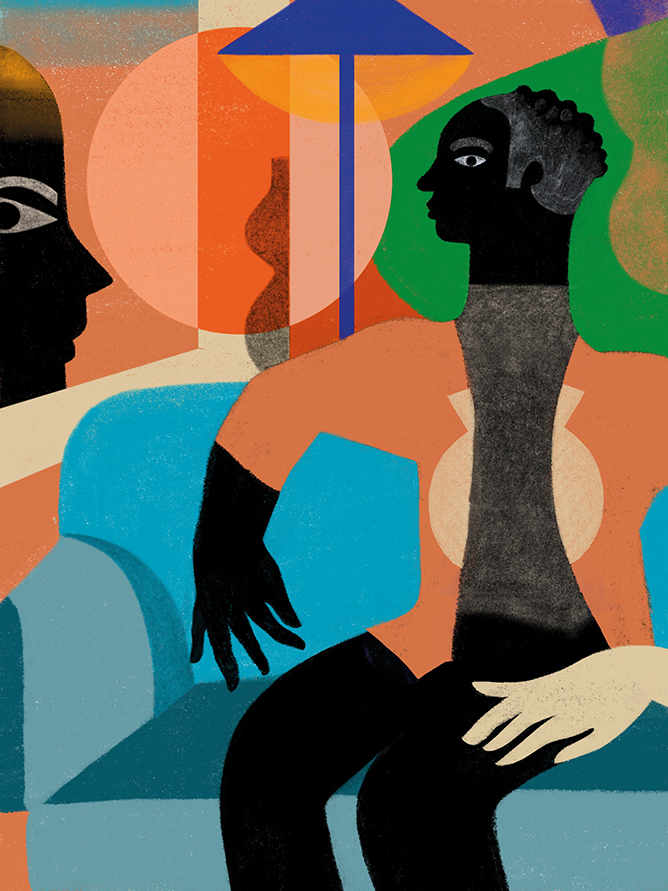
Somewhere in Manhattan, an emerging black painter watches a black man sleeping on a bench inside a McDonald’s. The painter observes the man’s hand dangling off the edge of the bench and thinks of the resting figure in Kehinde Wiley’s 2008 painting Sleep whose “hand, that bit of human frailty, hanging in the air… was the same”. And yet, something about Wiley’s colossal painting seems unreal to our observant young artist. He wonders if the man with the sculpted muscles in the portrait has anything in common with the homeless man sleeping inside the restaurant. Was Wiley “merely painting the way people wanted to see themselves”?
Wyeth, the young painter and the protagonist of Brandon Taylor’s new novel, Minor Black Figures, feels that Wiley’s portraits of black and brown people in stately poses, with the ornate flowers always in the background, are “dishonest”. In this, he is merely reprising a long-standing tradition of black American artists and intellectuals rejecting their forebears, accusing their predecessors of being inauthentic: think of James Baldwin excoriating Richard Wright’s landmark novel Native Son for being devoid of the “force and anguish and terror of love”. In an early essay, Baldwin famously wrote about wanting to be “an honest man and a good writer”. Honesty, in this instance, is just as much a claim to moral rectitude as it is an anxiety about being perceived as representative of one’s community.
Wyeth’s life and short career have also been beset by these spiky questions of representation. He grew up with a single mother in a “white people trailer park” in Virginia, but as a student in an art programme in the University of Wisconsin-Madison, his fellow black classmates found his work “disgusting”. Those were the late Obama years, around the time that 12-year-old Tamir Rice was fatally shot by a police officer in Cleveland, Ohio. While his classmates dutifully imported “images of dead children” into their own sculptures and video installations, Wyeth kept painting whimsical scenes from mid-century European movies with imaginary black faces and people in them: “His painting at that time had been personal, yes, but impersonal too. He felt misread on both scores.”
Eight years later, Wyeth is still an upcoming painter and lives in New York. He went viral during the pandemic for a painting inspired by a scene from Ingmar Bergman’s film Winter Light – Wyeth thinks it was misread again as a social comment on “the murder of black men and women as an ordinary feature of life in America” – and we find him, at the beginning of the novel, brooding over photographs he’d taken at a protest over the US Supreme Court’s 2022 decision to overturn abortion rights. As much as he’d like to transpose the “real black people” of the photographs onto his canvases, he realises that he can’t sketch them persuasively because he lacks a solid understanding about their lives.

Wyeth works two jobs – as a handler at an art gallery in Chelsea, and an apprentice to an art restorer on the Upper West Side – which, regardless of their salaries, sound terribly insular. During his off-hours, he works out of a studio space he shares with four other artists, while listening to “thematically suggestive music”. No wonder he feels that “while a scene might suggest real life, it was not real life itself”.
Long-time readers of Taylor’s fiction will recognise this refrain. Real Life (2020), his Booker Prize shortlisted debut novel, unfolds over a weekend in a Midwestern university town and is propelled by an inkling that the real world lies somewhere beyond the hermetic confines of the campus. Wallace, the gay black protagonist, frequently talks about wanting to be “out there with a real job, a real life”. In The Late Americans (2023), another campus trauma novel, one character – a poet – imagines his friends and classmates to be living in a sort of doll’s house, which is being watched over by an “enormous and indifferent God prying the house open and squinting at them as they went about their lives on their circuits like little automatons in an exhibit…”
Wyeth’s attempts to feel like less of an automaton can seem a little scattershot. He checks up on his estranged mother online (she and her second husband post regularly about their life in a vineyard in rural California), eavesdrops on fellow joggers while out on his morning run and spares no chance to gossip about MangoWave, a local collective of painters with South-East Asian roots dabbling in work that Wyeth dubs an “identity-based art grift”. Taylor has a lot of fun describing their efforts to pad their bad art with preachy rhetoric. Each of the five members of MangoWave grew up “comfortably middle class” and went to Yale, but in interviews they harp on about the “pain of exile”.
In a bar one night, Wyeth meets Keating, a lapsed Jesuit priest who now works in construction. They smoke together out on the pavement, and not long after, kiss in a park. The morning after they first sleep together, Keating points out to Wyeth that he isn’t actually interested in real lives despite being an artist, that he only ever thinks about other people when he is “making art about them”. Wyeth takes a few photographs of Keating and then starts working from them in his studio. Who should a non-white artist paint when their work is invariably construed as an expression of their race and ethnicity? His white lover, perhaps.
Too many scenes begin with Wyeth and Keating smoking on a sidewalk. As in Real Life, the sex is a mere madeleine to a Proustian recounting of the characters’ childhood traumas. When Minor Black Figures was published in the US last autumn it was promoted as a “sweeping modern romance”, but as a love story it pretty much goes nowhere. Keating hurts Wyeth’s feelings one afternoon by implying that other people might find him boring (“I mean it as a compliment. Really.”) Wyeth, in turn, ghosts him and sleeps with another friend. But their separation is brief and frictionless. Within the space of a chapter, Wyeth realises that he’d been trying to fit Keating into a predetermined outline in his mind, much like his drawings.
Interracial relationships have been getting a bad rap lately in popular fiction and films. In Natasha Brown’s bestselling 2021 novel Assembly, an upwardly mobile British black woman resents her posh boyfriend’s ancestral wealth because it might have something to do with colonialism: “He lives off the capital returns, while I work to pay off the interest.” A black man finds himself trapped in a sinister maze while visiting his white girlfriend’s parents in Jordan Peele’s 2017 hit movie Get Out. In Minor Black Figures, the romance is refreshingly free of social allegory. In fact, Wyeth seems to empathise too readily with Keating’s “pro-life” Catholicism. Their novelty is somewhat undone by Keating’s earnest ways. (At one point, he declares that he is reading Freud in order to “understand people more”.) Taylor has spoken in an interview about picturing the actor Joe Alwyn while developing the character of Keating, and indeed actors are deployed to do quite a bit of imaginative legwork throughout the novel. Isabelle Huppert, for instance, bizarrely reminds Wyeth of his mother. A tender moment between him and Keating is described as “absolutely, quintessentially Meg Ryan”.
The novel is at its most interesting when Wyeth is on the trail of Dell Woods, a forgotten black artist from the Seventies whose lithographs end up at the art restorer’s townhouse. Except for a mention in a couple of catalogues and a 1979 group show in Harlem, Wyeth can’t find any information about him online. He turns out to be spectacularly inept at research: it takes him until the end of the novel to realise that he could just pull up Woods’s birth details from a genealogy website. At one point he wonders if, “instead of asking the internet endless questions and hoping for an answer, he might begin to ask people” about him. But he never quite follows through on his resolve. Just when you expect the novel to open out from Wyeth’s cohort and reveal a feeling for older lives, we are back inside his studio, with Wyeth playfully declaring to a friend that he wants to call his portrait of Keating Black Man. “It’s a black painting,” he explains, “because I’m black”.
Taylor seems to have written this novel to ridicule “woke” identitarian shibboleths, but Wyeth’s story doesn’t adequately dramatise the contradictions of our cultural discourse. We see him reject the work of other non-white artists and admire an old book of sketches and drawings by John Singer Sargent, but these seem like no more than sideways glimpses into Wyeth’s own artistic vision. Surely there is more to his sensibility than imagining black people in a scene from the Luchino Visconti film L’Innocente, or dilly-dallying about painting Keating in watercolour? You can’t help but agree with Keating when he suggests that Wyeth thinks “slightly too much” about how others might perceive him. Wyeth needn’t feel so different for having a white boyfriend or for liking Caravaggio and Sargent more than, say, Amy Sherald or Kehinde Wiley.
It’s easy for artists to forget these days that everyone gets to choose their forebears. And we get to choose our lovers, too.
Abhrajyoti Chakraborty is a writer and critic based in New Delhi
Minor Black Figures
Brandon Taylor
Jonathan Cape, 400pp, £18.99
Purchasing a book may earn the NS a commission from Bookshop.org, who support independent bookshops
[Further reading: The Ladies of London need our help]
Content from our partners



Related


This article appears in the 25 Mar 2026 issue of the New Statesman, Easter Special
Join the debate
Subscribe here to comment