
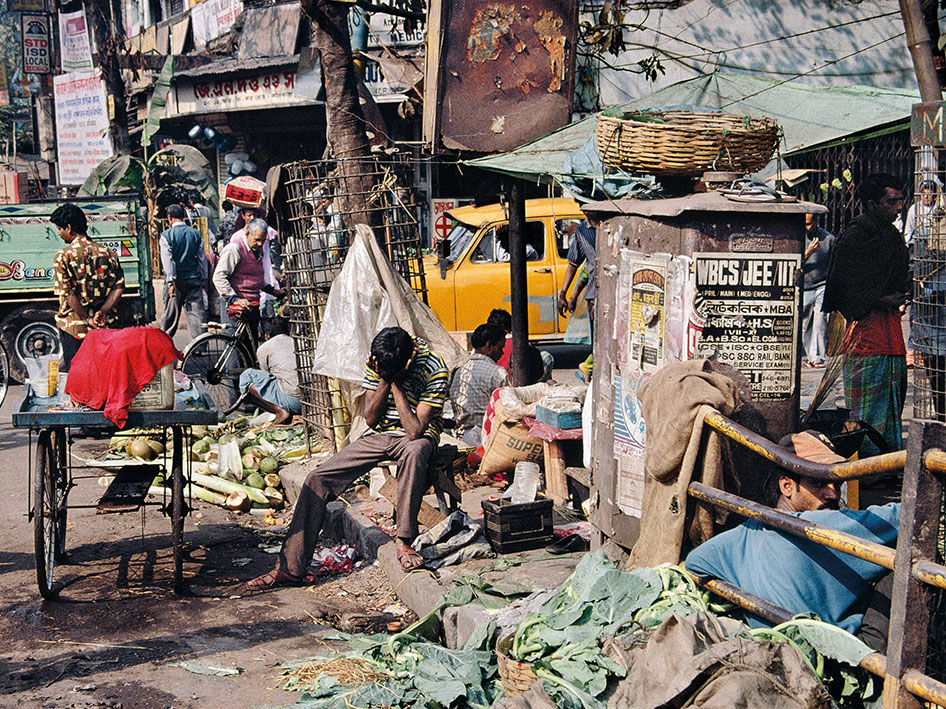
Early on in Megha Majumdar’s new novel, we’re reminded of the long history of famines in the Indian subcontinent. There was the ghastly Bengal famine of 1943 when three million perished because of a British policy of diverting produce from the region for wartime supplies, though Churchill blamed the Indians for bringing it on themselves by “breeding like rabbits”. Then the drought of 1876, when crop failure in southern India was worsened by the systematic export of foodgrain by the colonial regime, and before that, another famine in Bengal in 1770, shortly after the East India Company had gained economic control over the province. A Guardian and a Thief is set in a future Kolkata affected by another such “shortage”, when the climate crisis has forced the city’s shopkeepers to sell seaweed instead of fresh produce, and those who can afford to move to the West are applying for “climate visas”.
You’d think that the decision to begin a novel with a history primer is intended to establish what Virginia Woolf once called the “common meeting-place” between the writer and the reader, but no, Majumdar merely positions her characters as guileless victims of fate. Ma, who is christened after the Bengali word for “mother”, has successfully procured climate visas for herself, her two-year-old daughter Mishti, and her father Dadu (named after the Bengali word for “grandfather”) to the US. They are scheduled to move in a week to Michigan, where Ma’s husband is employed as a scientist in a research lab. They’ve finished packing their bags and booked their flight tickets. “All Ma needed to do was survive these seven days,” Majumdar writes. The choice of verbs here is characteristically dire: you don’t need to skip to the last page to guess if Ma will make it out of the city.
Late one night, their house gets burgled and their passports, with the stamped visas, get stolen. The burglar, Boomba, sleeps in a homeless shelter that Ma works in. Later on, we learn that Boomba had read about Ibn Battuta and Vasco da Gama in comic books as a child, but moments after stealing the passports from Ma’s house, he tosses them in a rubbish dump, apparently because he can’t read the text on the cover leaf. When Ma confronts him about the break-in at her home, he offers to lead her to the rubbish dump and help look for the passports, only if she agrees to sign away the papers of her house in his name.
It’s a desperate deal, of course, and for the reader to believe in the plausibility of this arrangement they must be swayed by the desperation of the fictional world. But Majumdar doesn’t inspire much confidence by plumbing the shallowest depths of her characters’ predicaments. Boomba is initially portrayed as a country bumpkin, who talks to his family from a “booth that rented cell phones by the minute”, then a few pages later we’re told that he finds the moon late at night to be as sad as a “painting in an after-hours gallery”, and that he shares his room at the shelter with an influencer who has “six hundred thousand followers on the internet already”. Ma’s motives – she is a mother who will “do anything” for her child – are also drearily transparent. Moments after picking up the stamped passports from the US consulate, she feels grateful for “her knowledge that she might have been born into a different life – a shelter resident’s life, or the barber’s life, or the rickshaw driver’s life”. You’d think that a woman who feels this way would care enough to stow away the passports in a safe place once she is back in her house, and not leave them lying overnight in her purse on the floor.

The novel is stuffed with samples of miserabilist kitsch: children fighting over scraps on a garbage heap, a stingy shopkeeper with “love for nobody” and a cigarette in his mouth, a hungry man who has grown skinny enough to slip through the bars of a window, the notion that honesty is an elite preoccupation and “itself a lie”. In a city where restaurants are reduced to offering a single item on their menu and salted peanuts have become a memory, Majumdar reasons that her characters, more so the impoverished ones, would be capable of nothing but indecency. At a charity feast for a billionaire’s daughter’s wedding, a group of homeless people attack the food on their plates with their “jaws open like those of an anaconda devouring deer”. Inside a crematorium, Ma runs into “charlatans demanding money”. On another occasion, Dadu steals an orange from a stranger’s unattended child.
In a recent interview with the Harvard Gazette, Majumdar remarked that she loves “thinking about how to entertain a reader”. In her bestselling debut novel A Burning (2020), the central character, a young Muslim woman who lives in a shanty in Kolkata, witnesses a terrorist attack and finds herself being falsely accused of the crime. The critic James Wood lauded the book in the New Yorker for its “urgency of appeal”, but for many readers familiar with the Indian subcontinent, the novel seemed to engage unsubtly with the grisliest of newspaper headlines from the region. By piling up scene after shocking scene that will keep the reader hooked, Majumdar risks portraying her suffering characters as pawns on a dystopian chessboard. Their tribulations and neat reversals of fate feel more contrived than real.
Many Bengalis retain a vestigial dread of famines that has persisted through generations. One thinks of the nameless narrator in Amitav Ghosh’s 1988 novel The Shadow Lines who visits a less well-to-do relative in Calcutta with his parents at one point and notices the shanties built on muddy ground right next to their house. “It was that sludge which gave our gentle decorum its fine edge of frenzy,” the narrator later reflects. In Satyajit Ray’s film Distant Thunder (1973), a couple in rural Bengal struggle to scrape together the barest of rations during the 1943 famine. A film crew travels to a remote location in Mrinal Sen’s In Search of Famine (1980) and discovers that decades after the British-era catastrophe, the villagers are still stuck in a sort of time warp about those days.
I yearned for A Guardian and a Thief to be in conversation with these antecedents, or at least to tap into a society’s residual fears. Instead, there are thinly veiled references to contemporary events – the billionaire’s daughter’s nuptials, for instance, draws heavily from the viral Instagram reels of the wedding of a scion of the phenomenally wealthy Ambani family in Mumbai last year – and martial similes about the weather. The rain in Kolkata is described, at one point, as falling “like a banner held by an advancing army”. The warm afternoon sun is “a pistol against one’s head”. Once, before visiting the US consulate, Dadu changes his clothes and thinks that dressing up was “one way of asking for respect”. It is one thing for an embassy to be indifferent to distressed visa applicants, quite another for an author to portray them as coarse and undignified. Does Majumdar respect her own characters? Time and again she appears content to describe them in salacious terms. You sense that there is more to their anxiety than procuring the next morsel of food: Majumdar has also deprived them of their inner lives.
A Guardian and a Thief
Megha Majumdar
Scribner, 224pp, £16.99
Purchasing a book may earn the NS a commission from Bookshop.org, who support independent bookshops
[Further reading: The Bone Temple and the return of the fable]
Content from our partners



Related


This article appears in the 18 Feb 2026 issue of the New Statesman, Class warrior
Join the debate
Subscribe here to comment