
Predicting political futures is hard. When Keir Starmer won the 2024 general election, I was pleased. I was also worried about my professional future. Months stretched ahead, then years, of colourless, unflashy competence and granular amelioration; few dramas, no resignations. What would we find to write about? Similarly, nobody quite managed to get the realities of post-Brexit Britain right ahead of time – although there were hundreds of scenarios in print.
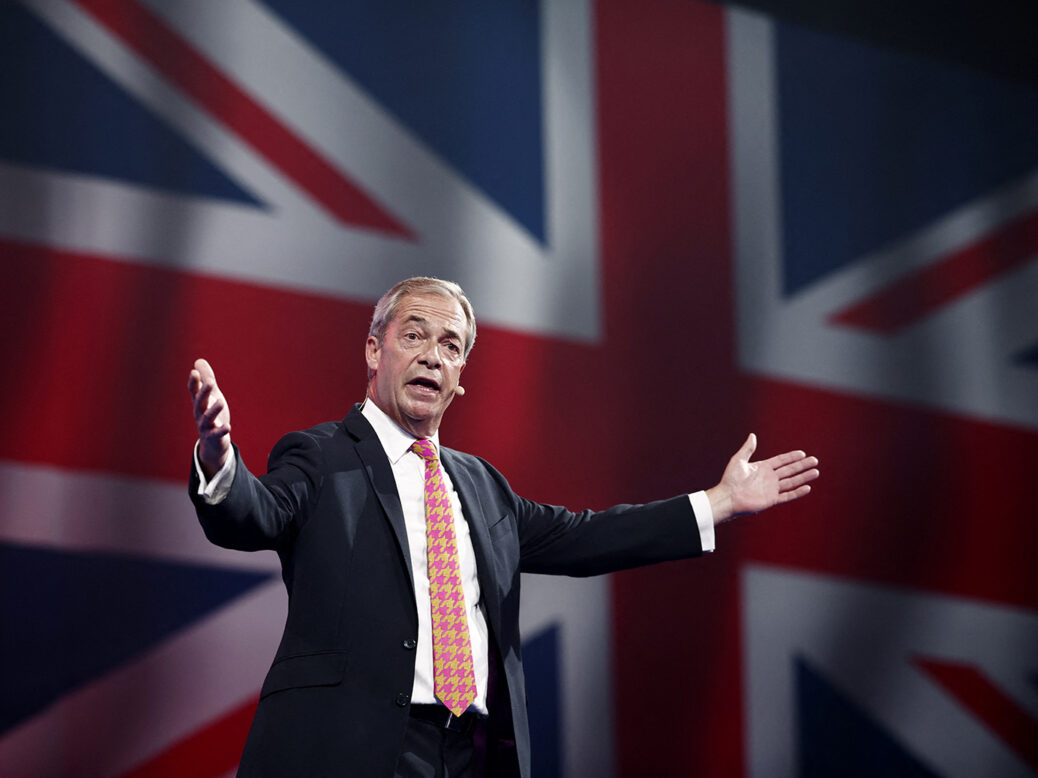
So, Peter Chappell is to be commended on his courage in trying to imagine, in some detail, what happens following an overall Reform UK victory in the June 2029 election, pitching Nigel Farage into Downing Street as Britain’s 60th prime minister.
What If Reform Wins is an overtly hostile account – though not a hysterical one. Chappell, a reporter for the Times, finishes it by saying that a new, dark reality is fast approaching: “Those who wish to avert the disaster still have time to remember a different future as possible, and act.”
His anxiety is well placed. In recent months, the complacency of the centre left and indeed the centre right with regards to Reform has become strange. We keep being told that, although they are ahead in the polls, Farage and his party have plateaued, peaked, reached the high tide, and are now retreating – even as the migrant issue continues to be salient, and fears over crime grow.

The result of this is a jellied, passive displacement politics. Let’s treat Shabana Mahmood as a wild outlier. Let’s take Zack Polanski as seriously as a future leader as we take Farage. Let’s turn back to assuming that Kemi Badenoch is the likeliest next prime minister.
Let’s not. It’s possible, surely, that the strong polling numbers are accurate and that Farage, despite dips and blips on the way, is not far from being able to win a UK election, with or without Tory outriders. Indeed, that ought to be the baseline assumption of all the other parties.
Although this is a hostile account, it would be foolish of Reform politicians not to read it very closely and learn lessons from it. There are many definitions of populism. The one I find most persuasive is simply that it offers the public simplistic solutions to complex problems – whether that is saying that migrants are to blame for everything, or suggesting that a tiny number of billionaires will happily stay put to pay more taxes to refloat the welfare state. If there is a single, coherent theme running through the book, it’s that big, simple, turquoise-coloured promises are likely to collide with the real world.
Written more like a novel than a conventional political book, What If Reform Wins envisages chaos at RAF Manston as the new home secretary, Lee Anderson, tries to close asylum hotels on the way to deporting 600,000 people, and mass protests against the deportations become almost uncontrollable. An overtly racist “remigration” plan is leaked to the BBC; Reform is forced to pull away.
Of course, Reform go after the BBC, ferociously, and reporters come under increasing pressure from their bosses to go easy on the new government. But Farage discovers that his voters are more attached to The Archers and Strictly Come Dancing then he’d expected.
Above all, in the real world, climate change proves to be more than a metropolitan fantasy, and a storm surge devastates Bristol, leading to a new popular uprising against Farage. With an eerie echo of politics that happened this month, President JD Vance tells Prime Minister Farage – in a row over south Atlantic oil reserves – that the US will back Argentina, not Britain, over the Falklands. And so it goes on.
The final crunch comes a month before Reform’s second Budget. (Reform’s current “shadow chancellor” Robert Jenrick will have to swallow the sad news that in this scenario he has been demoted for disloyalty, and Richard Tice is now chancellor.) While Farage pulls Britain out of the ECHR and other international agreements as part of his Great Reform Bill, the EU decides that it will tear up its trade and cooperation agreement with the UK. The economic consequences of a complete rupture with the EU are so great that, to reassure the markets, Tice has to make cuts so deep Reform that loses its majority. Parliamentary chaos ensues involving both the King and the possibility of a police arrest of the prime minister. The Farage government finally falls.
There is a lot of fun on the journey. Chappell mingles real-life characters, such as Reform activists Dan Jukes and Gawain Towler, or Sky’s Beth Rigby, with fictional characters, such as the extremist “Dan Sambrook”. Dominic Cummings makes a return to No 10 – with predictable results. There is a great deal of smoking, swearing, curry eating and phone slamming.
Chappell has also done serious research, on everything from the layout of rooms in Downing Street to constitutional and Whitehall conventions. We learn about the free breakfasts on Budget mornings for Treasury insiders, and the last chancellor to drink alcohol during the speech (Ken Clarke in 1997). Many parts of the scenario are in fact extensions or extrapolations of what has already happened. He understands the weaknesses of the British system: at one point, “hundreds of senior civil servants resign and these positions are quickly filled by the heads of Tufton Street think tanks, business leaders and former Reform advisers”. Much of what follows is entirely plausible.
I wouldn’t say this book perfectly captures what is to come. Nigel Farage, an opaque character even now, never comes quite alive, while Tice, Anderson and others are reduced to what seemed to me like caricatures. It is perhaps unlikely that climate change would play quite as neat a plot role as it does here.
Apart from these quibbles, this is a gripping and important book for anyone remotely interested in politics. Both Reform enthusiasts and their myriad enemies should read it, argue with it, and change their thinking accordingly.
In our unwritten constitution, as Chappell argues, the speed of change can be extraordinarily fast.
What If Reform Wins: A Scenario
Peter Chappell
Bloomsbury, 240pp, £16.99
Purchasing a book may earn the NS a commission from Bookshop.org, who support independent bookshops
[Further reading: The forgotten brilliance of Britain’s postwar cinema]
Content from our partners


Related


Join the debate
Subscribe here to comment