
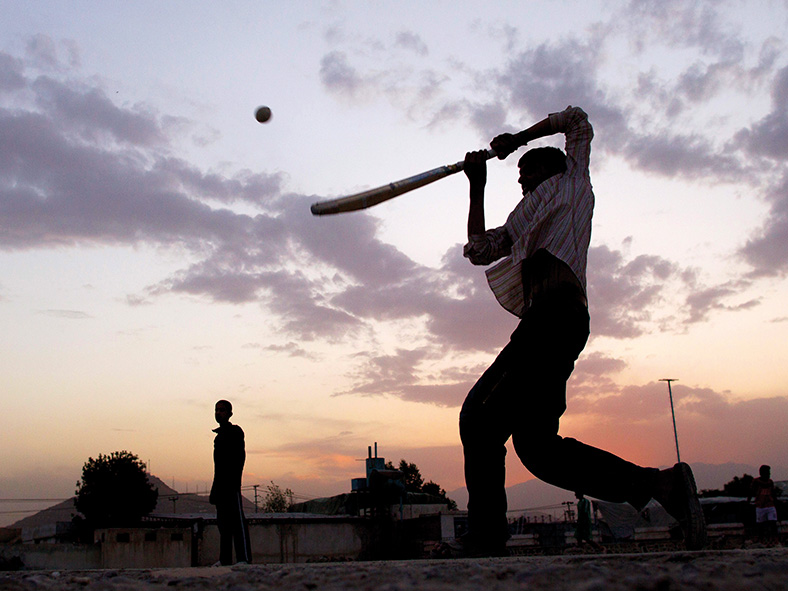
The English have always seen cricket as representing their country more than any other sport. Neville Cardus, the doyen of cricket writers, famously said: “If everything else in this nation of ours were lost – her constitution and the laws of Lord Halsbury – it would be possible to reconstruct from the theory and practice of cricket all the eternal Englishness which has gone to the establishment of that constitution and the laws aforesaid.”
Cardus wrote this between the wars, but even in 1993 John Major predicted: “Fifty years on from now, Britain will still be the country of long shadows on county [cricket] grounds.” Major was invoking cricket to wean his party away from the “bastards”, as he called the anti-Europeans in his government. But just as that failed so this image of England is one that no British prime minister would now dream of using as a political tool.
With the English cricket season having just begun, many of the best English players are not casting long shadows on England’s green and pleasant fields but playing in intense heat on hard-baked Indian grounds, driven by money. This change, argue Richard Heller and Peter Oborne in their new history of the game, has meant cricket has moved “full circle” – the title of the book.
A sport which began as commercial entertainment played by hired performers in England in the middle of the 19th century is similar to its current iteration, except the centre of the game has moved to India and the Indian Premier League (IPL) dominated by Mukesh Ambani, one of the richest businessman in Asia, and other Indian magnates. India provides 80 per cent of world cricket’s income and its takeover of this very English game, unthinkable two decades ago, means that for the first time a non-white country runs a major international sport. In contrast, the Saudis, having poured millions into golf hoping to transform it and take control, have now withdrawn, realising they cannot wrest control from the white men of Europe and America who have always run the game.

The 19th-century English businessman who transformed the game was William Clarke, a portly, one-eyed former bricklayer, who realised talented cricketers could be lured away from their existing employers by offering them more money. He set up a touring team of leading players in the 1840s, using the nascent railway network to take the game to various parts of England. A shrewd businessman, he made £70 a match, topped up by gate receipts and sponsorship income, but paid his players £4 a match. They didn’t mind, as this was nearly a month’s wages for a skilled tradesman. In the IPL today, the gap between owners’ and players’ earnings is similar, but these players could never hope to make such money playing in England.
WG Grace, like Clarke, had working-class roots but his influence on cricket was infinitely greater. Heller and Oborne compare him to Benjamin Disraeli, both outsiders (Disraeli had Jewish heritage) who became prominent in the 1860s. Disraeli rescued the Tory party which faced slow extinction; Grace converted cricket from being a constricted, amateur game into a national sport for all, using the long Victorian peace to help cricket replace war as a symbol of English superiority over foreigners.
Both men, argue Heller and Oborne, also exploited English hypocrisy. Disraeli attacked Robert Peel, then prime minister – describing him as “a burglar of others’ intellect” – but had privately written to Peel begging to be made a cabinet minister. When challenged, he lied to the Commons saying: “I never, directly or indirectly solicited, office.” Grace’s hypocrisy was over money; officially an amateur, during his career he earned an estimated £120,000 – about £18.4m today. The income was disguised as “expenses”. On his first tour of Australia, in 1873-74, these amounted to £1,500 – more than 20 years’ wages for a skilled tradesman – plus a free first-class honeymoon for his wife, Agnes. The professionals received £150 plus £20 spending money. On the 1891-92 tour his “expenses” were £3,000, with two of his children joining Agnes on the trip.
MCC connived in this, and for more than half a century after Grace had retired, also retained the distinction between amateurs and players. Until 1962, there was an annual “Gentlemen vs Players” match at Lord’s, and even a form of “apartheid” in changing rooms – “players” changed in separate and inferior rooms to the “gentlemen”. It was only in 1952 that England had its first professional captain, Len Hutton. However, he never captained his county, Yorkshire, which, for almost another decade, had a “gentleman” captain as they were held to have the leadership qualities professional players could never aspire to.
MCC was also racist. In this regard Heller and Oborne, to their great credit, examine a subject that many English cricket historians gloss over. They devote three chapters to race, starting with “South Africa: Cricket’s Original Sin” which corrects the widely held impression that racism in cricket started with apartheid. It was active long before that, with William Hendricks, one of the finest bowlers of his age, barred from touring England in 1894, 54 years before apartheid was officially implemented. Cecil Rhodes, then prime minister of the Cape Colony, unashamedly declared: “They wanted me to send a black fellow called Hendricks to England. [But] I would not have it”. He justified it as “the instinct of self-preservation”.
MCC even allowed white South Africa to dictate who England could select. Ranjitsinhji – Ranji – the Indian-born prince and, after Grace, one of the all-time greats, was excluded from one England team for reasons of racial politics.
In the 1930s the MCC, in effect, created two divisions of international cricket based on race. One was white: England, Australia, South Africa and New Zealand – who played each other. The other division included the West Indies and India, since South Africa would not play the non-white nations.
To make matters worse, the white countries ignored the very laws they had created. In 1961 when Hendrik Verwoerd, the architect of apartheid, took South Africa out of the Commonwealth, this also meant that under the rules governing cricket South Africa had forfeited membership of the sport’s international body. But England, Australia and New Zealand carried on as if these rules did not apply to South Africa and the matches they played are still recognised as Tests.
England eventually stopped playing white South Africa only in 1968 when the South African prime minister, John Vorster, became a de facto England cricket selector and vetoed England’s choice of Basil D’Oliveira, a “Cape Coloured” who, unable to play in his native land, had come to England and qualified to play for this country. Two years later England still wanted to entertain white South Africa but anti-apartheid protestors forced the home secretary to veto the tour.
Much has changed in both cricket and society. Of the many changes the books records, perhaps the most uplifting story is the emergence of a country that defeated Britain in a war in the 19th century but which, as a result of another war more than a century later with a non-cricket-playing nation, came to love this English game. The Soviet invasion of Afghanistan in 1979 made millions of Afghans flee to northern Pakistan, where they first discovered the game; nobody imagined the rise of Afghan cricket, but in 2017 they became a Test-playing nation and, in the process, also produced Rashid Khan. In his youth Khan passed his days hunting with his slingshot; now he is one of the most sought-after spin bowlers in the game. He is highly valued in the IPL, underlining the part played in modern cricket by the dominance of the league, whose success has spawned other franchises around the world – many of them owned by Indians.
Heller and Oborne tell cricket’s history with great skill, spicing the narrative with wonderful vignettes. I gave Oborne his first job in journalism, and both he and Heller played in the cricket team I ran and came on my cricket tours. I share their passion for the traditional variety of the game, but do not share their optimism that the cricket authorities can revive the declining interest in it just by promoting the long-form game. Cricket cannot avoid today’s vast and relentless social changes, but it needs to learn from other sports that have successfully adapted without losing their fundamental principles.
Full Circle: A History of Cricket
Peter Oborne and Richard Heller
Elliott and Thompson, 352pp, £25
Purchasing a book may earn the NS a commission from Bookshop.org, who support independent bookshops
[Further reading: Confessions of a bibliomaniac]
Content from our partners



Related

This article appears in the 06 May 2026 issue of the New Statesman, Tis but a scratch
Join the debate
Subscribe here to comment