
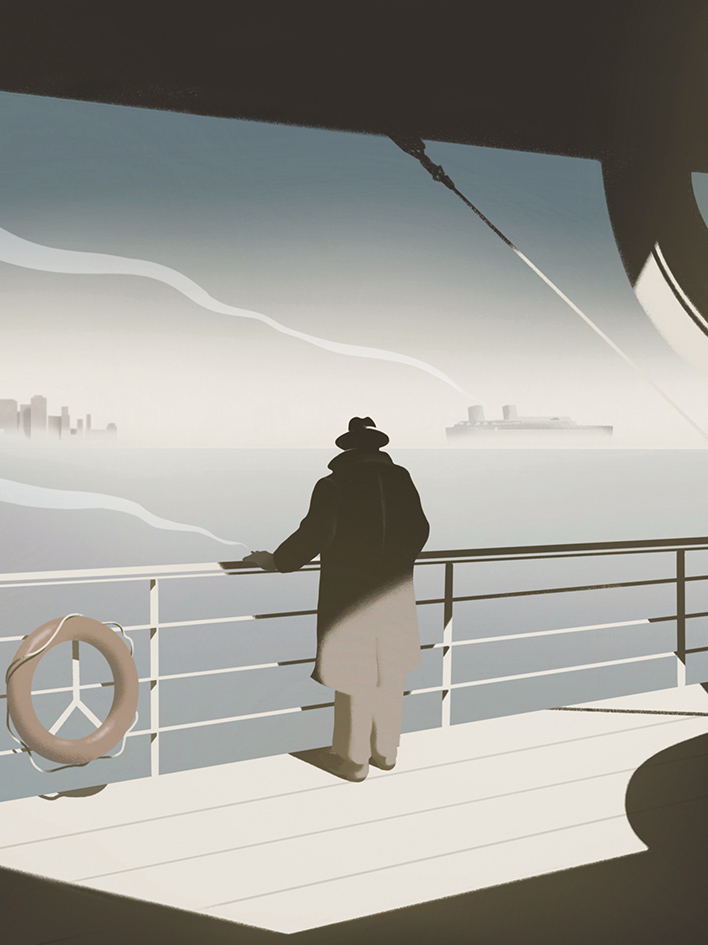
Shadow Ticket, Thomas Pynchon’s new novel, is built around doubles. It takes place in 1932, and there’s a strong feeling that “unfinished business” from the Great War – “so many wrongs unresolved” – will soon produce another one. It concerns a private investigator, Hicks McTaggart, who travels from Milwaukee, the junior twin of Chicago, to Budapest, itself two cities and here invoked as the lurid, supernatural flipside to sombre, psychoanalytic Vienna. McTaggart is on the trail of Daphne Airmont, who is both his old girlfriend and the daughter of a sought-after public enemy, the Al Capone of the cheese industry. Moreover, Shadow Ticket is two novels in one, or two kinds of genre exercise: a full-dress pastiche of the hardboiled detective novel which does homage, after Hicks is packed off to Europe, to the spy novels Pynchon loved as a boy – full of what the narrator calls “manoeuvring” and “go-betweening”.
Onboard the liner Stupendica, Hicks encounters a retired British lieutenant commander, Alf Quarrender, and his wife, Philippa, “neither quite old enough for the story they’re peddling – off on a world tour”. They claim to have spent part of their recent trip to the US in search of “a proper Sticky Toffee Pudding”, but Hicks senses “an air of international monkey business”. Reflecting on his first exercise in this vein, the story “Under the Rose” (1961), Pynchon said that despite the fin-de-siècle setting, he was channelling his terror about “the Bomb”; he seems to be inviting a similar reading here. There’s a reference to America as “a country not yet gone fascist” and even an insurrection. By virtue of some strange Pynchonian logic – Pynchronicity? – his first novel in 12 years appears a fortnight after Paul Thomas Anderson’s wild reworking of an earlier novel Vineland (1990) in the film One Battle After Another, in which modern totalitarianism is more overtly on the agenda.
Shadow Ticket features many of Pynchon’s hallmarks: the paranormal (“cold capitalist reality” coming into contact with “ghost worlds”), English eccentrics, shady Europeans, a period setting, film references, untranslated foreign phrases, acronyms, cabals, songs, slang. This isn’t the first time Pynchon has required readers to know what it means to be “86’d”. It isn’t even the first time he has written about fondue. But while hardly free of skill, or amusing touches – a suicide note in the form of a crossword puzzle – Shadow Ticket feels crabbed.
The 88-year-old’s latest book is an occasion to celebrate the achievement of perhaps the standout American novelist since Faulkner, as well as to reflect, in the way Pynchon himself has done, on more bittersweet elements of his trajectory – the unreliability of a writer’s touch, the stubbornness of bad habits.

Pynchon’s sensibility and strengths were evident from the start. In the spring of 1963, he appeared from nowhere with V. – “A young Cornell graduate”, as George Plimpton wrote in the New York Times, with “a vigorous and imaginative style, a robust humour, a tremendous reservoir of information”. Also, no less importantly: “a recluse”. In decades to come, fans and journalists would seek out the extremely camera-shy writer, who was born in 1937 in Long Island but has mostly lived in California and Manhattan, almost as relentlessly as Herbert Stencil hunts for the elusive force – either a woman, or a place, or a concept, or a rodent – that gives that novel its title.
V. wasn’t just an auspicious debut but an augury, containing as it did both of Pynchon’s favoured modes: in the episodes about the untraceable force V, an encyclopaedic, multi-perspectival grand quest, continent-hopping and epoch-straddling; in the sections devoted to the former sailor Benny Profane and his misadventures, a bubbly, slangy, allusive picaresque set over a short period (but with flashbacks). It was followed by The Crying of Lot 49 (1966) – his speediest follow-up and shortest book – which concerns a young Californian housewife, Oedipa Maas. As executor of her deceased ex-lover’s huge and fiendishly complex estate, she is brought into contact with the aerospace industry, an underground postal service, and a censored Jacobean tragedy (Pynchon provides a lengthy synopsis as well as select passages).
Then came Gravity’s Rainbow (1973), his enormous novel about the relationship between the German programme to create the supersonic V-2 rocket and the sexual activities of an American GI, the descendant of a faded New England family, Tyrone Slothrop. The go-to comparison was Ulysses (1922), but Gravity’s Rainbow, though not as groundbreaking in technique, is more formidable. Pynchon devotes the kind of attention that Joyce did to the Dublin of his youth to a place he had never visited, 1940s London. He also puts it in a scientific and world-historical context, generating countless tragicomic conceits for uniting individual and collective experience, such as the schizophrenic “who believes that he is World War II”:
He gets no newspapers, refuses to listen to the wireless, but still, the day of the Normandy invasion somehow his temperature shot up to 104°… Whenever the rockets fall – those which are audible – he smiles, turns out to pace the ward, tears about to splash from the corners of his merry eyes, caught up in a ruddy high tonicity that can’t help cheering his fellow patients. His days are numbered. He’s to die on V-E Day. If he’s not in fact the War then he’s its child-surrogate.
Those three books, plus an essay on the riots in the Watts district of LA and a handful of stories, constituted the entire Pynchon oeuvre during what proved his period of greatest influence. In the early 1980s, two of his fans drew on Pynchon’s work to invent new traditions: postcolonial magic realism in the case of Salman Rushdie, “cyberpunk” in that of William Gibson. Rushdie’s Booker Prize-winning Midnight’s Children (1981) adapted the figure of the Second World War child-surrogate to India’s partition and spun this cameo to epic length. Gibson – who came across Plimpton’s review when he was 15 – borrowed what he called Pynchon’s use of “mutant pop culture imagery with esoteric historical and scientific information” for his breakthrough stories, “Johnny Mnemonic” and “Burning Chrome”.
At the same time, a younger generation was falling under his spell. When Jonathan Franzen moved to West Berlin in 1981, aged 22, the only novel he took with him was Gravity’s Rainbow. He asked his fiancée – identified as “V” – “how can you write in America any more?” Pynchon had “done almost everything in the world”. Franzen was determined to “get over” him. A decade later, he had done so. His solution to writing in America still involved Pynchon’s example – but disavowing or misrepresenting it. In his 1996 Harper’s essay “Perchance to dream”, he wanted to balance analysis with a tragic human vision. For some, he didn’t go far enough. James Wood, confronted with the result of Franzen’s journey, The Corrections (2001), found evidence of the same frenetic, know-it-all aesthetic which he had diagnosed as “hysterical realism” in the recent work of other Pynchon fans: Rushdie, Don DeLillo and Zadie Smith.
What complicates this picture is that Pynchon had taken his cue from the writer who for Wood was the exemplar of a more soulful comic vision: Saul Bellow. The “diction” of The Adventures of Augie March (1953) had been the earliest influence on a key component of Pynchon’s “postmodernism” – the mixing of high and low registers. Plimpton linked the two writers as practitioners of postwar American picaresque. But Pynchon also shared Bellow’s more refined qualities, and this side was beginning to dominate just as he was becoming a byword for extroversion. James Wood’s “hysterical realism” discussion included Pynchon’s historical adventure Mason & Dixon (1997) due to the presence of a talking duck and cheese. But it was also a moving tale of male friendship, like the novel Bellow published the same year (The Actual). Pynchon’s Vineland told a similar story to Bellow’s Herzog (1964) – a troubled cuckold, living out in the woods, who is saved by his relationship with his daughter.
It seems that Pynchon had spent the long gap between Gravity’s Rainbow and Vineland reassessing his priorities. In 1983, the year he complained to Donald Barthelme about his “decade of Writer’s Block”, he wrote a 20-page essay about his development, which appeared as the introduction to his collected early stories, Slow Learner (1984). It reads less like a postmodernist credo than something by Wood, who again and again emphasised the indispensability of characters.
Looking back at his apprentice work, Pynchon regretted his tendency to indulge in “extra overlay” such as rain imagery and references to Hemingway and Eliot, or “adventitious lectures about tale-telling and geometry”, instead of portraying what he variously called “the main character’s problem”, “a number of unpleasant people failing to resolve difficulties in their lives”, “the humans”, “human reality”. Along the way he realised that the “printed sources” on which he relied were less valuable to fiction-writing than looking around, listening, drawing on “one’s personal life”. He slams the most recent piece of writing he considered a “story”, The Crying of Lot 49, presumably for being too desk-bound, too indebted to arcane facts and theories. (It can be hard to read that extraordinary novel now without being reminded of Dan Brown.)
Education, he asserted in his final sentence, “keeps going on forever.” On the one hand, Vineland, the next thing he published, was, just like The Crying of Lot 49, comic and contemporary and set in California, with references to American big business and anti-communism. It also begins with the description of an unwelcome letter, a reminder that unless Zoyd Wheeler does something “publicly crazy” in the next week, he will lose his mental-disability benefits. But then Zoyd reads something else, a note left on the kitchen table, and we hear a new sound in Pynchon’s work: “Dad, they changed my shift again, so I rode in with Thapsia.” Later, after Zoyd has run through a plate-glass window and Prairie is back from Bodhi Dharma Pizza Temple, they sit together on the floor in front of the television “with a chair-high bag of Chee-tos and a sixpack of grapefruit soda from the health-food store, watching baseball highlights, commercials, and weather” until coverage of what the anchor calls Zoyd’s “yearly leap”. “Lookin’ good, Dad,” she tells him.
The critics who wrote about Pynchon – Harold Bloom, Michael Wood, Frank Kermode, Tony Tanner, Richard Poirier – had no doubt he could be tender as well as brainy and silly. Nor did the American writers who kept faith with his example. In 2005, Bookforum printed various tributes under the strapline “Pynchon now”. Lydia Davis emphasised the “lyrical humanity” of “The Secret Integration” (1964), a portrait of race relations in a small town, Pynchon’s own favourite among his stories. There was a contrast made with Pynchon’s “heavier” work, or what Jeffrey Eugenides called his “darker” concerns. George Saunders identified “something Buddhist”. Richard Powers justly mentioned the astonishing sequence in Gravity’s Rainbow in which two young lovers, Roger Mexico and Jessica Swanlake, driving in Kent one Sunday evening, come upon a church – a lamplit hillock in the dark upland – and attend a Christmas mass.
For Paul Thomas Anderson, Pynchon’s appeal lies in his portraiture. The character identified in the credits of Anderson’s film Boogie Nights (1997) as Little Bill’s Wife, shot by her jealous husband at a 1980 New Year’s Party, draws on the serially unfaithful “admiral’s wife” who Benny Profane, in V., watches copulating with his friend Pig Bodine “one minute into 1956”. Benny himself is in the DNA of another reckless former sailor, Freddie in Anderson’s The Master (2012). Of Vineland, Anderson has said, “The characters still stick with me… the girl Prairie sticks with me,” and though One Battle After Another is a Pynchonian entertainment of a more boisterous kind – a zany, priapic, polemical cat-and-mouse adventure epic – the main thing it borrows is the bond between father and daughter (renamed Bob and Willa).
Anderson’s previous Pynchon adaptation, Inherent Vice (2014), reflected his belief that the novel – which appeared in 2009 – is “obviously autobiographical and from his generation and from his heart”. Anderson emphasised the star-crossed love affair between the private investigator “Doc” and Shasta, and heard in an opening that might be considered hardboiled a more wistful note, rendering it line-for-line as voiceover delivered by what his script called a “sweet, young” woman:
“She came along the alley and up the back stairs the way she always used to. Doc hadn’t seen her for over a year. Nobody had. Back then it was always sandals, bottom half of a flower-print bikini, and a faded Country Joe and the Fish T-shirt. Tonight she was all in flatland gear, hair a lot shorter than he remembered, looking just like she swore she would never look.”
In his introduction to Slow Learner, Pynchon talked about the “up-and-down shape of my learning curve”, and so it has proved in the four decades since. For every moment of pathos and intimacy, there has been at least one pun or scientific allusion. Shadow Ticket seems to consist entirely of what Pynchon claimed to “dislike” about his writing. It’s hard to believe that he “began from” Hicks and his personal predicament, and not the symbolic structure or topical resonances, or that the material about German inflation, Interpol and Béla Kun didn’t place him at the mercy of printed sources. Pynchon has written that the index to the seriousness of a writer’s intentions is the attitude displayed towards death – “how characters may act in its presence” or “handle it when it isn’t so immediate”. Hicks McTaggart could hardly be more blasé.
But then, confounding readers isn’t such a bad fit for Thomas Pynchon. It never made much sense that he became a “major” figure, a presence on shortlists and even bestseller lists, for a body of work so devoted to the also-ran, the passed-over. It’s another legacy that Anderson appears keen to reflect – both this time around and last. Promoting Inherent Vice, he singled out a line from a review about the novelist’s “ferociously batshit compassion for America and the lost tribes who wander through it”. Perhaps once Pynchon’s prominence fades, along with his peerless mystique, he will mutate into an example of the literary subtype he may have intended and surely expected to be: the cult writer.
Shadow Ticket
Thomas Pynchon
Penguin Books UK, 293pp, £22
Purchasing a book may earn the NS a commission from Bookshop.org, who support independent bookshops
[Further reading: The terrible contradictions of Tolstoy]
Content from our partners



Related


This article appears in the 08 Oct 2025 issue of the New Statesman, The truth about small boats
Join the debate
Subscribe here to comment