
For his first 20 years as a published writer, from the early 1990s to the early 2010s, George Saunders had only one thing on his mind. He wanted to write the best short stories that he could – which, in his case, meant the most ornery, jarring, bitterly comic. Educated at Syracuse University, hotbed of the contained, Hemingway-ish style known as “dirty realism” – one of whose leading exponents, Tobias Wolff, became his teacher and mentor – Saunders aspired to join a rather different American tradition. In stories like “CivilWarLand in Bad Decline”, “The 400-Pound CEO” and “Sea Oak”, he applied the absurdist techniques of postmodern writers such as Donald Barthelme and Kurt Vonnegut to the latest grim spectacles thrown up by corporate culture and the leisure industry.
Saunders’s work grew in force and purpose, and gradually introduced a Christian-cum-Buddhist perspective to the vaudevillian onslaught of carnage and rapacity. By the time his fourth collection, Tenth of December, appeared in January 2013, he would have been forgiven for thinking he had achieved his original goal. The book, largely comprising stories that had appeared during the preceding five years – notably “Victory Lap” and “The Semplica Girl Diaries” – was greeted by prizes, profiles, even a place on the bestseller list, and seemed to inspire general acceptance of the view, expressed by David Foster Wallace in 1996, that Saunders was the most exciting writer in America.
In the period since, Saunders hasn’t stopped writing stories, but his pace has slowed, his priority shifted. It seems possible he recognised that his tailored hellscape, dense with novelty theme parks and experimental testing centres, was at risk of becoming overworked. (The title stories of both his first collection, CivilWarLand in Bad Decline, and the most recent, Liberation Day, involve haunted re-enactments of 19th-century American battles.) As mid-career shifts go, it hasn’t been the most radical. He didn’t become an electrician. He began publishing standalone narratives, including the historical fantasy Lincoln in the Bardo, winner of the 2017 Booker Prize, and turned his Syracuse course on the 19th-century Russian short story into a study of craft, A Swim in a Pond in the Rain (2021). His new novel, Vigil, has resemblances to both books, though to different and surprising degrees.
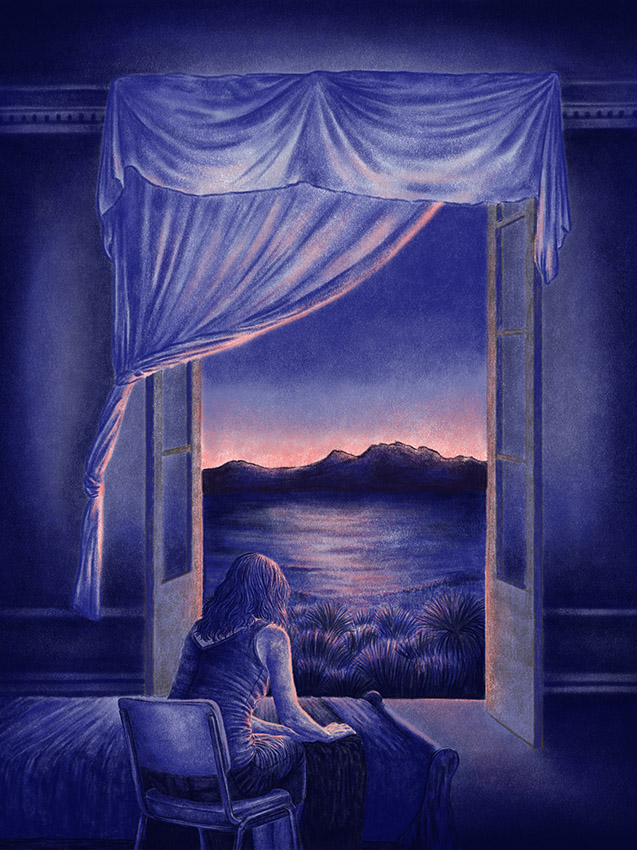
The narrator is Jill “Doll” Blaine, who inhabits a purgatorial state called “elevation” but retains certain human privileges – consciousness and a body. She is able to travel through space and enter human minds, though she is only recognised by animals and the dying, whose anguish she is there to alleviate. She defines her vocation as to “comfort whomever I could, in whatever way I might”, adding: “For this was the work our great God in Heaven had given me.”

Her latest “charge” is KJ Boone, a Wyoming-born oil tycoon who is dying of cancer in a mansion in Texas. Like the ghosts in Lincoln in the Bardo, Jill refers to others with her powers as her “ilk” and talks of entering the “orb” of Boone’s thoughts – from which we learn that an unhappy childhood catapulted him to dreams of world dominance. Saunders is looser here with the rules governing “those of our ilk” to human affairs. At points, she finds herself “somehow” or “suddenly” in possession of a fact that’s useful to her “task” – and to Saunders’s. She also calls cars “autos” and talks of “movie-films”. (I was reminded of Kingsley Amis’s baffled response to his son’s amnesia novel Other People: “She’s forgotten what a lavatory is and thinks the cistern and pipes are statuary. But then how does she know what statuary is?”)
Long-time readers of Saunders’s work may wonder if he has been marked by the process of writing A Swim in a Pond in the Rain. In one sense, it’s hard to say – he had then been teaching creative writing for a quarter of a century, and his Russian story class for most of that time. But Vigil adheres more closely and self-consciously to a classical structure than virtually anything he has written. Discussing Chekhov’s story “In the Cart”, Saunders considered why he chose to describe “this day, and not another” in the life of the heroine, Marya. She has travelled to the local town “countless” times to collect her salary. There’s the same device at work here. Jill is undertaking a familiar routine – Boone is her 343rd charge – and where Marya’s latest trip is differentiated by an apparent personal breakthrough, Jill is beset by an unfamiliar challenge, or a pair of them.
At first, her ability to comfort Boone in his final hours is undermined by a French angel, seemingly the ghost of Étienne Lenoir, inventor of the combustion engine, who is adamant that before his death Boone should display “contrition, shame, and self-loathing” for the damage that his lucrative career has done to human beings and the natural world. Then Jill starts to experience vivid flashbacks of her mortal existence as a young housewife in postwar Indiana killed by a car bomb intended for her husband. The “critical bend” – to quote her arch description – is when she begins to feel “a tad bit more” old Jill than elevated Jill.
Although Vigil has shades of the Chekhovian short story, it’s possible to imagine Saunders using the rupture-to-a-routine approach without having written A Swim in a Pond in the Rain. More confounding and far-reaching are the traces in the novel’s make-up of ideas about authorial conduct. Saunders’s experience of sustained critical analysis may or may not have left him more self-conscious or convention-bound. But it has brought him into direct contact with his underpinning philosophy of fiction – a development everywhere apparent in Vigil.
As her erstwhile self, Jill was “limited” in view, “constricted” in pity. “One judged,” she tells us, “one preferred”. None of this is true of “elevation” – or of Chekhov, who, according to Saunders, is unburdened by “a political or moral stance”, remains “open” and “perpetually curious” and used the short story “to move beyond opinions”. Saunders claims that as the reader watches Chekhov doubt all conclusions, we feel “comforted”. At one point, Jill notes that remembering her mortal life “always caused me to become less powerful and effective”. Hearing Tobias Wolff read aloud from a trio of Chekhov stories, Saunders realised that fiction was “the most effective mode of mind-to-mind communication… a powerful form of entertainment”. The novel’s heroine is a paragon of wisdom, acceptance and freedom from vanity whose only terrestrial counterpart, with the exception of certain spiritual leaders, is a great fiction writer while at work. In this analogy, Boone – whose own strength has been to make companies “profitable” and “efficient” – is equivalent to a character, whose inner world Jill inhabits, and a reader, beneficiary of comfort and communication.
If Saunders intends to challenge Jill’s world-view, as he has done with most of his previous narrators, it’s hard to see where. Her flirtation with reminiscence – the threat to her faith in elevation – proves short-lived, but the emphasis on the virtues of relinquishing the self is unwavering. Even the surly, stubborn Boone accepts that to achieve a peaceful death, he must stop being “swept up” in “me”.
By retaining clarity not only about Boone’s destructiveness but also the hypocrisy of green activism – in passages involving a friend of Boone’s daughter – Saunders is resisting the temptation of indulging his own liberal outrage. But the novel never extends its sceptical attitude to the idea that opinions are worthless. It remains entirely tunnel-visioned about the virtues of suspending judgement.
Yet, for all its promotion of the Chekhovian ideal, Vigil is also a rewriting of a very different kind of story: Charles Dickens’s A Christmas Carol, a book he often name-checks. What’s strange about this juxtaposition is that Saunders uses Chekhov’s example as a pretext for emphasising the element of religious didacticism, hardly faint in the original version. Rejecting easy answers was Chekhov’s mode of resistance to the absolutisms of his own time. To Saunders, it is a God-like position. This has led him to minimise the element of human empathy he identifies as crucial to Dickens’s book.
It’s the ghost of Jacob Marley who is sent to change Scrooge’s ways, Saunders has argued, because he “lived exactly the same life that Scrooge is living and committed the same sins”. But in Vigil, the like-minded, fellow-sinner position is occupied by the benighted French angel, whose argument that Boone should apologise and repent is derived from an awareness of his own contributions to climate change. The Marley equivalent, by contrast, is a housewife and victim of male violence whose approach, altogether more lenient, works best when she brings nothing of her personal history to the job.
The result verges at times on what Saunders would call a “lecture” – twinkly and condescending but self-undermining too, its schematic clarity at odds with its belief in the mysterious and multivalent. Saunders’s use of canonical short stories as a source of inspiration – the basis, to some degree, of all of his best work – is hampered here by a curious blind spot. Chekhov wasn’t writing about the importance of rising above animus. He just did it.
Leo Robson is assistant editor at the “Literary Review”. His novel “The Boys” (riverrun) was published last year
Vigil
George Saunders
Bloomsbury, 192pp, £18.99
Purchasing a book may earn the NS a commission from Bookshop.org, who support independent bookshops
[Further reading: Was this French cowboy the first fascist?]
Content from our partners


Related

This article appears in the 11 Feb 2026 issue of the New Statesman, Labour in free fall
Join the debate
Subscribe here to comment