
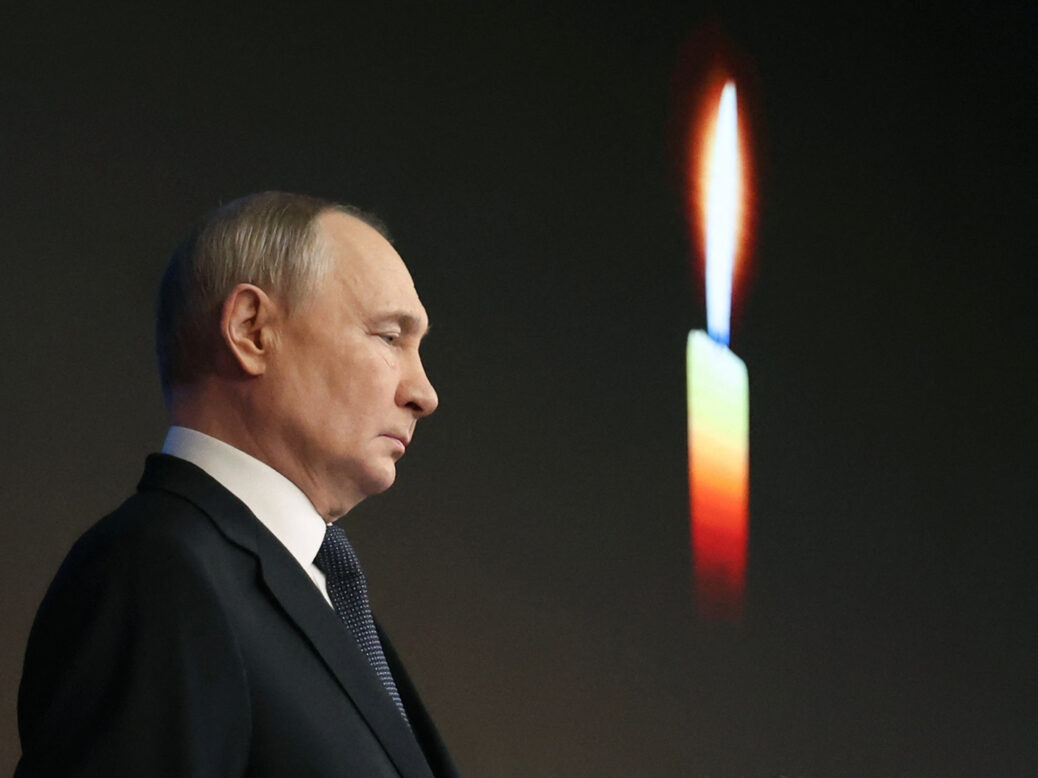
While Moscow anxiously waits for 9 May – the arbitrarily chosen anniversary of the Soviet victory in “the Great Patriotic War,” as the Second World War is known in Russia – few will notice that 7 May is a more personal occasion for Vladimir Putin. He was inaugurated as President of the Russian Federation on 7 May 2000, served until 7 May 2008, and returned to the presidency on 7 May 2012. This year, 7 May marks the twenty-fifth year of his rule – the silver anniversary of his marriage to Russia. Of the eighteen tsars and seven general secretaries who ruled Russia, only four held power longer than Putin already has. Four rulers, each associated with either transformative greatness or systematic terror, and usually both. But unlike those antiquities, Putin’s rule is not over. Immortality research, now run by his daughter, is among his personal preoccupations. And there is a theory that the man in the Kremlin is not Putin at all but one of his doubles – in Russia, this theory is taken seriously enough to require official denial. It articulates a fear, or a hope, that we will have Putin forever.
Putin’s grip on power has never rested on repression alone. It rests, more fundamentally, on oil. Russia’s fossil fuel revenues have financed everything that Putinism requires: the overwhelming dominance of security services, the patronage networks that bind the elite to the Kremlin, and the global flows of disinformation that are instrumental for Russia’s foreign policy. When European households paid their gas bills in the 2000s and 2010s, a fraction of every payment found its way into operations designed to corrode their democratic institutions. It was, in retrospect, political judo: the West funded its own destabilization.
Russian disinformation is not a Cold War propaganda campaign – the broadcasting of an ideological alternative – but something more sophisticated, even postmodern: the manufacturing of doubt, the poisoning of the intellectual wells. The hired “political technologists” did not need to persuade Western publics of anything in particular. They could not have done so even if they tried – persuasion requires coherence, and coherence was never the point. What they managed instead was to ensure that those publics could no longer agree on what was true. This is the strategic logic behind the troll farms, the bot networks, and the strategic leaks. The Russian financing of both the far left and the far right greased the horseshoe of politics with oily money. The goal of these myriad operations was not persuasion but paralysis.
Nowhere – not even in the adjacent and much-afflicted Europe – has this operation found more success than in the United States. The relationship between Putin and Trump remains obscure though I am sure we will know the truth pretty soon. What is clear is the family resemblance of their projects. Both have built their politics around the same core elements: the humiliated nation betrayed by cosmopolitan elites, the strong leader who alone can restore its greatness, and hostility to any politics organized around the future – whether that future takes the form of climate commitments, social change, or international law. Putin did not create Trumpism – Trump independently discovered many of the same moves. But Putin got there first, and his office has had every reason to encourage and amplify the American version. For some reason, Trump has not shown any trace of an anxiety of influence, nor did Putin claim his intellectual rights. This is, in fact, the only mystery that still remains to be solved.

There is a detail from Putin’s KGB file that explains more about his politics than any policy document. His superiors noted, as his only significant weakness, a “reduced sense of danger”. It probably helped him survive a perilous career in the security services. It almost certainly explains why he launched a war that surprised his own elite – people who shared his apocalyptic mood but had not imagined he would actually pull the trigger. “Why do we need the world if it is a world without Russia,” Putin once said. “Death is beautiful if we die together,” he said on another occasion. These were not rhetorical flourishes. They were the expressions of a man for whom the calculus of risk does not operate normally – a man who can threaten nuclear war because he does not fully believe in his own destruction, and cares about others even less.
This is precisely what makes Trump’s version of the same politics less risk-prone but, in fact, more dangerous. Trump did not inherit Putin’s reduced sense of danger. Trump is exhibitionist, transactional, and above all self-preserving. Where Putin can stare into the abyss with equanimity while disappearing from the screen in bad moments, Trump flinches, negotiates, retreats to Mar-a-Lago, and sets up another presser. Which means that Trumpism, for all its destructiveness, is unlikely to end in the bunker suicide that Putin’s logic suggests. It will end, instead, in a deal – a routinely bad one, celebrated as an unprecedented triumph.
There is a concept from ancient Greek tragedy that captures Putin’s predicament better than any political framework: nemesis. Not revenge, which requires an external agent, and not justice, which requires institutions – but the self-destruction of evil, the feedback loop in which every action produces the opposite of its intended effect. Putin feared Nato expansion – and brought it to the gates of St Petersburg. He feared Ukrainian nationalism – and conjured it into an existential force. He feared European unity – and forged it. He feared the dissolution of Russian power – and set in motion the military exhaustion, elite fragmentation, and regional resentment that make dissolution more likely. In nemesis, the evildoer creates exactly what he fears, only bigger and more horrifying than he could ever have imagined.
Nowhere is this logic more visible than in the figure of Trump. For two decades, Russian state actors cultivated the American populist right as an instrument of Western destabilization. The investment seemed to pay off magnificently in 2016. What Putin did not reckon with is that the forces he helped to unleash are not controllable from Moscow – or from anywhere. Trump is not a Russian asset but something more ungovernable: an independent replication of the Putinist model, operating on a vastly larger stage, with the resources of the world’s most powerful state and none of Putin’s strategic patience. In Russian, the same word – curator – describes both the museum professional who organizes an exhibition and the intelligence officer who manages an agent. Putin combined the two roles, as his language dictated, and he is failing at both: the curator has lost control of his exhibition, and the handler has lost control of his asset.
And here nemesis completes its circuit. Putin built his power on the assumption that Western democracy was decadent, divided, and manipulable. The Trump presidency has not delivered the pliable, toothless America that Russian strategists imagined. It has delivered something genuinely worse: an aggressive and unpredictable America that abandons its allies not out of strategic calculation but out of chaos, and threatens the international order on which Russia’s own interests – in energy markets, in the management of its imperial periphery – ultimately depend. Putin wanted a weakened West. He got a deranged one.
On 7 May, as Putin marks the silver anniversary of his marriage to Russia, the question is no longer whether nemesis is at work but how long it takes to complete its circuit. Ukraine is bleeding but unbroken. Europe is rearming. The fossil fuel revenues that financed the entire enterprise are threatened not by the green pledges Putin spent years trying to obstruct, but by Trump’s wars that facilitated the transition. And in Washington, the figure Putin helped create has become a monster that has no resemblance to his master. History, as the Greeks who invented it realized in despair, has a way of settling accounts.
[Further reading: Britain is still breaking up]
Content from our partners



Related
Join the debate
Subscribe here to commentAlthough I agree with most of this , there are one or two things that I’m not sure about . I would argue that in fact, Trump is both a Russian asset – he concedes time and time again to Putin’s world view – especially on Ukraine, and also an aggressive , unpredictable , out of control president of a country that is mindlessly upsetting and derailing the international order .
Russia is reaping vast rewards from Trump’s war on Iran and the revenues that Russia is now receiving are an absolute boon to her previously depleted war chest . So I would also argue that Putin is benefitting immensely from this misadventure of Trump’s.
There is nothing arbitrary about the date. Hostilities ceased at 23.01 Central European Time on 8 May or 00.01 9 May Moscow time. It was also 9 May in other Soviet time zones.
Yes, how stupid to begin with such a silly comment. Sort of sets out his agenda though.
Are the dates right here? If he came to power in 2000, wouldn’t the 25th anniversary have been last year? Or, excluding the 4 years he was PM, in 2029?
Putin isn’t threatened by nemesis – he’s threatened by failure in the war on Ukraine caused by his own incompetence.
Europe is as divided as ever. Any “unity” is a facade.
Its attempts at re-arming are hubristic, beyond its capacity in morale, merely an attempt by Europe’s elites to run away from the disaster they have inflicted on their countries in the form of immigration. Eurabia threatens.
European publics are worried about Islam, not Russia.
As for the USA, its dealings in the Middle East War suggest it’s even more toothless and divided than we had thought.
For better or worse Western diplomacy and violence of the last fifteen years drove Russia and China into a dangerous combination of warriors and armament. The author fails to appreciate their histories. Putin rose up from a legacy of powerful corrupt elite oligarchs, moving in and out of 19th Century royalty, Soviets and Russians. Lenin, and Stalin and the Romanov courts were much worse than 21st Century Russia. Remember, for nearly half the Soviet period, the Premiers were Ukrainian by birth and by Party. i have traveled to Russia twice in the 21st Century and completed two courses at StP State University.
The West constantly undertakes cute diplomacy with paid propaganda to poke the Bear in the eye, and foolishly financially supported Ukraine that has digressed to little more than a terrorist state. When the West led by President Obama overthrew the elected President of Ukraine in the city that was once the Capitol of Russ, did anyone really think Russians and a lot of Ukrainians would retreat to Siberia? I’m sure some in London, DC and Brussels really did and still do. Now, Ukraine claims victory after victory every week with drone attacks supported by NATO, Brussels and the US DNC, spending hundreds of billions and millions of lives… for what?