
Lately I’ve been trying to change my life – almost always a crap idea. Or, if sensible in theory, doomed in reality. Quitter’s Day is 17 January, the day when most people turn their back on New Year’s resolutions. My fickle friend Jack confessed that the evening of the 17th was when he abandoned his stab at Dry January. “I kind of thought I’d done enough,” he said. What tipped him over? “Someone invited me to a party, and I thought, you know, ‘quite fun’.”
Don’t mention the P-word
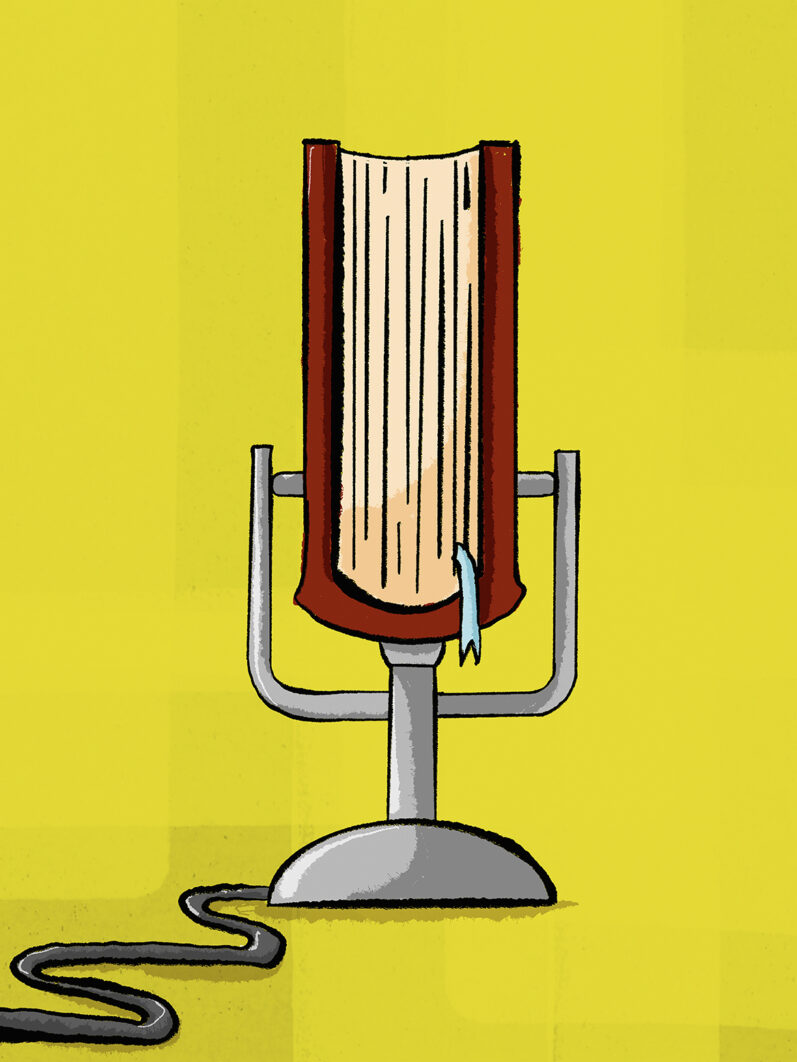
My own resolutions were mostly low-stakes, though I have still struggled with the main one – to moderate my relationship with podcasts.
A strong indicator of progress came on Tuesday, which started, like every Tuesday, with an episode of Goalhanger’s Football Clichés. Later, I took part in a podcast tied to Granta’s India issue: an interview with the remarkable Dalit writer Sujatha Gidla. My co-host, the historian and Granta editor Tom Meaney, recorded it between two sessions devoted to another podcast on the American conservative and dandy William F Buckley Jr.
Buckley was best known as the host of the long-running television programme Firing Line, a forerunner of today’s politics podcast – though feistier and more cerebral – in which he debated figures such as Noam Chomsky and Enoch Powell. The last of these encounters, available on YouTube, is worth watching not just for the battle of wits but also for the clash of highly eccentric accents.

Once podcasting duties were over, Tom and I met a group of friends at the Academy Club in Soho – co-founded by another Firing Line guest, Auberon Waugh. It was a thoroughly podcast-like affair, in which the P-word was anything but absent.
Hasta la vista, quitting
The idea of Quitter’s Day is one of the many things I have picked up from Arnold Schwarzenegger’s excellent newsletter – I never pretended I would be giving those up – Arnold’s Pump Club. With the tagline “Lift up the world”, it bills itself as “the positive corner of the internet”, offering a daily mix of advice, exhortations and “special reports” on fitness and nutrition.
Arnold’s main strategy for exercise converts keen to outface Quitter’s Day was to find a partner. Since I move in less athletic circles than Arnold, I wasn’t spoilt for options, but I could scarcely give up on what my new mentor describes as “the ultimate anti-quitting plan”.
Eventually I chanced upon a willing abettor, a formidable historian of the Fifth Republic. He was once a serious athlete, and was full of talk of “cleans” and “shrugs”. I was ill-equipped to understand the few words he said that weren’t quotations from De Gaulle in heavily accented French. We’ll see how it goes.
The only choice?
On Thursday the Oscar nominations were announced, which I caught up with via the Ringer’s podcast, The Big Picture. Head of the pack is Sinners, a supernatural horror film set in Jim Crow-era Mississippi. Next is One Battle After Another, in which revolutionaries take on white supremacists in an alternative but familiar present day – among the most overtly political as well as exhilarating Hollywood movies of my lifetime. A notable absentee was the similarly topical No Other Choice, from the South Korean director Park Chan-wook (Old Boy, The Handmaiden), which wasn’t nominated in the foreign film category.
I demonstrated my support by using the last free tickets from my Curzon membership, a relic of a 2025 resolution to see more films. I had intended to go to London’s most distinguished cinema, the original Mayfair site. Completed in its current form 60 years ago – the same week, as it happens, that Buckley debuted Firing Line – it is soon to close for redevelopment, and one of my more wholehearted resolutions for 2026 was to make a final visit. But the showtimes were awkward, so I opted for Curzon Soho instead, which was, admittedly, no hardship at all.
No Other Choice follows Man-su, a middle-aged family man who loses his job at a paper factory and is forced into an unpromising labour market. At first he despairs: he puts his house up for sale and gives away his children’s dogs. Then he reaches a different conclusion: perhaps he can simply kill off his competitors.
Clare Binns, long-time executive at Curzon’s rival, Picturehouse, complained this week that modern films are too long. Park’s film lasts a testing 140 minutes, but uses its time to trace every byway of Man-su’s crackpot scheme, offering a potent and highly welcome parable about the dangers of refusing to give up.
Leo Robson works for “Granta” and the “Literary Review”. His novel “The Boys” (Riverrun) was published last year
[Further reading: Labour was right to block Andy Burnham]
Content from our partners



Related



This article appears in the 28 Jan 2026 issue of the New Statesman, How we escape Trump
Join the debate
Subscribe here to comment