
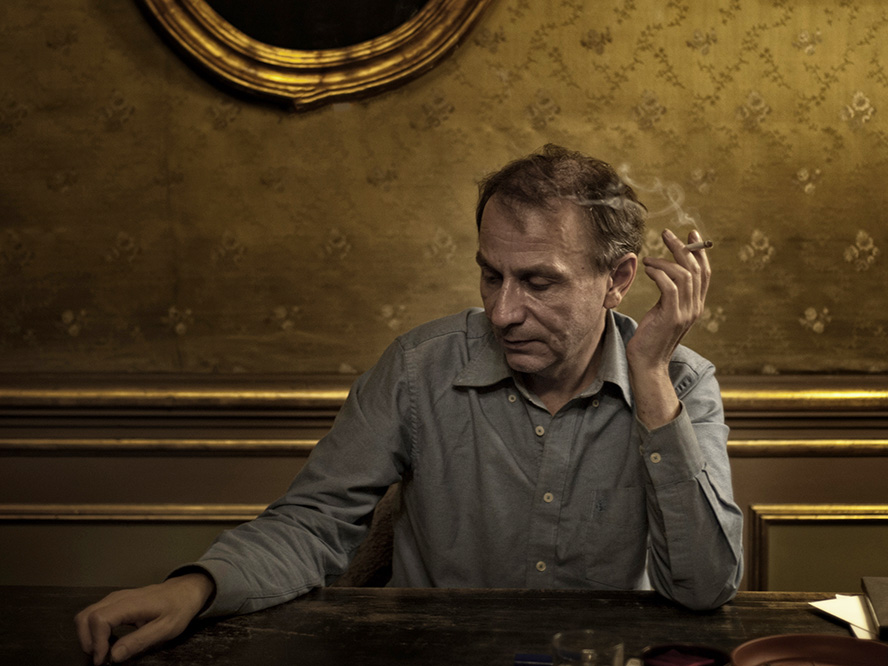
In 2022, in the acknowledgements of his novel Anéantir (published in English as Annihilation), Michel Houellebecq surprisingly announced that it was time for him to “stop” – although whether by this he meant writing novels altogether or just doing any more research wasn’t quite clear. Annihilation was widely received as a disappointing coda to Houellebecq’s seven previous novels – the most significant European fiction of the last few decades, some of us obstinately maintain. Since then, he has published only Quelques mois dans ma vie: Octobre 2022–Mars 2023 (“A Few Months in My Life”), a little book in which he unconvincingly tries to explain how he first got himself into trouble by making anti-Islamic remarks in an interview, and then by being tricked into appearing in porn by Dutch art activists. It seemed there might be little more to come from him.
Now, at 70, Houellebecq is back. He has just brought out his fifth collection of poems, Combat toujours perdant (“An Ever Losing Battle”), and an album, Souvenez-vous de l’homme (“Remember Mankind”) in which he recites 12 of his poems – half of them from the new collection – to a musical accompaniment composed by Frédéric Lo.
Although there have been two French-English parallel text editions, The Art of Struggle (2010) and Unreconciled: Poems 1991-2013 (2017), English-only readers know little of Houellebecq as a poet. But it is as a poet that he began his writing life, publishing in magazines. In 1991, when his first three books appeared at once, they included an endorsement of the horror writer HP Lovecraft, a manifesto for survival as a poet (have no shame, he implored, for basically you’re already dead), and his first poetry collection, La poursuite du bonheur (“The Pursuit of Happiness”). A novel did not appear until 1994, when Whatever was published.
Houellebecq has always regarded poetry as primary (“I’ve always preferred poetry, I’ve always hated telling stories,” he once told Bernard-Henri Lévy). His literary model is Baudelaire (whom he has called “my God”), and his poetry adopts formal 19th-century modes, with strict metre and rhyme, hard to translate. All the while, he delivers his bleak view of contemporary life, no less starkly than he does in fiction – the vision of a faithless society doomed to fail without anything to set against death, save sexual rapture, which is reserved for the young and beautiful.

Combat toujours perdant is, remarkably, even gloomier than his previous work. These are poems about approaching old age and death without any recompense, in worlds that have become meaningless or hostile. This being Houellebecq, he also recalls past ecstasies (one poem is nicely titled “L’éjaculation faciale”), mocks the optimism reflected in a property ad, and alludes to much-missed transcendence. These poems do not flinch from the harshness of his take on the terms of our existence, even as it begins to apply to himself.
The final verse of the last poem La mort ne suffit pas (“Death Is Not Enough”) reads:
L’image de la mort grandit sous les secondes
Dont le terne déclic résonne dans le vide,
Son visage lépreux se change en gueule avide,
Mes paroles se changent en hurlements immondes.
Et c’est ainsi que je me sépare du monde.
“The image of death grows with each passing second/ Whose dull click echoes in the void/Its leprous face turns into an avid maw/My words turn into foul howlings/And this is how I separate myself from the world.”
Houellebecq’s previous attempt at setting his poetry to music, Présence humaine, with Bertrand Burgalat, in 2000, sounded like amateurish rap. Souvenez-vous de l’homme, however, is terrific – Houellebecq reading his poems to their own rhythms, Lo supplying music that works like a film soundtrack, supportive, not dominant.
This is not simply a random selection of Houellebecq’s recent work, but a thought-out concept album which brings together poems projecting disaster and a distant post-human future. It’s very much in the spirit of the last chapter of his 2005 science fiction novel about cloning, end times and human exhaustion, The Possibility of an Island (2005), a work that seemed off the wall then but more telling now. He may be facing the end, losing the struggle, but Houellebecq hasn’t stopped yet.
Combat toujours perdant
Michel Houellebecq
Flammarion, €12
[Further reading: Jan-Werner Müller’s unfinished monument]
Content from our partners



Related
Join the debate
Subscribe here to comment