
Appearing in New York in April to promote The Christophers, Ian McKellen was being excessively modest. “Actors get far too much praise,” he said. “What attracted you to the part? Did you relate to it? How much of yourself did you give it?” The script’s everything, he maintained. “You just come along and say the lines, really.”
So much for almost all other actor interviews ever. Let’s say at once that, nonetheless, The Christophers is a film entirely made by the 86-year-old McKellen’s marvellous performance, which is among his career best. Although he is reprising his mega-movie roles, as Magneto in Avengers: Doomsday in December, and as Gandalf in The Hunt for Gollum next year, he is not currently appearing in the theatre after falling off stage in 2024. So getting to spend this much time with him, in such an intelligent film, is quite the treat.
The director, Steven Soderbergh, originally suggested The Christophers to the scriptwriter Ed Solomon over a drink: “I want to do a little thing… [with] maybe an older and a younger artist and there’s some potential scam… what if he despises his children.” This sounds almost like a regular Soderbergh heist story but Solomon took it in another direction.
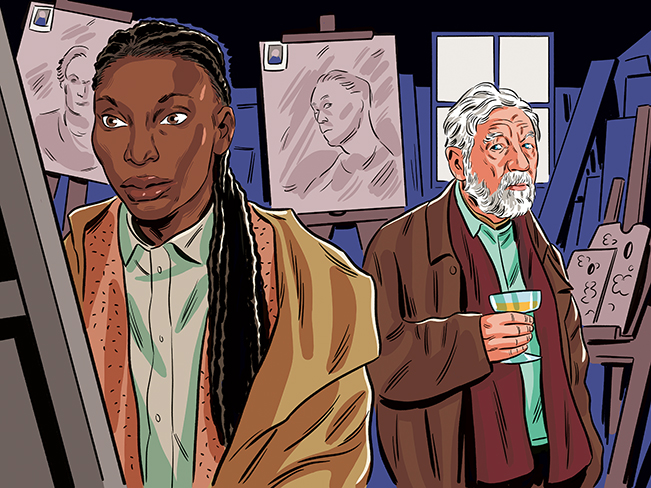
Julian Sklar (McKellen) is a vain, irascible wreck of a man. “Never get old,” he advises. Thirty years before, he became famous for a series of intimate portraits of his male lover, “The Christophers”, now enormously sought after, each worth millions. But since then he has achieved nothing, not painting at all for 20 years. He has been filling in the time by appearing on a brutal TV talent show, Art Fight, as a sarcastic judge, ridiculing the art market by holding a pavement sale of his work, selling personalised birthday greetings on Cameo, and charging £100 extra for an air signature.

The remaining unfinished Christophers are locked away in an attic room in his vast London house and he has never looked at them again. But they are much on the mind of his grasping, despised children, “the buzzard Barnaby” (James Corden) and “the hyena Sally” (Jessica Gunning, Baby Reindeer). “I blame their mothers,” says Julian dismissively.
Barnaby and Sally see the abandoned paintings as their inheritance. They bribe the artist and forger Lori (the formidable Michaela Coel, I May Destroy You) to become Julian’s personal assistant, retrieve the paintings and secretly finish them, using his original materials.
Lori’s initial interview for the job is a blast, Julian blathering away and not listening at all. “You’re not an artist and you’re not a fan,” he assures himself. When she points out that he said that, not her, he grandly ripostes: “I’ve no problem with questions, Lori, it’s the answers I can’t be bothered with.”
In fact, Lori turns out to have had a long and painful back story with Julian, who is both inspiration and enemy – as he soon learns. “Never underestimate the internet prowess of a man who has spent decades googling himself,” he sneers. Realising she’s there on behalf of his brats, he challenges her first to shred and then to burn the canvases. But Lori, so fierce and self-contained, proves his match. What follows is complicated and tightly plotted, involving issues of authenticity, legacy and value in the art market, as well as Julian’s refusal to acknowledge what brought him to this pass.
McKellen makes this quasi-King Lear irresistibly watchable, delivering all these lines brilliantly, in that unmistakeable voice, to the point that it’s difficult to resist finding certain parallels to his own career. So much the better.
Though neither Solomon nor Soderbergh knew McKellen or Coel previously, the parts were evidently written specifically for them and the film is effectively a two-hander. Another of those movies that might as well be a play, then? Not at all. Soderbergh is not just director and producer but also, under aliases, camera operator and editor. Barnaby and Sally are always filmed stolidly and statically, but once we are inside Julian’s house, the handheld, almost documentary-style camera moves all around the scene, weaving through the rooms, a purposeful, questing presence, making this genuinely cinematic and nothing like filmed theatre.
Thoroughly rooted in London, filmed in just 19 days, with only a couple of takes for each scene, on a modest budget, without pre-arranged distribution, The Christophers vindicates Soderbergh’s ornery independence, as well as showcasing McKellen’s mastery. Gandalf and Magneto can wait.
“The Christophers” is in cinemas now
[Further reading: Krapp’s Last Tape’s endless returns]
Content from our partners


Related

This article appears in the 13 May 2026 issue of the New Statesman, Never-Ending Chaos
Join the debate
Subscribe here to comment