
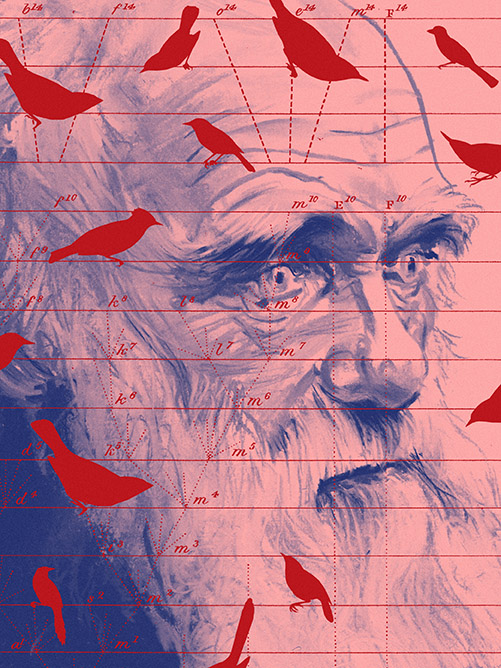
While we cannot be certain that the implied double meaning in the title of Charles Darwin’s 1871 masterpiece, The Descent of Man, and Selection in Relation to Sex, was deliberate, it would be remarkable were this not the case. This rhetorical trickery, playing on the meaning of the word “descent” – in a manner that would have been immediately obvious to the Victorian reader – was intellectual and societal dynamite. Rather than being “ordained for some divine purpose”, humankind was the product of “blind chance”.
Darwin’s book destroyed humankind’s metaphysical status and apparent dignity in an instant, toppling it from its hallowed pedestal and corrupting its “bodily frame” with the “indelible stamp” of its “lowly origin”. Humans, he argued, were the modified descendants of other species, having evolved by natural selection according to a shared set of general laws and causes. Their faculties could be explained by natural processes alone and there was an intrinsic physical and mental continuity between all living things.
The inner primate persisted stubbornly and irrepressibly within the genealogy of our substance, with the difference between man and higher animals being one of “degree and not of kind”. It was only “natural prejudice” and “arrogance” that had previously led us, in the face of incontrovertible evidence, “to demur from this conclusion”. “Nor should we,” Darwin stated, “be ashamed of it.” Indeed, through “having thus risen, instead of being aboriginally placed there”, humans could hope to elevate themselves even further.
Darwin, once destined for medicine and then unsuccessfully rerouted into a career in the Church – and whose father accused him of caring for nothing “but shooting dogs and rat-catching” – had introduced an irreparable and catastrophic fracture into the fabric of human exceptionalism.

His materialistic rejection of any spiritual component to human identity, furthermore, created an accompanying existential crisis for theology. His ideas undermined the “natural theology” espoused by the likes of Charles Bell in The Hand: Its Mechanism and Vital Endowments as Evincing Design (1833) – who argued that nature provided evidence of God’s design – and supplanted it with scientific theory.
But while evincing how life had evolved from a primordial descendant, Darwin carefully avoided the topic of life’s ultimate origins. James Costa and Elizabeth Yale observe in their epic and wonderfully annotated version of the corrected second, 1874 edition of The Descent of Man – which is arguably Darwin’s most significant text – that in doing so, Darwin, “left open the door” to theistic evolution – the idea that a deity could have “set the whole process in motion”.
Darwin’s book, however, does far more than simply anchor human origins in a common descent. The author contrives to deny the very constancy and universality of human nature. He replaces the illusion of immutability with transience, malleability, fragility and an apparently endless and directionless process of transmogrification.
On a more optimistic note, having descended from assorted zoological “early progenitors”, and a rogues’ gallery of “ape-like creatures”, semi-human “savages”, “brutes” and “barbarians”, the expectations of humankind remained great. The mechanics of the evolutionary process confirm the promise and “hope for a still higher destiny in the distant future”.
In their annotated version, Costa and Yale combine their complementary skills as biologist and historian to invigorate this magnificent exposition of some of biology’s most important ideas. In so doing, they imbue Darwin’s arguments with a new forcefulness, agency and relevance.
By means of their thoughtful and meticulously crafted commentaries, the reader is guided across the inconsistent – sometimes contradictory, sometimes brilliantly lucid – landscape of Darwin’s mind as it grapples with the issues that he had dared not raise in On the Origins of Species some 12 years earlier. The “human question”, life’s final frontier, could no longer be ignored.
The foundations of the journey are placed within the imperialist, colonialist and self-serving mindset of Victorian England, in which Darwin formulated his astonishing revelations. His “portrait of man” in the words of Costa and Yale, is “woven from many contrasting threads”.
He articulates his rigid – and from a modern perspective, demeaning – presumptions about race, gender, progress and hierarchy, which encouraged and perpetuated racial and sexual stereotypes and injustice while, simultaneously, outlining “startling new ways to understand the origin and evolution of the human species”. He was very much a product of his time, and we should take a considered view before judging him when, for example, among other such proclamations, he suggests that males have “a more inventive genius” than females, and have “ultimately become superior”.
One annotation details a correspondence with Darwin’s daughter, Henrietta, just a few months after the publication of Descent, in which he naively noted the book’s success, while optimistically stating that he had “been hardly at all abused”. That situation would, however, swiftly change. The Edinburgh Review in July 1871, for example, stated that “never, perhaps, in the history of philosophy, have such wide generalisations been derived from such a small basis of fact”.
Neither was this “fiery ordeal” short-lived. On the occasion of his being awarded an honorary degree at Cambridge University in November 1877, Costa and Yale recount how mischievous undergraduates caused a commotion by dangling a stuffed monkey in a cap and gown from the galleries, accompanied by what his wife Emma described as “unmannerly shouts and jeers”.
But the most jarring affront to Darwin’s ideas originated from the most unexpected quarter some two years before the publication of Descent. In his 1869 analysis of Charles Lyell’s Principles of Geology in the Quarterly Review, the co-discoverer of natural selection, Alfred Russel Wallace, argued that while able to explain the evolution of the human body, only the intervention of divine agency could account for the evolution of the mind. Costa and Yale describe how a shocked Darwin retorted that he hoped Wallace had “not murdered too completely your own and my child”.
By his own account, Darwin’s attempt to reconcile the contrast between humankind’s “God-like intellect” and its “lowly origins”, and his eventual conclusion, which he freely acknowledged many would find “distasteful” and “irreligious”, was rooted in his encounter with Fuegian “savages”. It was in 1832 when the HMS Beagle, the naval surveying ship transporting the 23-year-old Darwin, first sailed into the “rugged and inhospitable” terrain of Le Maire Strait.
It was as if, Costa and Yale inform us, he had “wandered into the pages of a Gothic novel”. His astonishment on observing men that were “absolutely naked and bedaubed with paint” whose “long hair was tangled” and “mouths frothed with excitement”, immediately resulted in a reflection rushing into his mind: “such were our ancestors”. While the pro-slavery Types of Mankind, published in 1854 by Josiah Nott and George Gliddon, argued that different races represented independent acts of divine creation and thereby justified their subjugation of specific types of human beings on racial grounds, Darwin vociferously rejected this, arguing that all types of humans had descended from the same common ancestor.
His attempt to explain the differences between races leads to the book’s most compelling and often overlooked theory. While many human characteristics have been shaped by the “struggle for survival” – that is, natural selection – a second mode, which he called sexual selection, operated in parallel to shape other defining traits, including altruism, cognitive capacity, imagination and morality.
Sexual selection, which in the case of non-human species, Darwin argued, involves females choosing between males based purely on aesthetic preference, is driven exclusively by preference, rather than by survival. The resulting rivalry between males leading to increasingly intricate ways of charming females – ranging from complex courtship rituals to extravagant plumages, cries and exotic ornamentation – should, according to Darwin, be treated as vital in driving certain aspects of human evolution.
Some of these efforts may even be detrimental to survival from the perspective of natural selection. The conspicuous dandy-like tail of a male peacock or extravagant pavilions constructed by bowerbirds, for example, reflect more of an impediment and wasteful depletion of resources than adaptive advantages when viewed exclusively through the lens of natural selection. There is a sense in which contemporary attempts to engineer, or even rewrite, portions of the human genome represent an extension of this innate, preference-based form of selection, generating the potential to propel humankind into a post-Darwinian phase of evolution.
Adrian Woolfson is the author of “On the Future of Species: Authoring Life by Means of Artificial Biological Intelligence” (Bloomsbury)
The Descent of Man
Charles Darwin, eds James Costa and Elizabeth Yale
Princeton University Press, 816pp, £45
[Further reading: Weimar from Goethe to Hitler]
Content from our partners



Related

This article appears in the 13 May 2026 issue of the New Statesman, Never-Ending Chaos
Join the debate
Subscribe here to comment