
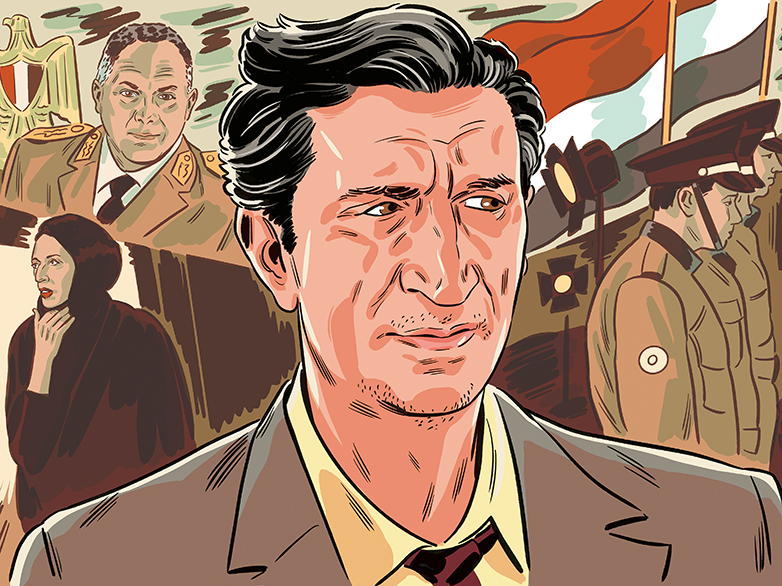
Critiques of existing political regimes that pull few punches are a rarity in cinema, so much so that the very existence of Eagles of the Republic, Tarik Saleh’s third film in a trilogy exposing corruption in Egypt, seems breathtakingly audacious. But its approach to Abdel Fattah el-Sisi’s authoritarian regime is an oblique one, made via its portrayal of a much-loved Egyptian actor who performs in state-censored movies. We watch as George Fahmy (Fares Fares), “the Pharaoh of Egyptian cinema”, is drawn, by slow-ratcheting degrees, into complicity with the state’s deadly doings. American reviewers have seen in this a portent of their country’s possible future.
Fares also starred in the first two films in Saleh’s thematically linked trilogy – as a corrupt policeman who catches a late bout of conscience when investigating the murder of a young woman in The Nile Hilton Incident (2017) – inspired by the real-life murder of singer Suzanne Tamim – and then as a security services operative trying to rig the election of an imam in Boy from Heaven (2022, aka The Cairo Conspiracy). Saleh and Fares can make these pointed films because they live in Sweden and shoot in Turkey. Born in Stockholm to an Egyptian father and Swedish mother, Saleh is persona non grata in Egypt, while the family of Beirut-born Fares fled the Lebanese Civil War for Sweden in 1987.
From Eagles of the Republic’s opening scene, in which we see George with gamblers gathered around a transistor radio to bet on the Epsom Derby, Fares gives him a raffish, distracted air of bottomless vanity. Reminded of the birthday of his teenage son Ramy (Suhaib Nashwan), George has his assistant buy an expensive watch; when Ramy introduces his girlfriend, he has to restrain his father from hitting on her. George’s own lover is just as young, and when he finds he needs viagra to be intimate with her, he uses it at an inopportune moment. Scenes of punctured dignity provide the humour in the film’s vivid early stages.
Once George’s gloriously pampered life is set up, he is suddenly put out of favour and the film he is due to be starring in is recast. A former co-star is blacklisted too, and tells him she’s been pressured to denounce him. This switch in George’s fortunes proves to be the preamble to an offer he can’t refuse. “They” want him to portray El-Sisi, in a hagiographic propaganda film called “Will of the People”, about El-Sisi’s removal from power of the democratically elected Mohamed Morsi in 2013 – despite tall, slim, fulsome-haired George bearing no resemblance to the short, pudgy, bald dictator. This grotesque chicanery echoes El-Sisi’s real-life portrayal by the Egyptian actor Yasser Galal (who also looks nothing like him) in the TV series El Ekhteyar (“The Choice”).

George’s attempts to turn down the role are thwarted. Arriving on set, he finds Dr Mansour (Amr Waked), a secret service ghoul who’s been stalking him, there to control the film’s political tenor. When the Beckett-quoting Mansour accuses George of overacting, it feels as though director Saleh is making knowing intertextual play of the fact that Eagles has its own pendulum swing between po-faced action and extravagant melodrama. Yet, despite this apparent self-awareness, he lets his villains glower balefully through narrowed eyes for easy identification.
In a more conventional thriller, George would grow wiser and braver the further into the mire he gets. Not so here. Though he strives to maintain his idea of himself as decent and honourable, invitations to dinners with generals and to a liaison with the Sorbonne-educated wife of the defence minister lure him into yet more vainglorious moves and, eventually, death-dealing consequences. To describe the convoluted narrative twists, as George’s destiny speeds towards its terrifying, if irresolute, end, would spoil the shocks and surprises.
Behind the anger that inspired Saleh to make these political thrillers, there’s a palpable love of his Egyptian heritage. The fragmentary posters behind the opening credits nod towards the 1960s heyday of Egyptian cinema. The most memorable aspect of Eagles of the Republic remains Fares’s performance of a compromised popular hero. If you sat the actor between Liam Neeson and Adrien Brody you might think he’d borrowed equally from the two, yet neither carries a melancholy mien quite the way he does – anguished as much by his own actions as the state’s.
Viewers must indulge some alarming narrative and tonal shifts, including a bewildering action climax which blunts the film’s moral appeal. At its best, however, it’s an often-electrifying experience.
Eagles of the Republic is in cinemas now
[Further reading: Ian McKellen thrills in The Christophers]
Content from our partners


Related

This article appears in the 20 May 2026 issue of the New Statesman, Definitely, maybe
Join the debate
Subscribe here to comment