
It seems just the right moment to re-release Steven Spielberg’s film AI, on its 25th anniversary. We are all rapidly becoming aware that our lives are being deeply changed by AI already.
So how much of this did Spielberg, working closely to the plans he had been bequeathed by Stanley Kubrick, foresee? Rewatching AI (by far the best film opening in cinemas this week) gives a surprising answer: almost nothing related to what is happening now. For AI is more fairy tale than science fiction, more about human childhood than its announced subject.
AI began with an eight-page short story, no more than a vignette, “Super-Toys Last All Summer Long”, published by Brian Aldiss in 1969. At some point in the future, a young mother spends the day with her awkward little boy, named David, who plays with a robotic toy, Teddy. Only when her husband, Henry, comes home from his job at “Synthank” and they joyfully learn that they have won that week’s “parenthood lottery”, allowing them at last to conceive a child of their own, do we realise that David is a synthetic life-form and can go back to the factory.
Kubrick bought the rights in the mid-Seventies and from this kernel began developing the story over many years, employing first Aldiss himself and then a series of other writers. Kubrick eventually concluded that CGI then wasn’t up to creating David, and no child actor would do either. In 1995 he handed the project over to Spielberg to direct while he produced, but it wasn’t until after Kubrick died in 1999 that Spielberg felt able to make the film, interpreted by some as effectively Kubrick’s 14th and last.

AI, set in the 22nd century after climate catastrophe, opens with a scientist, Allen Hobby (William Hurt), announcing that he has developed a robot (a “mecha”) capable of love. A woman sees a moral problem immediately: “If a robot could genuinely love a person, what responsibility does that person hold to that mecha in return?”
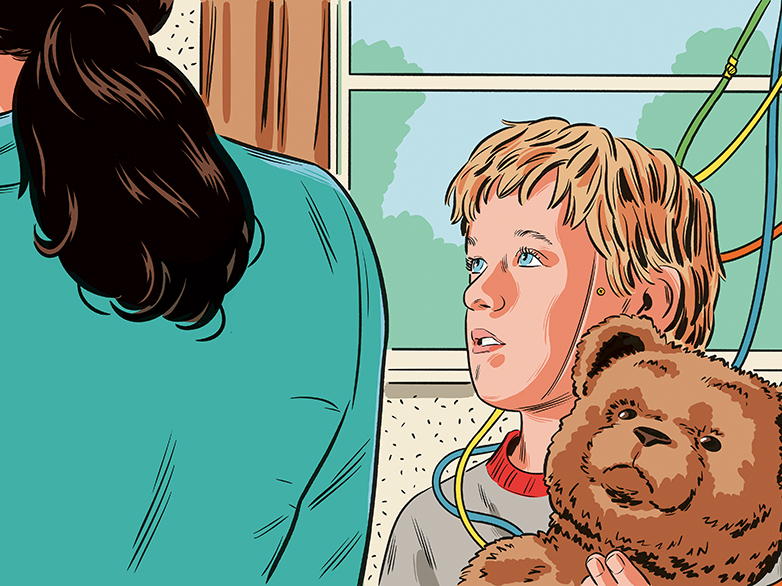
Twenty months on, we see parents Henry and Monica – whose son Martin is in cryogenic suspended animation, suffering from an incurable illness – taking David, Hobby’s artificial boy, into their home as a substitute child. He is wonderfully played by an 11-year-old Haley Joel Osment (the boy who sees the dead in The Sixth Sense), never blinking, his face attentive but not fully comprehending or expressive.
David imprints on Monica, calling her “Mummy”, telling her he loves her and hopes she never dies. But when Martin is unexpectedly cured and comes home, he jealously ousts David. Rather than returning him to be scrapped, Monica tearfully abandons him, along with Teddy (wonderfully gruff 70-year-old voice artist Jack Angel), in a forest.
There follows a long middle section which still seems to belong to another, more satirical movie: David pairs up with sex robot Gigolo Joe (Jude Law), escapes from a “Flesh Fair” where mechas are triumphantly destroyed and heads for drowned Manhattan, all the while in search of the “Blue Fairy” he has learned about from the story of Pinocchio, who he believes can make him a real boy, loved again by his mummy.
Instead he meets his maker, Professor Hobby, and realises he is part of a production line. Plunging into the sea, he ends up trapped underwater, turning to ice, gazing at a statue of a beatific blue fairy (a Coney Island showground relic), hoping still to become human. Many reviewers have suggested the film could well have ended here.
But there’s a shattering last act, returning us to the first. Two millennia later, advanced AI life-forms free David from the ice, cherishing him, ironically, as “the enduring memory of the human race”, otherwise now completely disappeared. They are able to resurrect Monica from David’s memories and DNA traces Teddy has preserved, but for one day only. David spends it with her, “the happiest day of his life”, as a peculiarly avuncular AI voiceover informs us. At last they say they love each other. Impossible to watch dry eyed, this.
The remarkable conclusion has to be that, while truly being all about human loneliness and loss, so far as the film is about AI, it’s not a warning but an embrace. Sara Maitland, who worked on the script, said that Kubrick believed computers would become intelligent, including emotionally, and were the future: “The film was intended to make us love them.” AI is well worth revisiting now – despite its oddity, it is among Spielberg’s best.
“AI” returns to cinemas from 8 May
[Further reading: The Devil Wears Prada 2 is pure guilty pleasure]
Content from our partners



Related
Join the debate
Subscribe here to comment