
The first time I noticed an increase in revisionist nostalgia for southern Africa’s white supremacist states was in 2015, when a maladjusted 21-year-old man called Dylann Roof killed nine black people in a church in South Carolina. Roof had taken numerous photographs of himself wearing a jacket emblazoned with the Rhodesian, apartheid South African and Confederate flags, and had published a manifesto on a website called “The Last Rhodesian” in which he declared: “Look at South Africa, and how such a small minority held the black in apartheid for years and years… if anyone thinks that think [sic] will eventually just change for the better, consider how in South Africa they have affirmative action for the black population that makes up 80 per cent of the population. It is far from being too late for America and Europe.”
As Trump 2016 was getting into full stride and the media began reporting on what was then called “the alt-right”, it became apparent that a new generation had embraced the Rhodesian and apartheid cause. The New York Times Magazine reported in 2018, during Trump’s first term, that numerous online stores, such as “the Commissar Clothing Company, were hawking ‘Make Zimbabwe Rhodesia again’ hoodies and T-shirts”. Another maladjusted, internet-addled 22-year-old hailing from Idaho, Joseph Smith, was quoted as saying: “I’m sure you’re aware these days being a conservative heterosexual white male is rather unpopular in the eyes of many,” and “this is the demographic that caused Rhodesia to thrive as well as it did for as long as it did”. There are two YouTube videos of the song “Rhodesians Never Die”, each with 2.7 million views.
By 2026, this unfortunate trend had made the journey from the margins of the internet to the halls of power, from politicians and staffers to influencers. Elon Musk frequently takes to the social media platform he owns to spread various forms of nonsense regarding non-existent white genocide: “They are calling for the genocide of whites,” he wrote on Tuesday (14 April), in response to a video of a protest in South Africa. Of late, he has also vented his frustrations regarding the South African government’s refusal to grant Starlink an operating licence without meeting equity requirements: “South Africa won’t allow Starlink to be licensed, even though I was BORN THERE, simply because I am not black!” His perverse father, Errol – who has had two kids with his own stepdaughter – is lobbying the Russian government to join the US in providing refugee status to “white farmers”. Nor is this trend confined to Maga. Look to Tommy Robinson, Douglas Murray and the “yookay” aesthetics types, and you will find the same narrative of white oppression in democratic South Africa, and nostalgia for white rule.
Social media these days, most notably the website formally known as Twitter, is awash with all manner of depravity. And anyone who has spent enough time immersing themselves in the X swamp will have encountered a particular type of young male poster sharing (sometimes sexually charged) tributes to Rhodesia and its khaki micro-short-clad troops, known as kortbroek (shortpants). In this environment, the claims around “white genocide” have metastasised. This conspiracy claims that there is a government-backed campaign of mass killings against “white farmers”, “Afrikaners” and whites, along with land seizures and racial laws excluding the white minority – laws worse than those on the books against blacks during apartheid.

The white genocide fever dream is only experienced by a minority of the minority-white South African population and expatriate communities. The majority of white voters cast their ballots for parties that accept the new constitution and democratic order established after the victory of Nelson Mandela in 1994. And this fantasy serves as both a rejection of the idea of a new, more democratic and egalitarian order, as well as a form of denialism – specifically the outrageous claim that these crimes are worse than what may or may not have taken place under apartheid. It all ultimately serves as fuel for a lobbying campaign to undermine South Africa and leverage US power in favour of revanchist interests.
The continuity Afrikaner right, led by the “civil rights” group Afriforum, rather than explicit support for apartheid, has built a strategy for pursuing their cause through litigation and the framework of international human rights law. In a supreme irony, white supremacy has given way to minority rights. However, since the mid-2010s, they have embraced Maga in all its depravity and lobbied the US government to punish South Africa for its imagined crimes. Far-right South Africans, such as the fanatical Willem Petzer, fantasise that “with the support of the West, we can make South Africa great again”. What this means is the overthrow of South Africa’s democratic order. After the US’s recent kidnapping of Nicolás Maduro, right-wing accounts flooded Twitter with AI-generated slop depicting President Cyril Ramaphosa receiving the same treatment as Maduro.
Only a few years ago, it would have been sufficient to mock or ignore this online bog. But to our and South Africa’s immense misfortune, this view is prevalent at the highest circles of the Trump regime and, increasingly, also among influential elements of the British right. South Africa has been hit with 30 per cent tariffs by the US, along with repeated threats of sanctions against public officials; no doubt these threats are also in part motivated by the temerity of the South African government to launch a case accusing Israel of committing genocide at the International Court of Justice. White South Africans are now the one named exception to the Trump regime’s crackdown on refugees, because they will more easily assimilate into “American culture”, whatever that may be.
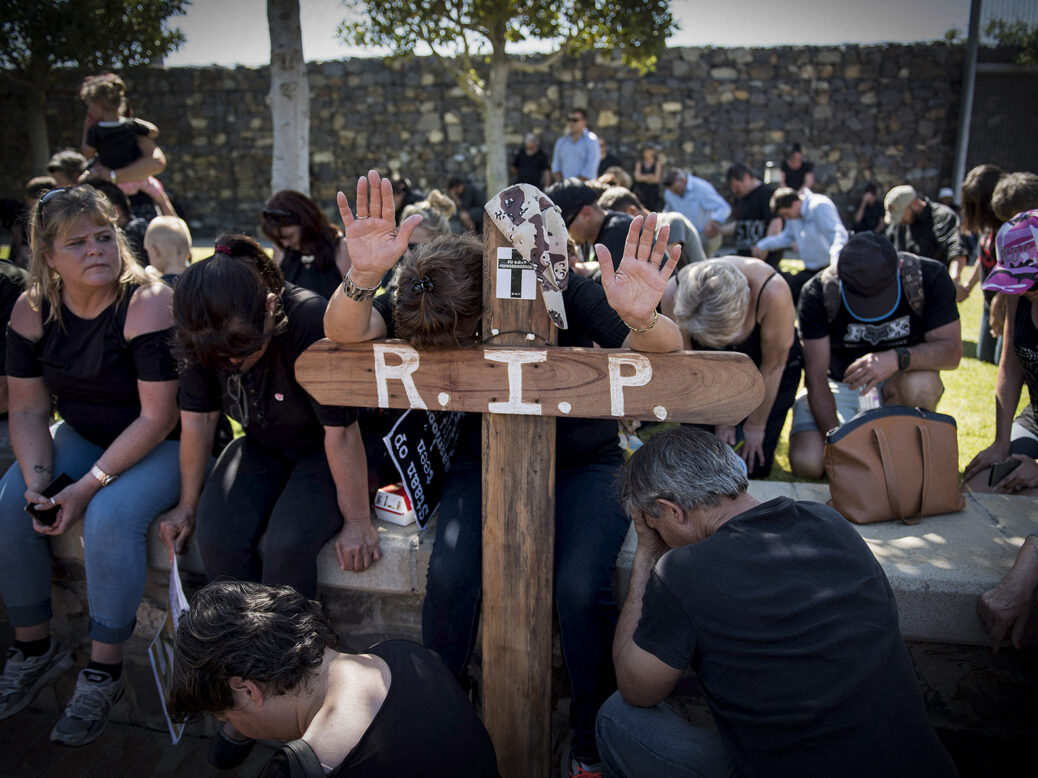
There is also the small matter that the white genocide nonsense is promoted by the richest man in the world, now widely despised in the land of his birth. Musk is only one of the many Trump-supporting tech oligarchs with roots in southern Africa, along with Peter Thiel, David Sacks and the much lower profile Roelof Botha, a grandson of Pik Botha, apartheid’s last foreign minister. Even one of the alleged founders of QAnon, Paul Furber (though he denies this), is a white South African. Indeed, Trump has explicitly justified sanctions against South Africa based on the fictitious “white genocide”. Some may recall that last year, in an extraordinary breach of diplomatic protocol (now par for the course), he interrupted a meeting with Ramaphosa to show an absurd video about “white genocide”: drone footage of thousands of white crosses taken from a protest rather than an actual burial site. Trump, never one for fact-checking or honesty, also brandished a photo showing atrocities supposedly taking place in South Africa that turned out to be from the Democratic Republic of Congo.
Since October 2025, 4,499 refugees have been admitted to the US, according to the Refugee Processing Center; only three were not white South Africans. So far, reports from the refugees on life in America have been mixed. One woman shared a post describing being “rejected for entry-level hotel jobs for being ‘overqualified’”. If it even needed to be said, South Africa is not exactly losing its best and brightest here: Melanie and Piet Viljoen have been arrested for allegedly shoplifting more than $3,000 of groceries (they seem to have made off with several bottles of prosecco). Another “refugee”, Charl Kleinhaus, who has a lengthy history of anti-Semitic posts on social media, spoke of the difficulties of life in America: “The biggest challenge is here you work, hey. There’s no kitchen lady you call to sweep the house, or clean the house, or stuff like that. You do the work yourself.” It would be insulting to the intelligence of the reader to rehash the case that there is no genocide against white people taking place in South Africa. There were 49 murders in the 2023-24 financial year on farms, and the majority of victims were black, out of 27,621 murders nationally (the majority of which were also black).
South Africa is a perfect nightmare for the new right. It and Rhodesia are the examples of the great replacement, by which white rule was replaced by the rule of the majority, which was black. The anxiety of changing demographics and foreign invasion is projected on to the supposed nightmare of post-apartheid South Africa: a crime-ridden, apocalyptic society in which whites are routinely targeted by state forces and have their property rights menaced by violent criminals. In Musk’s summary, from Thursday (16 April), “The current South African government has objectively implemented apartheid 2.0.” (Somehow, none of this stops the Springboks dominating world rugby.) The anxieties posed by imperial decline in the US and the UK are manifesting in the imagined consequences of majority rule in South Africa.
Apartheid South Africa and Rhodesia have long been significant in the imaginations of the British and American right. The Reagan administration gave support to the apartheid regime through its policy of “constructive engagement”, the idea that the best way to end apartheid was through occasional mild finger-wagging, and focusing on shared values rather than sanctions and disinvestment. As the US assistant secretary of state for African affairs, Chester Crocker, put it in 1981: “A more constructive relationship… based on shared interests, persuasion, and improved communication.” Leading figures on the right, such as the tele-evangelical Jerry Falwell and Dixie Republican senators like Jesse Helms and Strom Thurmond, fought against any attempt to pass sanctions. Dick Cheney called Nelson Mandela a terrorist, an accusation he claimed he didn’t regret in 2000. The leadership of the Young Republicans at the time, the disgraced lobbyist Jack Abramoff and the anti-tax militant Grover Norquist, worked on behalf of the apartheid government – this included producing a Dolph Lundgren action movie titled Red Scorpion with South African money. Right-wing American publications like the National Review and groups such as the John Birch Society supported apartheid and Rhodesia for decades.
As the British anti-apartheid movement gained strength, hard-line Thatcherites such as the MP Teddy Taylor routinely declared that Mandela “should be shot”. The Federation of Conservative Students (FCS), of which David Cameron was a member (though there’s no evidence he was involved), went as far as wearing stickers declaring “Hang Nelson Mandela”, before it was banned. The Tory chairman, Norman Tebbit, told the BBC that: “He [Mandela] was the leader of a political movement which had begun to resort to terrorism. You have to act within the constraints of the time, and I get very irritated by people who judge the past by the present.” Even as apartheid was patently on its way out by the late 1980s, the right-wing press continued to portray Mandela as a terrorist.
While much of right-wing support for apartheid stemmed from anti-communism, as the historian Quinn Slobodian recounts in Crack-Up Capitalism (2023), there was also a starry-eyed sort of enthusiasm for apartheid among significant sections of the right as a type of grand social experiment in decentralisation. The constructed tribal homelands known as “Bantustans”, which were created to strip millions of black South Africans of citizenship and served as dumping grounds for cheap migrant labour, were portrayed as zones for experimenting with capitalist freedom – “decentralisation zones”, as apartheid’s agents tried to sell them to foreign investors. As Reason magazine put it in 1980: “It is possible that in the past decade no country has moved further toward a libertarian society than South Africa.” Murray Rothbard, a founding figure of the American New Right, similarly said “that the solution for South Africa was not in less apartheid but more – a ‘Grand Apartheid’… not just canonisation, but separate sovereign nations in the territory of the existing Union of South Africa”.
Rhodesia occupies a slightly different symbolic space. For one, it was an Anglo-state, founded on the premise of an imagined set of traditional English values that were being lost in postwar Britain. It was also a pariah state from when it declared independence from the UK in 1965, with a white population of only 250,000 (slightly less than the population of Wolverhampton) ruling over a black population of six million through a system of institutionalised disenfranchisement, public segregation and political repression. While Rhodesia’s racial order may not have had the ambitions and branding of apartheid, it was more or less the same in practice. And as many who have had the misfortune to encounter the “Whenwes” will testify, open racism against blacks was intrinsic to Rhodesian culture.
Rhodesia never enjoyed any sort of international recognition, or official state support from a major power for geo-strategic reasons. Nevertheless, many on the right flocked to its cause. William F Buckley’s National Review described Rhodesia’s leader, Ian Smith, as “Rhodesia’s George Washington”. Protestant paramilitaries in Northern Ireland also adopted the Rhodesian and apartheid South African causes as analogous to their own, painting murals of the white-settler states’ flags in neighbourhoods they controlled. Ian Paisley’s newspaper, the Protestant Telegraph, compared Ulster to Rhodesia – “both having problems with ‘primitive natives’”.
A significant section of the Conservative Party supported Smith’s rogue white-settler state, most notably the Monday Club. Thatcher even proposed normalising relations with Rhodesia during the 1979 election, though she went on to broker the Lancaster House Agreement, which helped lead the way to Zimbabwean independence. In the US, Rhodesia was promoted as a vanguard of white civilisation and anti-communism by a certain section of the hard-line, anti-communist right struggling with Vietnam syndrome, most notably by Soldier of Fortune magazine. This self-described “journal of professional adventurers”, founded in 1975 by Robert K Brown, a Vietnam veteran, championed Rhodesia as a haven of Western civilisation and individual freedom uncorrupted by the liberalism and counterculture that had swept the West. Soldier of Fortune’s support for Rhodesia went beyond rhetoric; it actively sought to recruit Vietnam veterans, both American and Australian, to join Rhodesia’s armed forces to fight “terrorism”. Martin Luther King’s assassin, James Earl Ray, was apprehended at Heathrow trying to board a flight to Rhodesia, where he planned on living in exile.
Rhodesia served and continues to serve in the reactionary mythos as an outpost on the dark continent, symbolising traditional English values rather than the Afrikaner Calvinism of its southern neighbour. This “more English than the English” society, as its apologists were wont to claim, was betrayed by liberal Britain and the West, making it the site of, in the words of the British psychoanalyst Dylan Evans, “the defeat of the white man’s world”. Today’s Rhodesia nostalgists see it as analogous for the struggle against the liberal globalist plot to replace white civilisation. Rhodesia, continues Evans, “has become a mythical lost homeland symbolising betrayal by liberal governments, the erosion of white civilisation, the moral mission of white rule, transnational solidarity among Anglo-Protestant racists, and a template for nationalist secession and resistance”. Like the US military in Vietnam, the narrative goes, Rhodesia was stabbed in the back by perfidious liberals, who sold out to the communists and terrorists. This mythology lives on through the genre of bush-war memoirs and an increasing number of YouTube documentaries about the supposedly invisible Rhodesian military and its elite units, like the Selous Scouts and the Rhodesian SAS.
Contemporaneous reactionaries see their struggle against immigration, collectivism and all the other “globalist”, “woke” or “communist” values, as analogous to those last redoubts of white supremacy in South Africa. The most explicit articulation of this can be found in the work of a young man called Will Tanner, who runs a Substack called the American Tribune and has 161,000 followers on X. For Tanner the West, as proved by its rejection of Rhodesia, turned its back on its own values. “Rotted internally by cultural Marxism and the Leninist grievance impulse, it destroyed them out of a dark desire to tear down what had previously been its driving impulse.”
European social democracy and New Deal liberalism in the US represented a hatred of hierarchy that is the foundation of Western civilisation. As Tanner puts it, “In Europe and America, this meant punitive taxation and regulation. In the post-colonial world, it meant violent chaos as European administrators left and native thugs waged wars on their tribal and European enemies. Society was indeed levelled, at great cost.” Somehow, the backwards holdout, where whites could slurp gin and tonics by the pool served by black servants while ranting about the “terrs” and “Africans”, has come to represent “high civilisation”; never mind that the most famous writer associated with Rhodesia, Doris Lessing, was a notable opponent of white supremacy.
Post-apartheid South Africa and Zimbabwe represent a “path of anarcho-tyranny” that the US and the UK are heading towards. To quote Tanner again, reluctantly: “America continues to descend down the South African-style path… and, as it does so, the videos and stories that emerge are increasingly disturbing. Illegal immigrants have overwhelmed the Texas National Guard and stormed through the border in scenes seemingly out of Rome’s Decline and Fall. ‘Squatters’ are given more rights than landowners in blue states and allowed to take over homes at will, with the homeowners arrested if they protest that sorry state of affairs. Shootings, stabbings, and robberies routinely happen on subways, and people cower rather than fight back. Protesters screeching about conflicts abroad deface American monuments and light Old Glory on fire.”
The reality is that conservative media, right-wing influencers and what passes for “intellectuals” on the new right are invested in portraying South Africa as an apocalyptic failure. It not only justifies their racial anxieties but also their political project. The story of Zimbabwe’s crisis and transformation into a military dictatorship held together by Chinese investment is beyond the scope of this essay. But South Africa, for all its problems, is a robust democracy with more freedom of speech than any Western democracy, competitive elections, a strong constitution, great wine and great weather. It is governed by a coalition government of national unity, which includes the right-wing Afrikaner nationalist party VF+, the centre-right Democratic Alliance (which is perceived as a “white” party) and, to a lesser extent, coloured (the official term for mixed-race South Africans) and Indian-minority dominated.
The ANC’s leadership still includes Indians, whites and coloureds. The recently appointed ambassador to the US, Roelf Meyer, is a 78-year-old white Afrikaner and former member of the apartheid National Party. The fact that the right is looking so longingly at southern Africa’s dark past – rather than its optimistic future – not only demonstrates the return of open racism to mainstream politics, but it also tells us what type of future society they will build, given the chance.
This essay is part of Alameda’s After Order project, which explores the dispute for sovereignty in a fragmented world
[Further reading: Elon Musk vs the woke mind virus]
Content from our partners


Related
Join the debate
Subscribe here to comment