
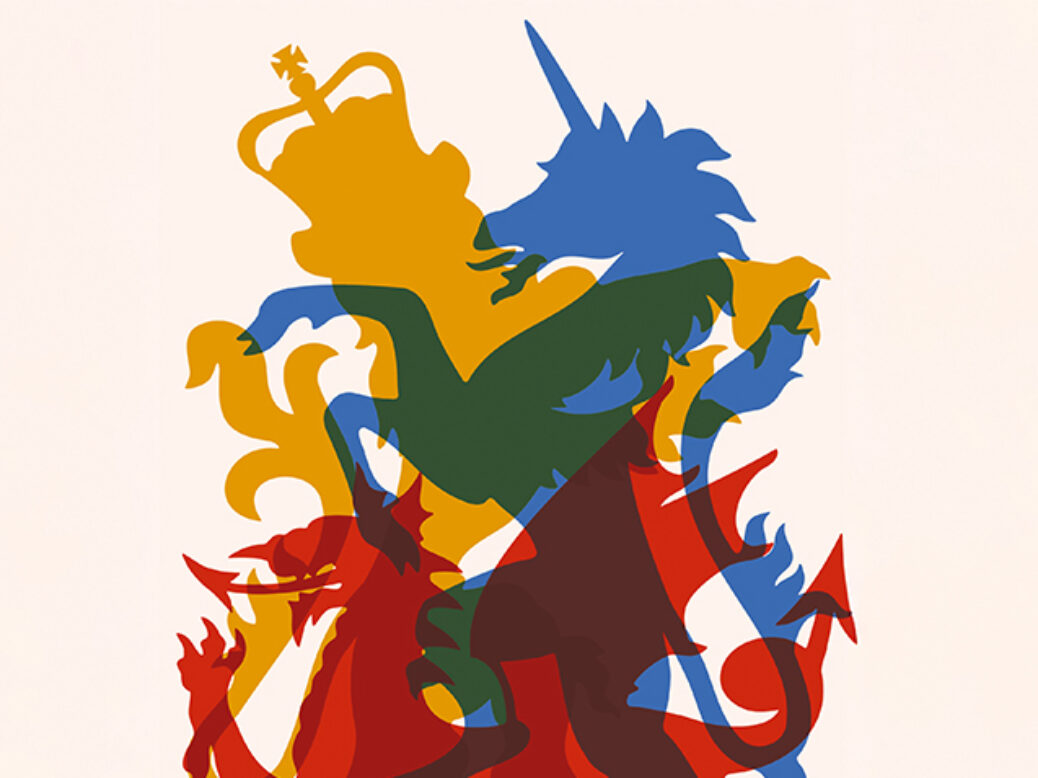
Nationalism, we are told, defines our age. At any rate, it seems likely to have defined these May elections. In Scotland, there is a strong possibility – at the time of writing – that the Scottish National Party will emerge with a majority in the Holyrood parliament for the first time since 2011. Reform surged in popularity ahead of the Senedd elections, but Plaid Cymru looks like it will be the dominant force in Wales, one way or another. If we include Sinn Féin’s sway over the Northern Ireland Assembly, then the United Kingdom may be confronted with the heady prospect of the three devolved governments being controlled by – or at least challenged by – explicitly anti-unionist parties for the first time.
These parties are moving in parallel, if not quite in alliance: the SNP First Minister, John Swinney, said on 22 April that he would “enjoy the cooperation” with Plaid and Sinn Féin should his party win. “I think the UK would be changed irreversibly if that outcome was to be the case,” Swinney said. Meanwhile, in England – the historical motherland of British unionism – there is a contrasting blend of ambiguity and rancour about the whole question of nationhood. This may well be the age of the lamp-post flagpole and the performative patriot. But at a fundamental level there is widespread confusion over matters of constitution and English identity.
Walk down any street in England and ask a handful of domestic nationals the question: “Of which nation are you a citizen?” You are likely to get at least three different answers. Some will say Britain or Great Britain (half-right, and understandable, given that national passports say “BRITISH” on the cover). Many will say England, by which is often meant something like the hazy Anglo-British imaginary left over from the time of empire (daydreams of Churchill, monarchy and the pre-decimal pound). A few will say the UK, the actual correct answer – though only a minority will be mindful, when using this term, of the disputed, frequently bloody outline of their real country of citizenship: the “United Kingdom of Great Britain and Northern Ireland”.
But if nationalism is the zeitgeist, it is this fully drawn UK – our weirdly uncredited true nation state – that we must explore if we are seeking to understand what national sovereignty means in 2026. At the turn of the decade, it was fashionable to speak of a potential “break-up of Britain”. But detailed discussion of our national set-up – as opposed to endless handwringing about “patriotism” and “national feeling”, or hyperbole about the immediate prospect of Scottish and Welsh independence – has been less common recently.

As in so many other aspects of mid-2020s British life (notably the undead, unredeemable Keir Starmer government), the constitutional narrative of the UK is one of confusion, evasion and inertia. Is this yet another symptom of national decline? Or is it possible to get a clearer, more authentic sense of what the United Kingdom means in the present tense, and how it might evolve – or devolve – in the future?
The modern idea that Britain – or rather, the UK – is structurally weak to the point of being on the verge of “break-up” dates from the high days of decolonisation in the postwar era. More specifically, it was given concrete form in the work of the Scottish Marxist historian Tom Nairn, who began writing on the subject in searching ways in the 1960s – and whose 1977 anthology The Break-Up of Britain: Crisis and Neo-Nationalism created an enduring meme.
For Nairn, casting his eye back through history, the English-led state that would become the UK was a remarkable success story – the first “state-form of an industrialised nation”, and a revolutionary blueprint, from the 18th century on, for “general modern development” across the world. However, he argued, it was precisely the astonishing global capture of the open-ended British imperial state that would later freeze its development, preventing it from undergoing a second, modernising revolution and the sort of “logical reorganisation of its constitution” enjoyed by other nations in this period. As Nairn put it, the English “had acquired such great advantages from leading the way – above all in the shape of empire – that for more than two centuries it was easier to consolidate or re-exploit this primary role than to break with it”.
Writing in the 1970s, Nairn could see how the postwar collapse of the British empire – and the slower but equally ruinous demise of British industry – had fatally weakened the British state-of-convenience, creating the backdrop for the Irish Troubles and the rise of Welsh and Scottish nationalist movements – not to mention the cycle of economic and industrial crises then known as the “British disease”. Though Margaret Thatcher and Tony Blair would respond to this apparent malaise with attempts to reshape the national architecture in various ways, Nairn’s long-range diagnosis of structural British decline would mostly retain its relevance into the 21st century – a time of rising clamour for Scottish independence, plummeting faith in the structures of British governance, and the sort of confused existential questioning about the basics of nationhood noted above.
Indeed, by the end of the 2010s, it seemed to many that Nairn’s Break-Up had finally reached a spectacular finale. As Westminster was riven by quarrels over the role of the Northern Ireland protocol and the Democratic Unionist Party in Brexit negotiations (exposing the absurdity of a “united” kingdom with an erratic and divisive post-colonial partition in its midst), and as the Scottish National Party regained its dominance of the Scottish Commons quota in the 2019 general election (allowing Nicola Sturgeon to be acclaimed de facto leader of the opposition for much of 2020-21), the mood of constitutional crisis became all-pervasive. Nairn himself, in a 2020 interview with OpenDemocracy towards the end of his life (he died in 2023), was moved to pronounce: “Within the next five years, in one form or another, break-up is likely to come about.”
Despite Nairn’s prediction, there is little sign, six years later, that the UK is suddenly about to implode. The feverish debates of the Brexit era have also subsided. But it would be a mistake to conclude from this that the kingdom itself has undergone a resurgence, either in the realms of Westminster party politics or the more demotic avenues of everyday life. Instead, we seem to have returned to the condition of perma-stasis, deferred modernisation, and unrealised selfhood that Nairn identified as the default mode of the United Kingdom – a patched-together, “transitional” entity originally set up to serve as a pragmatic foil for imperialist expansion.
In Scotland, Sturgeon’s fall from grace in 2023 led to a time of torpor and uncertainty, which may or may not now be morphing into something more dynamic. The SNP has lost ground in recent years in Westminster, though a further comeback is likely not just at Holyrood but also the next general election. The party will have to account for a Caledonian version of the Reform surge – which in this case means the revival of a glitchy brand of retro-unionism. Though Reform is unlikely to pose a really serious threat to the SNP in the Scottish Parliament itself, its rapid ascendancy in Scotland is a reminder that a large demographic will probably stand firmly in the way of any push for independence via a repeat of the 2014 referendum (the most likely trigger for British break-up, and a recurring talking point of the late 2010s and early 2020s). Perhaps crucially, opinion polling on the subject among Scots is still finely poised.
Welsh and Irish narratives are also at a stalemate. The former is another breakthrough site for Reform (make that Reform UK, though in Wales Reform tends to deploy more anti-immigrant rhetoric than strident British unionism). This rightward tendency clashed head on with Plaid Cymru’s Welsh-nationalist co-option of the progressive Labour vote in the run-up to the Senedd elections. Whatever the final result, a referendum on independence is even less imminent in Wales than in Scotland – though a Plaid victory would improve its long-term prospects. In Ireland, the slow growth of a popular consensus behind reunification – another likely trigger for UK collapse – is complicated by formidable practical obstacles: the sheer constitutional headache that uniting Ireland would entail, for one, as well as fear of the civil conflagration that would be likely to follow.
In the centre of all of this, English nationalism continues as it invariably has done since the birth of the Union, and gets by on a mixture of hubris and oblivion. Here, the national question is often a kind of opaque nightmare. On the one hand, nationalism in England has arguably never been so omnipresent. St George’s Crosses decorate roundabouts and lamp-posts all over the land, and the far right surges by capitalising on a widespread sense of English grievance and exceptionalism (an impulse immortalised in Stewart Lee’s legendary “These days, if you say you’re English…” comedy sketch of 2014).
But unlike the nations formerly known as “Celtic”, there are deep historical reasons why England’s ability to forge a viable path towards independence will probably always be limited – despite the battle cries of emancipatory Englishness from a far right that, tellingly, cannot ultimately make up its mind whether it is pro-British or pro-English. For all Reform’s grounding in St George’s flag-style cultural nationalism, for example, its nomenclature is overtly pro-UK, which is something slightly different from either. Again, Nairn’s broad diagnosis – that imperial Anglo-Britishness devoured English nationalism many centuries ago, making it extremely difficult to recover a coherent English nationhood from the distant pre-modern past – remains pithy.
What we have, then, in the convoluted, globally eccentric case of the UK, is a deep and enduring crisis of cultural sovereignty. In Scotland, Wales and Ireland, the residues of British imperialism and its unionist mindset are stymying growing independence movements (despite the fact that militant unionism itself is largely a fringe pursuit). But at least there is frequent agreement in those countries about the broad outline of the nationalist imaginary. In the post-imperial campagna that is England, by contrast, the available forms of nationalism – barring some anaemic centre-left chatter about “progressive Englishness” – are based on a nostalgic muddle of British and English signifiers derived ultimately from the UK’s exceptionally ill-defined foundations. As a result, far from being a brute conservative case of “making Britain great again”, it is surely only through a radical overhaul of national structures that we will finally gain the chance to take ownership of our collective selves.
Perhaps the best way to define our current state of national unbeing is “post-British”. This is not a dismissal of national identity; let me be clear what I mean by this phrase. By describing the present moment as post-British, I do not mean that we have yet made it through to a time after the United Kingdom. Instead, in the same way that postmodernism was for many people merely a more trivial, insubstantial version of modernism, the post-British era might be seen as a time in which the United Kingdom continues, but as a ghostly echo of what it once was – largely (and here parallels with Starmer’s Labour Party become unavoidable) because we are, for the moment, constitutionally unable to find a replacement.
Where, in all of this, is the escape route to a better, collectively empowered future? After acknowledging that the United Kingdom is – and perhaps always has been – a provisional, inadequate vehicle for nurturing a truly sovereign modern politics, we must envisage gutsier, more imaginative alternatives to it, rather than attempting to keep the terminal case of Anglo-Britishness on life-support.
It is possible that the separatist nationalist movements in Scotland, Wales and Ireland are too far down the path of development – and too popular among younger demographics – to fall back in line with even a reformed, progressive brand of unionism (and who could blame them?). But the response to this must be more creative thinking about English reform, not the conjuring of an atavistic English nation state that will likely always be the totem of the conservative right – and will merely replicate the centralising imperial tendencies of the Anglo-British establishment, but on a smaller scale.
True to recent form, Labour under Starmer is conspicuously failing to pick up this baton. Indeed, it is failing to heed even its own erstwhile visions of modernising reform. In the case of the progressive devolutionary movements that could save us from the disaster of a rump, right-wing English state, alternatives have been offered. Starmer’s government seems largely to have forgotten the more assertive recommendations in the 2022 Gordon Brown led Report of the Commission of the UK’s Future (such as replacing the House of Lords with an elected Assembly of the Nations and Regions), as well as the radical regionalist tangents in Andy Burnham and Steve Rotheram’s lively 2024 manifesto Head North. As far as the latter is concerned, signs that the nascent Burnhamite leadership campaign will push constitutional reform to the fore of its political offer as it seeks to move on from the ideas vacuum of Starmerism is hugely encouraging.
Whether the successor to the UK will come from ideas such as supercharged regional government, or a more wholesale push towards a federalist national system, is a debate that cannot be deferred while an ailing Starmer government wraps itself in the Union Jack for the sake of meagre messaging about governing in the national interest. One way or another, in the years to come, the United Kingdom will break. It is merely a case of whether we do this constructively and with progressive ideals in mind – or if we are left picking passively through the ruins of a long-dead dream of British unity.
[Further reading: Could the Welsh Greens split from Zack Polanski’s party?]
Content from our partners



Related


Join the debate
Subscribe here to comment