
The result was an equivocal mess of competing loyalties and aspirations. Portraits of Marshal Philippe Pétain were still on display across the city and Vichyite thugs roamed the streets looking for Jews even as General Eisenhower and his Allied forces took up residence and French Resistance units continued to plot and to rage.
The cause of this strange, uneasy state of affairs was the presence of one man: Admiral François Darlan, the Marshal’s second in command, who happened to be in Algiers visiting his sick son when the Allied invasion began – or so he claimed. The British and Americans had hoped to instal another French general, Henri Giraud, yet almost immediately after landing in North Africa it had become clear that he did not have the authority to command the 125,000 French forces still in the region, whom the Allies wanted to avoid fighting.
The British and Americans needed to move quickly if they wanted to force a French ceasefire. The US general Mark Clark was given the go-ahead to negotiate with Darlan directly, wresting from the French commander a formal order to his troops not to resist the Allies, issued “in the name of the Marshal” back in France. Though this order was swiftly disowned by Pétain himself, it worked. Suddenly, the Allies could advance on the Germans. As a result, however, the Allies were now working with a regime that had not broken with the collaborationist government in France. For the British, this was calamitous. For the past two years, Winston Churchill had held up an entirely different man as leader of the real France, the free France: Charles de Gaulle.
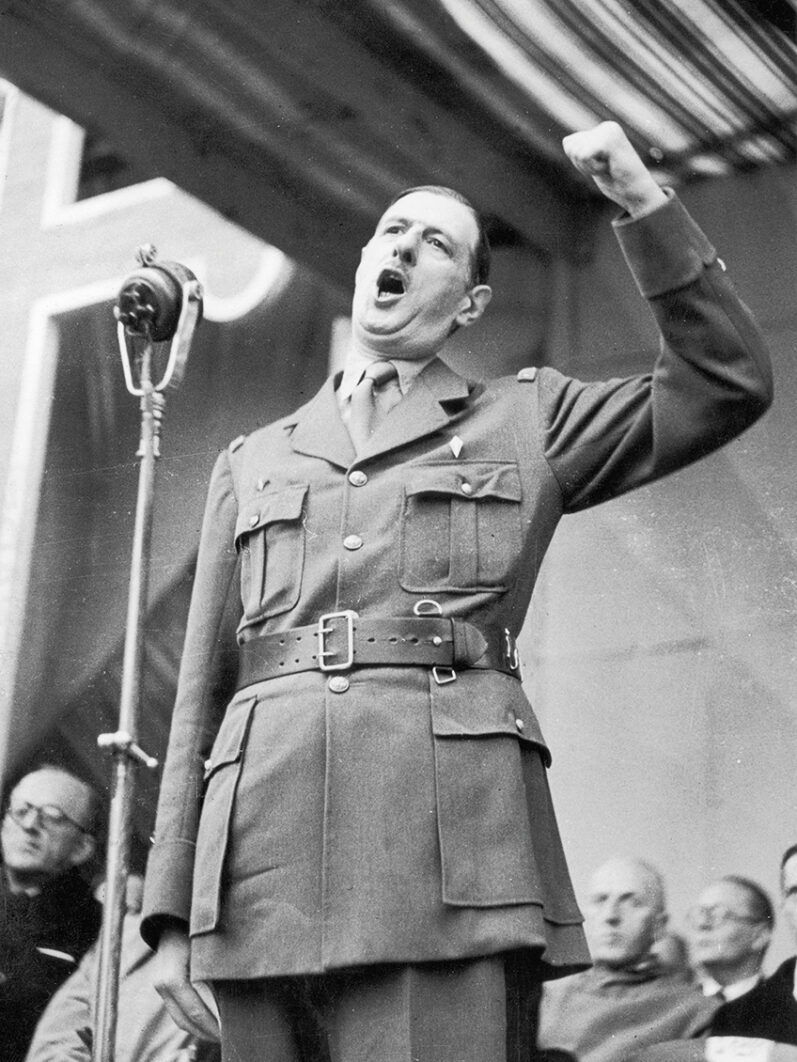
De Gaulle was untarnished by collaboration, having fled France in 1940 refusing to accept the terms of Pétain’s surrender. Despite being little more than a junior member of the last government of the Third Republic, De Gaulle had grown into something much more in London: an emblem of France unbowed. With his broadcasts on the BBC, he had held up a different idea of France from the one that was shaming itself in Paris and Algiers.

If Britain now recognised Darlan as the legitimate leader of the French in North Africa, where did that leave De Gaulle and the idea for which he and Britain were supposed to be fighting? Where did it leave the future of Europe? In 1941, Churchill and Franklin Roosevelt had signed the Atlantic Charter, committing themselves to the principles of freedom and self-determination. How could they possibly deal with Darlan, this proconsul of Vichy, as anything other than a temporary expedient?
Today, it is hard to comprehend the stakes involved, the prospect of a France unmoored from its Gaullist future. Yet there was little in 1942 to suggest De Gaulle would emerge as the leader of a free, democratic France after the war. In Washington, Roosevelt saw in him the spectre of a future dictator, one he could not control. In London, meanwhile, Churchill’s primary concern was to avoid any Anglo-American split. “The question… we must ask ourselves is not whether we like or do not like what is going on,” he warned MPs in a closed session of parliament. It was, he said, “What are we going to do about it?”
With the Americans now in the war, the invasion of North Africa was a joint expedition. “Neither militarily or politically are we directly controlling the course of events,” Churchill warned. A new world order was emerging, which would have profound effects for Britain and the whole of Europe.
Behind the scenes, the British were furious. “Darlan is Vichy, and Vichy is the rule of the wealthy and selfish interests which have ruined France,” read one note compiled by a clandestine body set up to disseminate propaganda behind enemy lines in Algiers. By this time, British forces had spread through the surrounding hills and villages, including some from the GHQ Liaison Regiment, code-named Phantom – several members of which would go on to play a curiously outsized role in the great drama of British postwar history.
Overseeing Britain’s secret effort in the war was the foreign secretary, Anthony Eden, who was appalled at the alliance with Darlan. “We are fighting for international decency, and Darlan is the antithesis to this,” Eden annotated a Foreign Office note on 17 November 1942. The note itself had described Darlan as a “temporary expedient” and posed, bluntly, the central challenge now facing the government: “At what point and by what methods Darlan is to be eliminated must be governed by military considerations.” The solution would soon come from the barrel of a gun.
Just after 2.30pm on Christmas Eve 1942, a young royalist Frenchman – a pied noir, born and raised in North Africa – called Fernand Bonnier de la Chapelle arrived at the southern gates of the Palais d’été in Algiers filled with dreams of glory.
Bonnier had been part of an underground resistance in the city that had been cultivated by the Allies before the war and had been appalled when it emerged Darlan would remain in place. He had then joined a unit of 70 other Frenchman armed and trained by the British Special Operations Executive, the celebrated branch of British intelligence created by Churchill to “set Europe ablaze”. These fighters were drawn from various groups operating in Algiers at the time, all opposed to Darlan and the stain of Vichy. The group was controlled by the Special Operations Executive’s Brandon mission, which was due to move on Tunisia in support of the British First Army to finally push the Germans out of North Africa. On the evening of 18 November, however, a group of these patriotic young men met in a barn on the outskirts of Algiers and drew straws for a more specific and deadly task.
On 19 November, when Brandon moved east, it was Bonnier who stayed behind – the fateful figure who had drawn the shortest straw. Bonnier joined another clandestine British operation, code-named Massingham, where he attended a course in small arms and sabotage. By mid-December, his training completed, Bonnier neither returned to unit with his former comrades on the Brandon mission, nor was he tasked for other duties by Massingham. Instead, he loitered in Algiers, waiting.
In the background, the Allied armies under Eisenhower remained stuck in Tunisia, not able to push the German forces out of Africa. But Churchill and Roosevelt had agreed that they needed to meet in person to discuss the war’s next phase. Should Darlan have joined them, he would have been legitimated in the eyes of the world. If he was to be eliminated, it would need to happen quickly.
Exactly who ordered Bonnier to put an end to this shameful period remains clouded in the mists of war. Was it the British, who saw Darlan tightening his grip? Or perhaps the Gaullists in London? Maybe it was Giraud himself, still demanding supreme command of the Allied forces in their assault on Tunisia.
What we do know is that, after Bonnier arrived at the Palais d’été on Christmas Eve, he was admitted to a small waiting room. For half an hour he waited. Then his chance arrived: at just after 3pm, Admiral Darlan walked past. Bonnier opened fire before attempting a frantic escape out of an open window to a waiting car. But tragedy struck: hearing the commotion, a nearby cavalryman rushed in and grabbed Bonnier, wrestling him to the ground. One of Darlan’s aides remembered Bonnier in these final moments, “excited eyes, very blue, with the pupils dilated as if by a drug”. Darlan himself lay on the floor, still, eyes open, blood flowing from his mouth, dying.
For six weeks, the Allies had tolerated Darlan as a necessary evil. But the collaboration risked sullying not just the Allied war effort but the ability of France to re-emerge into the European family of nations after the war. Darlan’s violent removal presaged not only the end of Vichy, but the beginning of modern France and, with it, modern Europe.
To get there, however, the politics still needed to be fixed. With Darlan gone, Giraud and De Gaulle remained – one backed by the US, the other by Britain. In 1943, Churchill and Roosevelt dispatched three of their most trusted political representatives to manage the situation. Representing the US president was Robert Murphy, the chargé d’affaires at the embassy in Vichy who had cultivated the secret network in Algiers that had tried to instal Giraud in the first place and that had almost certainly included Bonnier. Representing the British prime minister was the suave Conservative minister Harold Macmillan, whose political career had, until the war, been largely defined by back-bench mediocrity. Completing the triumvirate of political fixers was a French businessman and bureaucrat who was working for the British in Washington at the time, and who, like De Gaulle, had left France for Britain in 1940 to avoid the shame of collaboration. That man was Jean Monnet, the future founding father of modern Europe.
For Macmillan, Monnet and De Gaulle, the following year in Algiers would be a pivotal moment in their careers, each bearing witness to a new dawn for Europe, and for Britain’s place in it. They did not know it yet, but that future was theirs. Each would go on to play a decisive role in the great continental revolution to come, a transformation that would present Britain with the problem to which it has never quite found an answer: the question of Europe.
“What we call the beginning is often the end,” TS Eliot wrote in the last of his Four Quartets, “Little Gidding”, first published in 1942. The poem is a meditation on the deep continuities of time, connecting the poet not just to the living who were then fighting for national survival over the skies of England and in the deserts of North Africa, but to the dead who came before them. “A people without history is not redeemed from time,” Eliot observed, “for history is a pattern of timeless moments.”
The poem became a favourite to conservative iconoclasts of the 20th and 21st centuries, including many of those who would lead the great Tory counter-revolution of the 1980s, enraptured by Eliot’s evocation of England and its history. Roger Scruton, perhaps the most influential of all postwar conservative thinkers, later wrote that the power of Eliot’s poetry lay in its ability to convey both an atmosphere of England and an idea of life in which the present was moored to the past.
We shall not cease from exploration
And the end of all our exploring
Will be to arrive where we started
And know the place for the first time.
Through the unknown, remembered gate
When the last of earth left to discover
Is that which was the beginning;
At the source of the longest river
The voice of the hidden waterfall
And the children in the apple-tree
Not known, because not looked for
But heard, half-heard, in the stillness
Between two waves of the sea.
These lines capture the story of Britain’s postwar struggle over “Europe”: a story of the waves of events and ideas, memories and dreams, personalities and politics that have rolled over the country since the grim years of 1941 and 1942.
Britain, of course, is itself set “between the waves”, lying in the stillness that separates “us” from “them”, as Edward Heath would later lament. But the story of Britain’s uneasy relationship with Europe is not merely a story of geography, but one of history; a process that is neither ordained nor ordered, but rather chaotic and contingent, shaped by character and chance and circumstance. There is no arc of history, no permanent settlement – only endless struggle.
The world that exists today is the product of men like Monnet and Macmillan, often through their failures as much as their successes. Yet it is also the product of those who struggled against them, filled with ideas of history shaped by the poetic imaginings of those such as TS Eliot.
As Monnet, Macmillan and De Gaulle plotted the future of Europe in Algiers in 1943, one such figure of opposition happened to arrive in the city: John Enoch Powell. Then just a young lieutenant colonel in Britain’s directorate of intelligence, Powell had been sent to Algiers to head up a team of 30 officers tasked with disrupting the last German supply lines operating in Tunisia. Though little more than a bit-part player in this high Algerian drama, Powell’s time in North Africa forever shaped his dreams for an entirely different future from the one then being planned. Indeed, Powell’s ideas about the new European order would come to define British resistance to it. That resistance would ebb and flow through the years of Britain’s subsequent decline, suffering defeat after defeat until, years after Powell’s death, the tide would turn.
It is a remarkable quirk of fate that these four men came together at the same time and in the same place. In them we find the source of many of the ideas that grew to dominate British, French and European politics for much of the next 75 years: ideas of nation and order, identity and belief. These were men of vision and intellect, but also – some more than others – messianic self-belief, wild passions and cataclysmic fantasies.
Throughout their lives, each suffered great reversals, only to see their ideas adopted by new generations of politicians, from Margaret Thatcher and Jacques Delors to Tony Blair and Nigel Farage. The story of Britain’s relationship with Europe, then, is in large part a story of the battle between the ideas the four men of Algiers encapsulated. But it is also the story of the lesser-known actors in Britain’s great postwar drama who yearned to “wrench the public mind out of the groove it had been running in since 1940,” as the radical Tory philosopher Maurice Cowling put it: a coterie of Powellite intellectuals, Thatcherite student radicals, Cold War warriors, eccentric billionaires and iconoclastic political strategists who turned the tide of history.
Bonnier would not live to see this future. “I am calm, London has been advised,” he is reported to have said in his cell on Christmas Day 1942. During the night, Bonnier had asked his jailer if there was anything unusual happening outside, as if he were expecting something to save him, even speaking of a simulated firing squad with blank cartridges. When the moment came, at 7.30am on 26 December, the cartridges were not blank. “Much to his surprise,” Churchill noted in his memoirs,”[he was] executed by firing squad.”
Bonnier died a martyr for a future he could not have imagined, but one of which he is forever part. “We are born with the dead,” Eliot observed in “Little Gidding”. “See, they return, and bring us with them.”
This is an edited extract from “Between the Waves: The Hidden History of a Very British Revolution 1945-2016” by Tom McTague, published by Picador and available now
Tom will appear at the Cambridge Literary Festival on 22 November
[See also: The age of deportation]
Content from our partners



Related
This article appears in the 03 Sep 2025 issue of the New Statesman, The Age of Deportation
Join the debate
Subscribe here to comment