
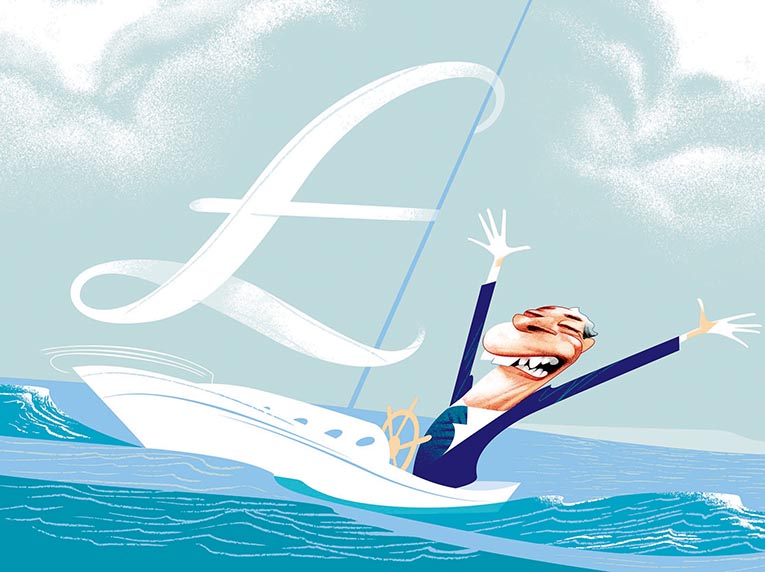
“There’s no money in politics,” Nigel Farage told an American podcast at the beginning of June 2024. The show’s host, a bearded, despot-curious YouTube contrarian, raised his eyebrows and made an odd little noise, but Farage added: “… if you’re straight. If you’re corrupt…” and then it’s hard to make out the rest of the sentence, his words lost in cigar smoke and croaking batrachian laughter. Still, life outside party politics was going well. “For the first time in 30 years,” he said, “I’m earning good money.” And yet, in the same week the podcast aired, he announced his return to the fray as Reform UK’s leader and candidate for Clacton. By sheer coincidence he had, some weeks earlier, been given £5,000,000 by his main political sponsor.
It’s debatable how much money there is in politics, but there is unquestionably money in being Nigel Farage. That £5m came from the Thailand-based cryptocurrency billionaire Christopher Harborne, who is (whether you include the £5m as a donation or not) the biggest individual donor in the history of British politics. Harborne has given £25,740,000 to Farage, Reform UK and his party’s previous incarnation, the Brexit Party; he also gave the office of Boris Johnson £1m in November 2022, then the biggest ever donation to an individual MP. The question of whether Farage’s five mil should have been declared (MPs are supposed to register any “personal benefits” they have received in the year before they were elected) is currently in the hands of the parliamentary standards commissioner.
It was for Nigel’s protection, apparently: Harborne told the Telegraph the money had been given to Farage with the object of “ensuring his safety”. During the 2024 election campaign, Harborne had seen first hand the danger Farage was in when a 25-year-old OnlyFans model threw a McDonald’s milkshake at the Reform leader outside a Clacton Wetherspoons. Perhaps when Farage is prime minister, Harborne – whose investments include a significant stake in the laser weapons company QinetiQ – can supply him with a laser turret to vaporise non-alcoholic beverages entering his airspace.
As the public has become more interested in the gift, Farage has further explained it (in an interview with the Sun) as “a reward for campaigning for Brexit for 27 years”. Because that’s what you do when you admire someone’s principles: you give them five million pounds. It’s just good manners! Anyway there is, according to Farage, a piece of paper that says he doesn’t have to do anything for the entirely non-political pile of money Harborne (coincidentally the biggest spender in British politics) gave him for entirely non-political reasons.

“I can’t be bought by anybody,” Farage declared, a phrase – along with “I’m definitely a qualified surgeon” and “there’s no proof I poisoned him” – worded to offer reassurance, but which invites further questions. According to his many submissions to the MPs’ register of interests, Farage’s time is very much for sale. Since he was elected as an MP in July 2024, he has recorded 1,513 hours of work for people other than the voters who elected him. Over the roughly 400 working days (minus statutory holiday requirements) in that period, that’s more than three and a half hours per day of additional work. What a grafter! Parliamentary surveys have found that MPs commonly work more than 60 hours per week; if Farage was working as hard as the average backbencher for his constituents, he’d be putting in 16-hour days.
There’s reason to suspect he’s taking it a little easier than that – he has voted on 69 of 206 possible occasions and does not, unlike most MPs, meet constituents in a weekly “surgery” – but even so, Reform’s leader certainly keeps himself busy. Perhaps this helps him understand the lives of people in the UK who work multiple jobs to make ends meet. Although in Farage’s case, it’s not so much making ends meet as tying ends up around a huge bag of money: he’s declared £1.65m of additional earnings on top of his MP’s salary (£98,599) during the period.
Among all this extra work are 261 hours of videos recorded for the Cameo app in which Farage was paid to wish people a happy birthday, or to give a shout-out to a far-right rally, or to say almost anything; one early review from a paying customer complained Farage had only partially read out the requested message – although the commission “referred to beastiality [sic] to be fair so understandable perhaps”.
Some of his work commands incredible hourly rates. As a “brand ambassador” for Direct Bullion Ltd of Mayfair (also owned by a cryptocurrency investor), Farage registered £415,500 for just 12 hours’ work. Of course, this rate reflects far more than just a day or so of the Reform leader’s time; like Beyoncé making millions for a single show, this is a whole career paying off. Farage himself recognised this when he wrote to the parliamentary standards commissioner (who had found that he had breached the MPs’ code of conduct 17 times in failing to report £380,000 of income on time) about why he was making so much money: “I’m making it because I’m Nigel Farage.”
When Farage speaks to people in Clacton about all the money he makes, they say: “Good luck to you, mate.” Or so he told the Sun, before adding, sotto voce: “No one cares.” And then, taking a leaf from the Nixon playbook: “They care if you’re a crook. Which I’m not.”
Perhaps Farage is right when it comes to people not caring about his money. No one cared when he was found to have opened a trust fund in the inheritance-tax-free Isle of Man in 2003, about which he later said he “felt uncomfortable” (but not so much as to prevent him from setting up the vehicle). No one cared when, in 2020, he monetised his fans by flogging them high-risk personal investment ideas for £199 a year (readers may not be surprised to learn that these ideas included investing in cryptocurrencies). The questions over his claim to have “bought a house in Clacton” that turned out to be owned by his partner (meaning no additional stamp duty was paid) did not prove nearly as damaging as the questions over Angela Rayner’s stamp duty (which she has since settled with no penalty).
On the contrary, Farage’s personal finances are part of his brand. When he was asked to move on as a customer of Coutts, the posh bank, he was able to whip up a “debanking” scandal, aided by the spectacular arrogance and carelessness of NatWest Group’s then-CEO, who told a senior BBC journalist over dinner that Farage didn’t have enough money to qualify for a Coutts account. (Incredibly, neither the head of one of the UK’s largest banking groups nor the BBC’s business editor seemed to realise telling the public about the amount of money in someone’s bank account was a GDPR nightmare.)
The money is also part of what he wants for the country. He reveres Thatcher, although her path in life (from above a grocer’s shop to an Oxford scholarship) moved in the opposite direction to his (from public school to the London Metals Exchange). Thatcher trained the working-class Midlands accent out of her voice; he has tried to obscure his plummy diction with ciggies and gin. But he embodies the Britain she created, a nation in which money takes on its own moral importance, in which grasping and getting are self-evidently correct, in which every City boozer rings with the chant: more, more, more.
[Further reading: Silicon Valley’s “Get Rich University”]
Content from our partners



Related
This article appears in the 20 May 2026 issue of the New Statesman, Definitely, maybe
Join the debate
Subscribe here to comment