
In September 2022, 17-year-old Theo Baker arrived at Stanford University in California to start his freshman year. He was a self-confessed nerd who loved spending long hours delving into computer coding. To have a hobby, he joined the student newspaper, the Stanford Daily. Within weeks, he was on the trail of a story that would, despite much obstructive resistance from the university administration, send shockwaves through both Stanford and the larger world of scientific research. As a result of Baker’s sleuthing, the university’s president, Marc Tessier-Lavigne, an acclaimed neuroscientist who once was thought to be on the way to discovering a cure for Alzheimer’s, was forced to resign. Baker had not even finished his first year as an undergraduate when he won a George Polk Award – the first student journalist ever to receive this accolade (the Polk Awards are the Oscars of US journalism).
Here is what Baker discovered. There had been significant weaknesses or irregularities in some of Tessier-Lavigne’s most celebrated scientific articles over two decades, but at the time questions about these potential flaws had been ignored or covered up. The science was highly technical and the practice of multiple authorship of scientific papers clouded the issue of who was responsible – but some data had been misrepresented, perhaps unwittingly. The failure to properly investigate doubts over the reliability of widely cited papers that were the foundation of a hugely successful career (in financial as well as academic terms) raised ramifying questions about procedure and publication more generally. Initially, Baker was faced with refusals of cooperation, followed by denials, followed by legal threats from representatives of one of the country’s most feared law firms. But he pressed on, trawling the internet for details that had escaped most people’s notice, amassing evidence from interviews with sources who spoke only on condition of anonymity and submitting his drafts to experienced editors and legal advisers whose goodwill was one of the Daily’smost valuable assets. Eventually, Stanford’s trustees set up a committee of enquiry to look into Tessier-Lavigne’s record. Such investigations can often involve putting a respectable public face on a whitewash, but Baker’s continuing documentation of damning material forced them to conclude that the game was up, even though it ultimately could not be proved that Tessier-Lavigne knew about any of the manipulation involved in his published research. In July 2023, nine months after Baker’s first article, Tessier-Lavigne resigned as president, though he remained on the Stanford faculty. (Nine months later, he raised $1bn to found yet another new company.)
The determination, resourcefulness and sheer courage shown by a young man who turned 18 in the course of that year is remarkable (it no doubt helped that both his parents hailed from that once-fine newspaper, famed for its investigations, the Washington Post). His memoir How to Rule the World is not afraid to milk every moment in novelistic fashion, complete with ostensibly verbatim, though implausibly extensive, dialogue. For all its narrative dash, the true significance of Baker’s book lies not in the story of a brave student journalist nor in the size of the scalp he eventually claimed, but in what it reveals about the ethos of the institution now routinely referred to as “America’s top university”.
Stanford is no longer “the Harvard of the west”; Harvard is now “the Stanford of the east”. We are not talking about the Stanford of a couple of generations ago, nor even the Stanford of 20 years ago. Between 2013 and 2024 its endowment grew by $9.9bn; today, Baker reports, “the university’s annual revenue is nearly twice that of Harvard or Yale, despite educating about the same number of students”. The institution’s annual budget is now greater than that of 116 countries.

The key to Stanford’s transformation is its close, even symbiotic, relationship with Silicon Valley (much of which is housed on Stanford land) and its decision in the 1970s to own the patents of inventions by its staff and students. As Baker puts it: “Perhaps the greatest, if not fully appreciated, key to Stanford’s ascension has been its approach to intellectual property”. Stanford graduates (and, feeding the legend of the lonely genius, Stanford dropouts) created the majority of today’s big-name technology companies, from Hewlett-Packard to Google, Palantir and Nvidia. So potent is the myth of the student who is too brilliant to waste time getting a degree that the Thiel Fellowship, a programme started by the PayPal co-founder Peter Thiel, pays $250,000 to students under the age of 22 to drop out of college.
There is one term that sends a tremor of arousal the length of Silicon Valley, a term signifying the focus of worship in the region’s religion as well as the ultimate accolade for the ambitious Stanford student: a start-up. All it takes is an idea, or even the sketch of an idea, or even the hint that you might one day come up with the sketch of an idea. Then the venture capitalists who swarm across the Stanford campus every day looking to have coffee with the most promising undergraduates will pile in with the money. Many of the most ambitious students will have founded at least one company by the time they graduate, lavishly backed by optimistic venture capitalists hoping to get in early on the Next Big Thing. A start-up that races to a valuation of $1bn is known as a “unicorn”; as Baker wryly notes, at Stanford a unicorn is a status symbol. One of Baker’s fellow students summed up the spirit of these transactions: “I just want to get, like, filthy rich.”
Stanford, as Baker illustrates in shocking detail, “is awash in money”. Big bucks are everywhere, starting with the cost of being a student there in the first place: “the sticker price to attend Stanford is now higher than $95,000 a year”. Perhaps not surprisingly, “Stanford’s faculty is the richest professoriat in the world”. For example, one professor mentioned in the book who taught full-time at the university for decades “amasseda fortune worth more than $20bn”, largely by investing in the companies he or his students set up. Tessier-Lavigne, too, was very far from the stereotype of the underpaid academic: as a result of various commercial ventures growing out of his research he has a “current net worth north of $500m”, according to his tormentor’s enquiries.
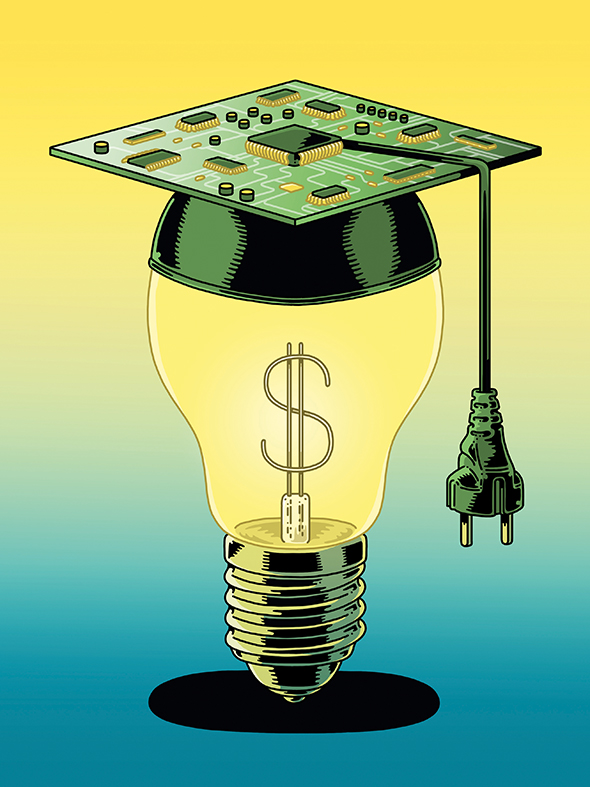
Nowadays, the university’s biggest business is selling talent: in the new economy, ideas are the source of value, and Stanford students are seen as being the greatest concentration of relevant talent (the university takes in just 3.6 per cent of applicants). An article in the New Yorker entitled “Get Rich U” described the university as “a giant tech incubator with a football team”. The excitement associated with the explosive growth of spin-offs from its computer science and engineering courses has dramatically transformed the intellectual character of the university. As Baker observes:
Stanford today has more professors in the philosophy department than it does graduating seniors majoring in philosophy… As recently as 2008, the history department graduated more seniors than the computer science department. Now there are 16 times as many graduates in computer science as in history – 341 to just 21 in 2025.
The stench of big money fuddles students’ choices, you say? But hey, this is the United States in 2026, where finance capitalism is the only game in town. “How many military divisions has the pope?” was supposedly Stalin’s dismissive retort to claims about papal power. “How many unicorns have come out of the history department?” might now be Stanford’s equivalent.
Intimate links between big business and America’s top private universities are nothing new. The social theorist Thorstein Veblen detailed them over a century ago in The Higher Learning in America: A Memorandum on the Conduct of Universities by Businessmen (1918), denouncing the “expedients of decorative real estate, spectacular pageantry, bureaucratic magnificence, elusive statistics, vocational training, genteel solemnities and sweatshop instruction [that] may be imposed by the exigencies of a competitive business policy.”
But now, not only is the financial scale of a quite different order but the nature of technological advance itself changes the relationship. The expansion of US higher education after 1945, especially the growth of its world-changing research culture, depended on a partnership between public authorities and private finance. Now, suggests Baker, that compact may be breaking down: AI requires “so many resources that only the private sector can lead the way”. It is that thought, rather than the Promethean capacities of AI itself, that should really set alarm bells ringing. Start-ups are not charities. Capital does not have our interests at heart.
According to the enquiry into the charges against him, Tessier-Lavigne had, in his labs, created a dynamic “that tended to reward the ‘winners’ (that is, postdocs who could generate favourable results) and marginalise or diminish the ‘losers’ (that is, postdocs who were unable or struggled to generate such data)”. It was this dynamic that helped explain “the unusual frequency of manipulation of research data and/or substandard scientific practices”. This judgement was surely more damning of the whole ethos of the “entrepreneurial university” than its authors may have intended. Still, it should be acknowledged that Stanford’s trustees did, in the end, conclude Tessier-Lavigne’s doubtful record was not compatible with his remaining president, emphasising that commitment to the ideal of scholarly enquiry has to be at the heart of any university worthy of the name.
Although Baker does not couch it in these terms, that tension between ethos and ideal is what makes this book of more than topical significance. There are no doubt distinguished professors at Stanford doing excellent work in their fields, and presumably many clever students getting a good education. We have to hope that in this way universities will, in practice, stubbornly cling to the scholarly ideal in the face of passing fashions, bullying governments or the seductions of great wealth. But what if we get to a point where nobody studies history or philosophy, and every student has to found a company in order to graduate?
Those intent on pouring resources into “Silicon Fen”, the UK’s answer to Silicon Valley, focused in Cambridge, would do well to ponder this book. An obsession with “economic growth” can misdirect the efforts of universities as well as governments. In medieval legends, a lot of time is spent hunting for unicorns; modern universities have more important things to do.
How to Rule the World: An Education in Power at Stanford University
Theo Baker
Allen Lane, 336pp, £18
Purchasing a book may earn the NS a commission from Bookshop.org, who support independent bookshop
[Further reading: America is rising against Trump]
Content from our partners



Related



Join the debate
Subscribe here to comment