
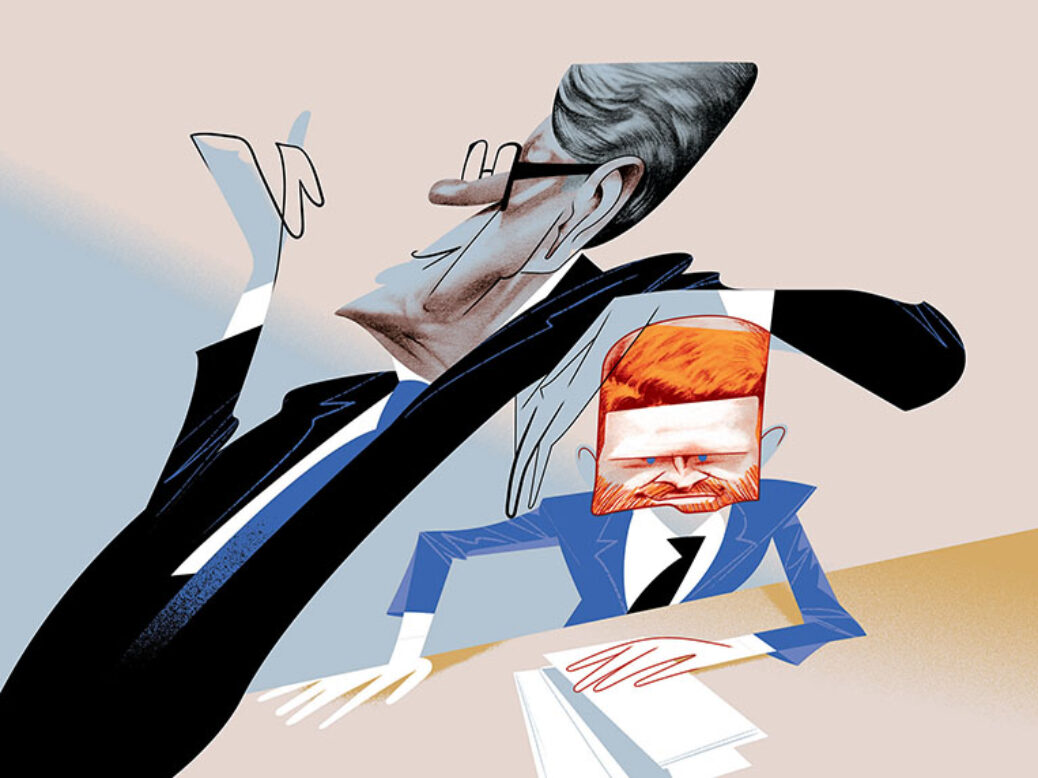
The members of the Nursery Oversight Committee are now clear that it would in retrospect have been possible to make a better decision than appointing the primordial titan, Kronos, to run the Baby Room. The previous manager, Susan, was experienced and well liked. Kronos was known to the public for having devoured his own children as soon as they were born, in a failed attempt to thwart an ancient prophecy (a story confirmed by a number of well-known paintings). These actions had been recognised in the due-diligence check on Kronos, as were other issues (castrating his father with a sickle, impregnating his sister), but the thinking was that this had been a long time ago, he had since disgorged the children, and that an elder deity like Kronos would bring serious name recognition. This was indeed the case – but, as it turned out, for exactly the wrong reasons.
Morgan McSweeney expressed a similar sense of wounded mystification at the end of April as he became the latest person to take a seat in front of the Foreign Affairs Select Committee to explain that while they had all heard of Peter Mandelson, they had also been involved in the appointment of Peter Mandelson as ambassador to the US, despite checks which revealed that the things many people already knew about Peter Mandelson were still true.
The live viewing figures on BBC Parliament and the YouTube livestream of the committee suggested that at least 10,000 people were ready to watch the committee hearings on the morning of Tuesday 28 April. It was to be a big day for political intrigue. The committee hearings would be followed by a debate, and a vote, on whether Starmer would be investigated by another committee for the statements he’d made about appointing Mandelson. Incredibly, it did not seem at all certain that Starmer, who has 403 MPs, would win this vote. BBC News ramped up the tension from the beginning by showing a picture of McSweeney wearing a tuxedo and a brooding – perhaps Machiavellian – expression.
But Morgan McSweeney is no Malcolm Tucker, the sweary, conniving spin doctor of the uncomfortably realistic Westminster comedy The Thick of It, nor is he Alastair Campbell or Dominic Cummings. He’s a quietly intense political nerd, who declared earnestly: “I did not swear at Sir Philip Barton. I did not swear at Sir Olly Robbins, either.” His testimony was not so much a prickly defence as an admission that he and his Prime Minister had been taken for fools. He rejected “this mythos that’s been built” that Mandelson had been “some sort of guiding hand behind me, on my strategies or my life”; Mandelson, he said, was “not a fan of what I was doing” with his think tank, Labour Together. “I don’t think he backed Keir Starmer to be leader of the Labour Party.” He has dined with Mandelson four times, that he can recall.

Mandelson soon took an interest when electoral victory became a prospect, however. Before a general election, the opposition party holds “access talks” with the civil service so that they can begin governing promptly if they win. It was in the spring of 2024, before Labour came to power, that Labour began to discuss who might be the best ambassador to the US, and that this might be a political appointment by the Prime Minister, rather than by the usual civil service process. At some point after this, someone began suggesting that Peter Mandelson was the obvious choice. That person, McSweeney revealed, was… Peter Mandelson, who began a conversation with himself, and then a lot of other people, “making it clear that he was interested in the job”.
As McSweeney spoke about the chain of events that somehow led to the man known as the “Prince of Darkness” being appointed to the most sensitive position in British diplomacy, there were flashes of Mandelson’s brilliance as a lobbyist. In September of last year, for example, after Angela Rayner’s resignation, Starmer and McSweeney were busy reshuffling the cabinet. For some reason, Mandelson was also in the building. “I don’t know why he walked into No 10,” McSweeney said. Mandelson was not in the reshuffle meetings, nor did McSweeney consult him, but simply by hanging around near the centre of decision-making, he cultivated the impression that he was still pulling strings.
The process by which Mandelson was appointed seems also to have involved a masterful fait accompli. The one credible reason McSweeney gave for appointing him was that as a former EU trade commissioner, he might get the UK a trade deal. Surely there were others who might have achieved the same aim, but somehow, the process came down to two candidates: Peter Mandelson and George Osborne. How is it that they didn’t consider a third candidate, someone who might have seemed less toxic to the public? Perhaps the reanimated corpse of Oswald Mosley, or just a writhing mass of hagfish? It’s true that robo-Mosley is far from perfect – and a single hagfish can produce a bucketful of slime in a fraction of a second – but the big point in favour of both candidates is that neither of them are George Osborne.
And so it was that, despite a due-diligence file containing more red flags than Beijing on National Patriotic Flag Day, Mandelson became the preferred candidate. McSweeney travelled to the US to gather opinions, which ranged from “who?” to “meeehhh”; no one seemed particularly enthusiastic about the UK being represented by the man who would become known to the Trump administration as “Sneaky Pete”. And the evidence of his relationship with Epstein was already there, in a report commissioned by the US bank, JP Morgan, which showed that Mandelson had stayed at Epstein’s house in 2009, after the financier was jailed for child sex offences.
The committee circled for some time around the question of how a person in the public eye could possibly think it was a good idea to go for a sleepover at the home of the world’s most notorious paedophile. You can’t just let someone with a known relationship with Jeffrey Epstein and business links to our geopolitical enemies wander into a crucial political position, least of all in America! They’ll think you’re copying them!
But like Starmer, McSweeney seems to have trusted in the process, which does not appear to have been sufficient, and – more naively – in Mandelson himself. “I thought he cared about his party and he loved his country,” McSweeney said, “so I banked that he would at least be honest with his Prime Minister.” When the truth emerged, he said, “it was like a knife through my soul”.
Clearly, the most troubling thing about the Epstein scandal is – as McSweeney rightly said in his opening statement to the committee – its effect on the many victims of a long series of horrifying crimes against women and girls. But for McSweeney, author of the “Ming vase” strategy, it also represents a bleak truth: the recognition that victory was not enough, that without a project, all the government he helped bring to power has to say is that it is sorry for its bad decisions. That the vase, on closer inspection, is empty.
[Further reading: Morgan McSweeney has no one to blame but himself]
Content from our partners


Related

Join the debate
Subscribe here to comment