
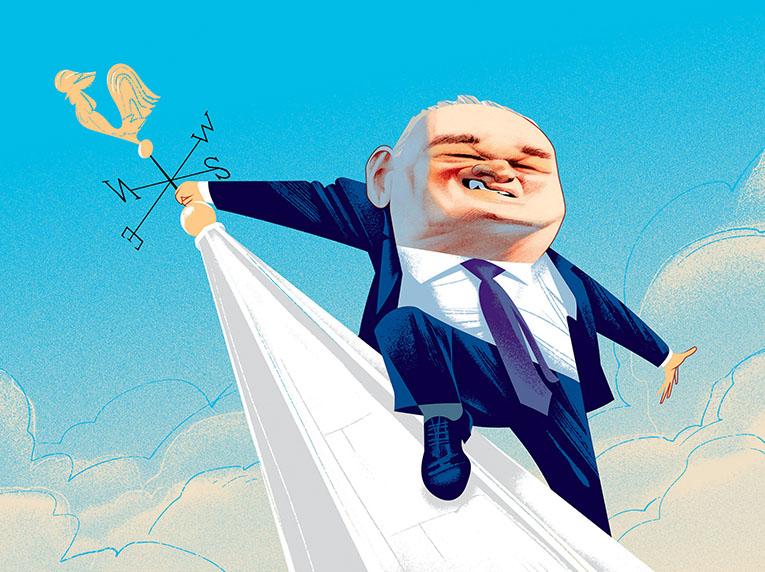
The scene begins: an average house in the county of Normalshire, Middle England. A letter lands on a doormat. The camera leans forward to read the front. It looks like a polling card… Then – argh! – it’s Kemi Badenoch! What’s she doing in the hallway? The camera backs away as Kemi starts talking about why Britain needs to get serious. Into the kitchen now, where – woah! – Mel Stride is sitting at the dining table, frowning at a laptop. “You can’t keep spending money you don’t have,” says the shadow chancellor, who seems to have gained access to your online shopping history. The camera whips between Kemi and Mel, then – whoosh – flees to the nursery, where the shadow education secretary, Laura Trott, looks eerily calm. She is placing David Cameron’s autobiography next to a coloured abacus. The camera heads desperately for the front door, but… shit! It’s the shadow home secretary, Chris Philp! And he’s closing a window, even though the house is already guarded by two framed photographs of Kemi Badenoch. “Rules only matter if they have consequences,” says Philp, with the air of a man from whose cellar you have unsuccessfully attempted to escape. At last the camera makes it outside, but the shadow energy secretary, Claire Coutinho, has the hood up on the car. This vehicle, her expression says, is going nowhere.
This disturbing psychological thriller, shown by the BBC as part of the broadcaster’s “party election broadcast” season, perfectly encapsulates the claustrophobic sense of horror a viewer might feel when confronted by the idea of a Conservative government. It makes for challenging viewing; most audiences will find it, at four minutes long, unwatchable in one sitting. There are moments of satire, however – “No empty slogans,” Badenoch intones, before reeling off no less than eight empty slogans – and the feeling of seeing it through is cathartic: the relief of waking up from a nightmare.
If you prefer to watch drama in the Greek tradition – tragedy for main course, comedy for pudding – then it’s important to follow up a Conservative Party election broadcast with one from the Liberal Democrats. When it comes to visual imagery, the Lib Dem approach is to represent political ideas in the bluntest and most obvious manner possible. If there is political dialogue about a “Blue Wall” of Conservative constituencies, the Lib Dems will literally build a blue wall of bricks and get Ed Davey to push it over.
It’s for this reason that the Lib Dem’s local election broadcast starts with Davey quoting Badenoch’s criticism of his party – that they are parochial do-gooders, preoccupied with “fixing the church roof” – while literally standing on a church roof. “We don’t sneer at local people,” says Davey, as the video cuts to some footage of him handing a local person a slice of Victoria sponge cake beneath a fluttering string of Union Jack bunting.

Community politics, Davey tells the viewer, is about “hearing your concerns”. And there he is, hearing them: Davey in a hi-vis tabard, looking at some houses; Davey in a wax jacket, frowning at a river; Davey holding a coffee and pointing at a small business. In one shot, Davey is dressed up as a paramedic, which is a step too far: he’s welcome to try his hand at paddleboarding or flower arranging, but emergency field medicine should be left to the professionals.
The Green Party’s pre-election broadcast begins with Zack Polanski walking a dog over a bridge in London. This is not Polanski’s dog, although the video doesn’t explain this. The animal, whose name is Will (how flattering), belongs to Hannah Spencer, the Green Party MP. Polanski holds forth on why two centuries of the two-party system must now come to an end; the animal whines with frustration.
In the Victoria Tower Gardens beside the Palace of Westminster, Spencer emerges from parliament and Polanski tells her he’s brought her a “luxury lunch” of sausage rolls. Then he starts feeding them to Will, and Spencer conceals her disappointment. Over the sound of a dog chewing a mouthful of minced pork, Polanski asks Spencer: “What’s it like in parliament?” This is a helpful reminder for viewers that the Green leader doesn’t spend much time in parliament, because he’s not an MP. The two Greens look wistfully up at the Palace of Westminster. “We just need more normal people in there,” says Polanski, a former travel agent, breast-enlargement hypnotist and immersive-theatre performer who wants to legalise crack cocaine.
How did parliament become “so disconnected”, from the lives of normal people, Polanski asks, like the normal plumber that Spencer was until she became an MP? “I have no idea how we ended up here,” she replies, “but we have to change it.” Say what you like about the Greens, it’s refreshing to see a politician say openly: “I don’t understand the context of this situation, but I’m certain I represent the solution to it.”
The hardest thing to say about the party election broadcasts is which of them is worst: they are all awful in their own way, as party political broadcasts always have been. When these short TV spots began in 1951 they were mostly stentorian lectures on policy, but during the 1970s the advertising industry got involved, and they became promotional material. When they are memorable – such as the Tories’ 1997 “New Labour, New Danger” ads, in which a pair of demonic eyes appeared in various situations before hovering over the Houses of Parliament – it is for their awfulness.
This year, the most depressing message came from Reform UK, which used one of its three broadcast slots for a video in which Robert Jenrick promised the nation’s retirees that his party would protect the interests of pensioners over anyone else in society. As Jenrick spoke, the video showed a nation grumbling itself into the ground; men of retirement age reading newspapers and shaking their heads, mottled hands counting cash. Disability benefits would be cut, the natural world would be sacrificed, but Jenrick and his pals wouldn’t take a penny from people who had “paid in their whole lives” (this isn’t how the state pension works). The woke civil servants, the young, the foreigners: they would pay, somehow.
Worst of all, however, were Labour’s broadcasts. The first involved Keir Starmer standing in front of some flags. “I could give you so many reasons to vote Labour,” the PM said, pinching the air in front of him, but he didn’t. Instead he talked about how Nigel Farage and Kemi Badenoch would have been worse at foreign policy than him. The second was worse still: an actress sits with a pint, reading out a selection of the offensive things Reform’s MPs and senior figures have said. No policies, no plan, no hope: the government presented simply as the lesser of two evils.
As American politics has demonstrated for at least a decade, this approach doesn’t work. Voters who support offensive men do not change their minds when the offensive men are caught saying offensive things. That’s what they like them for! And if an incumbent government threatened by an upstart populist party does nothing more than ask its voters: “Are you sure you want to vote for those guys?” it should not be surprised when many of them say yes.
[Further reading: Why the right is obsessed with Angela Rayner]
Content from our partners

Related
Join the debate
Subscribe here to comment