
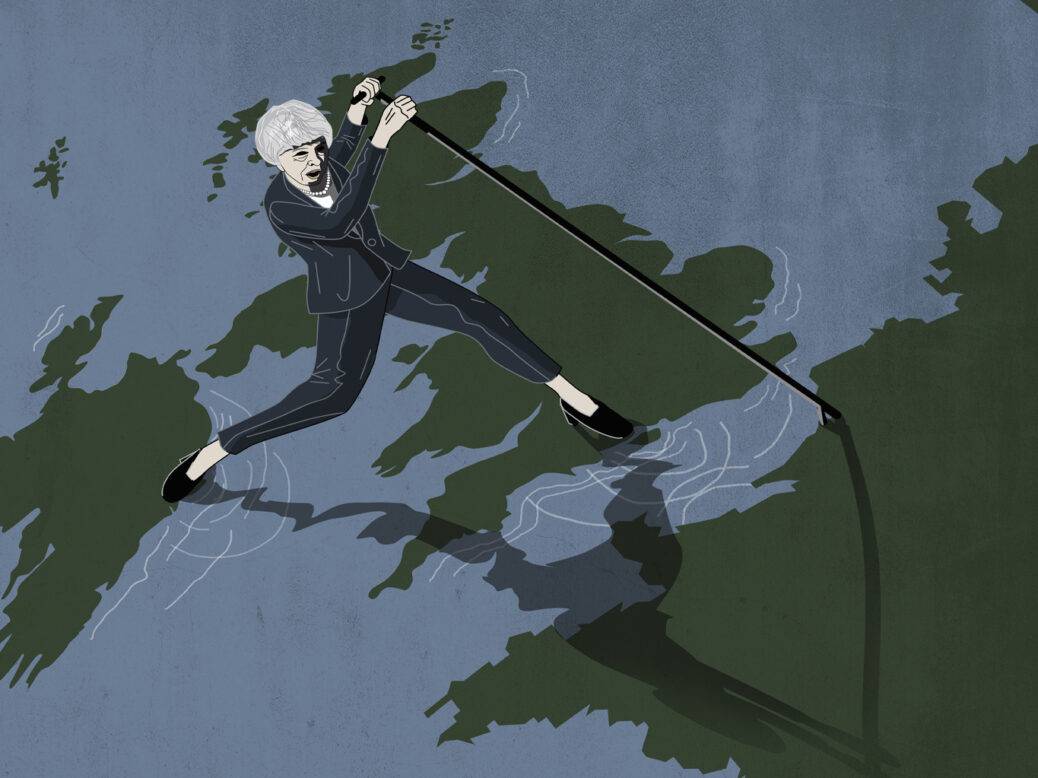
It was supposed to be simple. Britain would leave the European Union and send all that money back to the NHS; the EU-UK trade deal would be “the easiest in human history” according to Liam Fox; and the 300-mile border between Northern Ireland and the Republic would be an issue so trifling that no one in Great Britain was even minded to bring it up before the referendum.
If it just weren’t for the meddling Irish! If in 2018 you survived on a media diet of Telegraph columns and broadcast hits from Steve Baker and Jacob Rees-Mogg, you might reasonably believe that the Troubles and the subsequent peace arrangements were works of fiction cooked up in a lab by Michel Barnier to thwart the smooth passage of Brexit. The border was a non-issue, maliciously wielded by Berlaymont to force the single market on Britain and disrupt the course of its democracy.
In this great European plot, Leo Varadkar was accused at once of being a “useful idiot” and a conniving operator. Most people would find it hard to be both, but Varadkar was an unusual politician. Gay, half-Indian, only 38. What happened to that homophobic island, under the cosh of Rome, run amok with unruly Celts and roguish politicians like Bertie Ahern? No, Varadkar wore a good suit and spoke in a clipped, non-lyrical accent. At 6 ‘4”, he might have been the tallest Irishman anyone in Britain had ever met.
But had Ireland, out of Westminster’s eyeline, changed? No one had really looked since the 2010 bailout, and even then it was only a passing glance. Perhaps the most recent concerted study was when Dublin and London collaborated on the Good Friday Agreement in 1998. A world away now. In 2017 Varadkar walked into the consciousness of Great Britain like he was on day release from McKinsey and announced a new Ireland – managerial, rich, with allies on the continent. Troubled by this development, Boris Johnson spluttered back “why isn’t he called Murphy like the rest of them?”
We don’t need to relitigate the finer details but what happened next was an almighty diplomatic mudslinging party. Theresa May’s former chief of staff, Nick Timothy, wrote in the Telegraph that Varadkar “doesn’t understand the Good Friday Agreement” while Conservative Party Historian Simon Heffer said he was “wrong to disregard the ancient ties between Britain and Ireland”. The Sun called Varadkar’s efforts to “wreck” Brexit a “suicidal failure of statesmanship”.

And what, exactly, were these wrecking efforts? Before the referendum was called, the Irish delegation in the European Union had the foresight to convince other member states that there could be no return to a hard border on the island – the region is too unsteady, only recently at peace, long awaiting real reconciliation. Soon after that, Theresa May painted herself into a corner when she said the imposition of a border in the Irish Sea is something that no prime minister could accept. The catch, of course, is that there has to be a border somewhere between the European Union and the country that voted to leave it. The conclusion? A toppled prime minister, Boris Johnson, a few more years of arguing, a fudge with Northern Ireland in the customs union and no hard border on the island. Varadkar won his argument and altered the trajectory of British politics.
Maybe it is all in the telling. But behind the accusations of venality and perfidity and bad faith, something more significant was happening. Yes, the Brexiteers accepted that they had perhaps undercooked the significance of the border. But more than that, Varadkar’s successes forced a realisation that Ireland was no longer reliant – diplomatically, economically – on the United Kingdom. Perhaps the Conservatives expected Ireland to be supine: neither powerful nor willing enough to make its case. These oldest and closest neighbours wouldn’t turn on each other, would they?
Well, in the time when no one in Westminster was looking, Ireland had transformed itself into a rich nation with professional diplomatic channels to the continent. This made it both powerful enough and totally willing to make its case on the Irish Question – and to defy the patronising expectation that Ireland didn’t have its own interests to defend. Dublin loves the EU because – through solidarity and the single market – it amplifies the voice of otherwise small countries. Perhaps there is sanity behind the Brexiteer conspiracy: EU membership did allow Ireland to frustrate the whims of Brexiteers.
Out of their view, Ireland had been slowly disentangling itself from its neighbour, becoming – while not quite a European country – less and less of a British one. The United Kingdom hadn’t gone through this psychological process, and was blindsided to learn in 2017 – by a Taoiseach with a confusing, foreign name – of Ireland’s quiet revolution. And there was the new political reality, laid bare: the former colony was central to the great constitutional maelstrom. And this time, it called the shots.
[Further reading: The timeline: How Starmer lost control]
Content from our partners


Related
Join the debate
Subscribe here to comment