
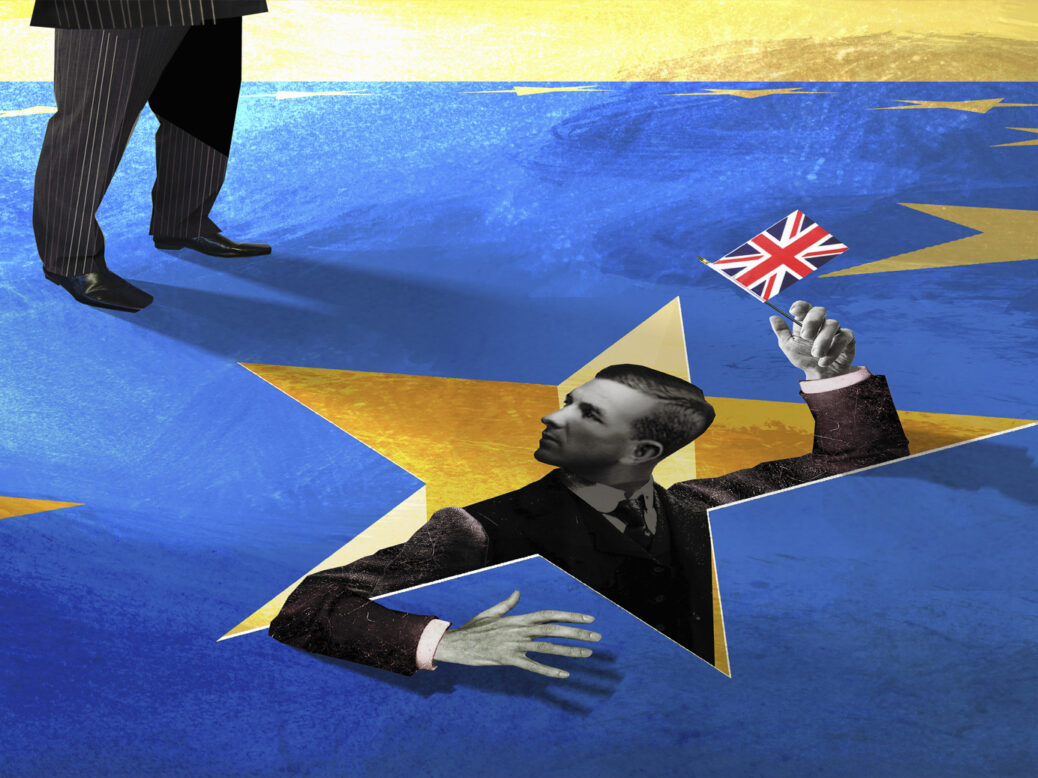
“This Labour government will be defined by rebuilding our relationship with Europe, by putting Britain at the heart of Europe.” To prove his sincerity for his premiership-salvaging speech yesterday (11 May), the Prime Minister had dispensed with the tie and rolled his sleeves up. But this was what young people call “vibes”. It was not policy. Clearly Keir Starmer would like to see the UK have a closer relationship with the EU. Doing so, however, will mean going beyond empty platitudes.
And platitudes we have had in abundance. “Make Brexit work,” declared the Labour manifesto of 2024, an implicit recognition, if nothing else, that Boris Johnson and his successors had failed to “get Brexit done”. Yet, two years on, and even Starmer’s slogan is proving tougher to turn into reality than its drafters might have hoped. The search for a stable equilibrium in UK-EU relations goes on.
Having promised to improve relations with the EU, to tear down unnecessary barriers to trade, the government now finds itself in something of a bind. The status quo is unsatisfactory, with progress to date on the “reset” of relations with the EU yielding only negligible economic gains. Yet further progress in easing trade frictions will involve painful trade-offs. And they will hinge on the willingness of the European Union to make room for solutions which promise meaningful economic results while respecting the red lines Keir Starmer and his team laid down so carefully and so deliberately ahead of the last election.
This matters more than it usually would in the context of today’s politics. Labour, fresh from their drubbing in the local and devolved elections, are not only after a source of growth but also a way to lure back disaffected progressives. A recalibration of relations with Europe is one approach under consideration. And it is an approach that will be turbocharged in the event of a leadership election that will see a disproportionately Europhile membership choose our next Prime Minister. So, where have we got to? What are the options open to us? And what might they entail?

“Making Brexit work”, it transpired, meant tinkering with the Trade and Cooperation Agreement, attempting to negotiate away some of the impediments to trade it imposed in certain specific – and limited – sectors. And this had to be achieved in a manner consistent with the manifesto’s stipulation that there would be no return to “the single market, the customs union or freedom of movement”. The very wording betrayed a certain ignorance. Membership of the single market and the customs union are the preserve of member states and members of the European Economic Area.
And the record to date? The tone of the relationship has certainly shifted. That process had already started under Rishi Sunak, but it has continued apace under Starmer. Relations with both the EU and member states are clearly warm (reflected not least in sheer number of bilateral agreements signed with the latter). Yet in substantive terms, the picture is more limited. All we have to show for the reset so far is a deal on fisheries that the French pushed for, a Security and Defence Pact that, if not exactly generic, was hardly ambitious either, plus an agreement on UK participation in the Erasmus exchange scheme which – and I’ll come back to this – came at a considerable cost. In addition, negotiations are currently ongoing on several other subjects, ranging from an agricultural deal to possible UK participation in the EU’s energy market to the details of a “youth experience” scheme. It’s not entirely clear how these will end – or indeed whether a summit tentatively planned to declare victory will go ahead.
However, one thing has become clear from the process thus far. We have discovered (again) that negotiations with the EU are tough. And that these talks matter more to us than they do to Brussels. The sense of urgency that was increasingly apparent on the UK side after the May 2025 summit was simply not reciprocated in Brussels. As London chafed, the Union took months to even come up with negotiating mandates for talks on agriculture or the linkage of UK and EU Emissions Trading Schemes. The UK is not a priority in the EU.
Equally, those areas in which the EU has agreed to carry out negotiations on greater single market access are all sectors where agreement would help ease the functioning of the GB-NI border. Allowing the UK selective access to the single market, then, is acceptable if it serves the EU’s purpose. None of which is to say that there aren’t benefits to be had. An agrifood deal will help the sector and potentially impact on food prices. A deal on UK participation in the EU’s electricity market will have significant impacts in terms of energy security and encouraging investment in the North Sea.
However, the bottom line is that the EU is far more satisfied with the status quo than is the UK. Brussels has hinted that if it cannot get the one thing it really wants from the talks – a youth experience scheme that (as far as the EU is concerned) must involve EU students being able to pay domestic fees at UK universities – they’re not going to simply hand over those the British government hankers after, such as a deal on agriculture.
So, success – even when it comes to the limited agenda so far agreed – is far from guaranteed. But let’s assume the talks succeed. The summit goes ahead and the various deals – on agriculture, youth mobility and so on – are unveiled. Then what? The UK government have made it clear that they see these negotiations merely as the starting point for a more ambitious agenda.
Indeed, it’s notable just how much the tone in London has changed over the last few months. Keir Starmer recently told a news conference that Brexit did “deep damage to our economy”, a claim fleshed out some weeks beforehand by his Chancellor, who argued that Brexit had led to higher “costs for businesses and therefore higher costs in our shops”. She not only cited the 8 per cent figure that lies towards the top of the range amongst economic studies for the effect Brexit has had on the UK economy, but referred to a deeper trade relationship with the EU as the “biggest prize”.
So why this shift? Partly because Ministers are coming to realise that their original agenda was simply not ambitious enough for an increasingly insecure world. The actions of the Trump administration, the ongoing war in Ukraine plus, as the Prime Minister has argued, the war in Iran, have added greater urgency to the quest to strengthen UK-EU economic and security ties. Partly too there is an economic issue in the form of the disconnect between claims that Brexit is costing 8 per cent of GDP and a reset which, according to the government’s own figures, will contribute around 0.3 per cent to GDP by the end of the next decade. Ministers are increasingly aware of the need to find a way to narrow that gap.
Finally, there is politics. Even prior to the local elections, the government had become notably more assertive in its tone on Brexit, increasingly deploying it as a stick with which to beat Kemi Badenoch and Nigel Farage. On top of this, its hammering at the ballot box served to underline the fact, highlighted pre-election by John Curtice, that its support has fallen by more among Remainers than Leavers. A more ambitious approach to UK-EU relations is thus increasingly seen as a potential way to woo back disillusioned progressives.
For a combination of these reasons, the government is keen to secure closer security and economic ties with European partners, above and beyond what is currently under negotiation. There is little need to dwell too much on security. The EU is generally receptive to UK requests to participate in initiatives such as the Ukraine loan scheme. While initial negotiations on Security Action for Europe (SAFE, the EU’s $150bn defence fund) did not work out, the indications are that the UK will seek to participate in future funding rounds. And perhaps most importantly, much of the security cooperation going on in Europe bypasses the EU entirely and consequently is much less cumbersome to negotiate.
It is on the economic side that things become more problematic. Rachel Reeves has indicated the direction of travel she favours, speaking of the need for alignment with more sectors of the EU’s single market, with the maintenance of national regulatory autonomy “the exception, not the norm”. (Though we should note the financial services sector represents a large and economically significant exception.) And it’s easy to see why. Bilateral dynamic alignment – where the two sides formally agree that the UK will follow EU rules – across more sectors would lessen the economic impact of Brexit while being – in principle at least – reconcilable with the government’s red lines.
The problem is that this might not be something the EU is willing to give. Brussels has in the past (noting the exception to this rule alluded to above) given short shrift to “cherry picking” – whereby the UK selects bits of the single market with which it wants to align. And it’s worth bearing in mind that this is not a positive sum game. The EU is not interested in what might be economically beneficial for the UK. Rather, member states will consider what they are willing to give based on what is good for them. There are mutterings that even a Swiss-type arrangement – a formal model of cooperation that might in principle be acceptable to the EU, albeit it would not respect Starmer’s red lines – might not be on offer because some member states feel they benefit from the impediments to trade imposed on the UK under the status quo.
Let must just add here that the government would bite the EU’s hand off for the kind of deal that Theresa May negotiated in 2018. That the all-UK backstop was on offer at all bore eloquent testimony to the importance the EU placed on avoiding a border between Northern Ireland and the Republic. The Protocol and subsequent Windsor Framework having addressed this issue; however, this kind of arrangement is no longer on the table.
Anyway, enough reminiscing. The UK now finds itself in a situation where it wants closer economic ties but the kind of model it favours might not be obtainable. And even if it were, this would come at a significant cost. One rather unfortunate contingent circumstance around UK-EU talks is the fact that they’ve coincided with the start of negotiations within the EU over its seven-year budget or Multiannual Financial Framework. And it’s hard to avoid the impression that some member states have come to see the UK, and its desire for closer economic and security ties, as a handy MFF ATM.
As we’ve seen, talks over SAFE broke down even once the EU had backed down from its ludicrous initial demand for a €6bn participation fee. The EU negotiation mandate for UK participation in its electricity market stipulates that any deal would involve UK contributions to EU cohesion funds. And this even though – as with the demand that the youth experience scheme allow EU students to pay domestic fees – there was no mention of this in the 2025 Common Understanding. The British Government has already agreed to pay £570m for one year’s participation in the Erasmus student exchange scheme. Meanwhile, the EU has suggested that, if it were willing to consider the idea of further sectoral alignment beyond those areas already under discussion, this might cost in the region of £1bn annually.
Further cooperation, in other words will come at a price. And there are legitimate questions to be asked as to whether the EU approach is a sensible one. Member states are being buffeted by the same international storms that have contributed to the more ambitious approach to UK-EU relations adopted in London. I’ve lost track of the number of visiting European politicians and officials who have devoutly expressed to me their desire to see closer UK-EU links.
And yet somehow these sentiments never seem to get translated into outcomes via negotiations with the EU. Perhaps this is because it is in member state foreign ministries and not the corridors of the Commission’s offices where the perils of world politics weigh most heavily. Perhaps it is because member state finance ministries do not listen to what their foreign ministries say. It is certainly a function of the fact that deals acceptable to the EU must find approval amongst 27 member states with very different interests. Thus, those refusing to budge on the issue of domestic university fees for EU students are not those who might baulk at the idea of UK membership of a customs union. At heart is the question of whether the UK and the EU can be simultaneously economic rivals and allies.
Whatever the reason, the EU is where it is. Consequently, the UK’s options are limited. If we are to believe what EU officials say about selective alignment, the options open to the UK if it is serious about reducing barriers to trade are either some kind of customs union, or some kind of single market arrangement along either Swiss (single market for goods) or Norwegian (the single market as a whole) lines. Both, obviously, involve breaching the manifesto’s red lines. Perhaps more interestingly, both are coming in for serious scrutiny. The economic benefits of a customs union would be limited – and participation might mean being bound by trade deals which we would play no role in negotiating. As for the single market, recent steps towards alignment have brought to the fore the issue of what it means to be a “rule taker”.
The muted reaction to Priti Patel’s outburst about the implications of an agricultural deal for the labelling of marmalade perhaps provided some reassurance that dynamic alignment could be achieved without a major backlash. But imagine what a broader policy of alignment might herald politically. The issue then would not be condiments but the regulation of financial services, the rules that cover manufacturing, things that will matter economically and resonate politically. Imitating Norway would mean simply copying EU laws while having no formal say over them. Much is made by proponents of this idea of the ability we might have to “shape decisions”. The thing is, “decision shaping”, however it is packaged, is not equivalent to having a full say in negotiations and a vote on the outcome. Not to mention the significant budgetary contribution and acceptance of freedom of movement, both of which would be part of this package.
None of the available options, then, seem hugely attractive. And as this fact begins to sink in, it is interesting to see that a number of Labour MPs in private, and Labour outriders in public, are starting to talk about “rejoin” as a possible option. These are currently just murmurings. But they could become louder and more forceful, not least in the event of a Labour leadership campaign. These campaigns are ultimately decided by the party membership. And what we know about the Labour membership suggests that they tend to be overwhelmingly pro-European. It stands to reason then that Brexit would be disproportionately important in a campaign and that candidates would see an ambitious position on UK-EU relations as a necessity in order to secure election.
Of course, the easiest political pledges to break are those made to party members during a leadership campaign. Pandering to members is necessary until the vote – they are effectively powerless afterwards. Yet there are reasons to imagine that whoever is Labour leader at the next election might see Europe as a useful wedge issue. Brexit, as Sam Freedman has argued, is polarising enough to gain attention and might be the kind of issue that helps win back enough of their 2024 coalition. Recent polling from Best for Britain similarly made the point that a policy of rejoin would rally progressive voters in a way halfway houses such as a customs union or single market membership would not.
It’s certainly possible. Though it might not be the electoral fillip such arguments suggest. For one thing, there’s no obvious reason why progressives who have fled Labour over issues such as Gaza will come back simply because the party has embraced a policy already adopted by the Greens. Nor is it clear – particularly in a world in which (as seems possible) net immigration numbers are very low – that providing Nigel Farage with a means of reigniting the Brexit identity division necessarily plays in Labour’s favour.
Yet it is hardly surprising that, in the minds of some at least, the post-Brexit choice is beginning to crystallise between an unsatisfactory status quo and a leap back towards EU membership. It is at least conceivable that Labour will go into the next election promising a far more ambitious approach to the EU. And that this, given the problems surrounding all available options short of membership, might even involve a pledge to rejoin.
Again, it’s worth considering what this might mean. For one thing, we’ll need to get as familiar with Article 49 as we became with Article 50. More substantively, and given the experience of Starmer’s reset, we need to be honest about what any attempt to join the EU would involve. The Union and its member states would set out to extract what they can from us in terms of budgetary contribution and commitment to schemes such as the euro. The EU has changed in the period since we left (partly because we left). And it has changed in a direction we would not have approved of. It is more protectionist, it has used common borrowing (for its Covid bailout) and the European Commission now has an explicit role in defence policy. All things any British Government would have tried to block. The EU now is a far less UK-friendly institution than the EU of 2016.
And accession negotiations would be long and fraught. Every demand made would be subject to furious scrutiny in the Eurosceptic press. The process would see far greater and far more intrusive oversight by EU institutions of what happens in our country than was ever the case during our membership. It is unlikely, moreover, that negotiations could be completed within one parliamentary term, not merely because there will be difficult negotiations over issues like money, but also because the EU itself is struggling with its enlargement obligations. There is a queue forming already. And a large European state like the UK will be harder to digest – institutionally as much as economically – than a small Western European country like Montenegro.
All of which rather provides some context to the idea – publicly propounded by Sadiq Khan – that if Labour stick “Rejoin” in their next manifesto, they can avoid the need for another referendum. It is highly unlikely that rejoin can happen in one parliamentary term. Which means at least two elections dominated by the issue. Do Labour really want to commit to that?
And if the choice is made to have a referendum, then what? I’m not sure the politician who calls for another Brexit vote would be showered in plaudits. As for the result, it’s simply impossible to say. Except that, apart from the substantive arguments, “Leave”, or “Stay Out”, would be armed with “tell them again”. Suffice to say, none of this will be straightforward.
We appear to have reached a tipping point. The Government wants more from its relationship with the EU than the current round of negotiations will provide. This will confront them with some stark choices.
Whichever option they plump for, it seems likely that the Brexit debate is about to resurface. Labour clearly sees the issue as one they can exploit electorally. To do so, they will need to persuade the public that relations with the EU are important. For all the shifts we have seen since we left the EU, perhaps the most striking is the way the salience of the issue has collapsed. Nigel Farage’s signal success in 2016 was to link an issue the public cared a lot about (immigration) with one they spent precious little time thinking about (the EU). It remains to be seen whether economic growth, the cost of living, or the security situation in Europe can perform this task for Labour.
And of course, just as happened during the Brexit years, the debate is threatening to polarise. For the “progressive” parties, closer relations with the EU are the objective. Whether they attempt to outbid each other on this score remains to be seen. On the other side of the divide, both the Conservatives and Reform UK are promising not merely to reverse any steps taken by Labour to bring the UK and EU closer, but also to take the UK out of the European Court of Human Rights. This latter pledge would doubtless be seen by the EU as the breach of an “essential element” of the Trade and Cooperation Agreement, enabling them to ‘terminate or suspend’ it in whole or in part. Rejoin versus no deal, anyone?
And so here we are. Still as far as ever, it would seem, from that stable equilibrium. The choices are invidious. The status quo is unsustainable; the government’s preferred solution unachievable; the other alternatives inconceivable. Peak Brexit.
[Further reading: Keir Starmer is right to put Brexit in the bin]
Content from our partners



Related

Join the debate
Subscribe here to comment