
The Jean Monnet who stared back at me was young and handsome and confident, his whole life ahead of him. He had money to make and people to meet, battles to fight and continents to order. I turned the page of the album and there he was again, now walking in his garden with General Eisen-hower, now smiling with President Kennedy: great men from a great age when the West still meant something, Britain still mattered, America was still good and France was still France.
I was in Houjarray, a little village in the French countryside 30 miles or so west of Paris. Monnet’s grandson, Jean-Marc, had picked me up from a nearby train station and driven me back to the village where he was born and his grandfather rebuilt Europe. Jean-Marc now runs the Institut Jean Monnet, which he hopes will “put Monnet back to work”. I was on a pilgrimage of sorts, to discover the heart of the Continent – our Continent – a decade after Britain had voted to sever its arterial connection. I wanted to know what was left of the world Monnet had built and what might be coming next.
Houjarray sits comfortably in the Parisian Home Counties: a land of rolling open fields, forests and country cottages; peasant chic half an hour from Gare Montparnasse. Brigitte Bardot chose the village as her rural retreat and set up an animal welfare charity that remains to this day, sustained by millions of euros of donations each year. Dogs and cats roam her old house, looked after by a coterie of human butlers who return every night to their little houses nearby. Britain is not the only country with strange animal neuroses.
Monnet – the founding father of the European Coal and Steel Community that would become the EEC and now the EU – bought his country cottage in 1945, a bolt hole where he could think and host and shape the world. A businessman from Cognac, he had risen to prominence during the First World War, heading up a joint Anglo-French Allied Executive Committee to secure the resources for the war effort. By the time of the Second World War, he had become a man of great significance, close to everyone from Franklin Roosevelt to Winston Churchill. After the war, it would fall to Monnet to resurrect the French economy and design the future of Europe. Every morning he would walk out into the countryside – an hour, 90 minutes, more – a meditation that he called his “real work”. Once he returned home, he would change and head into Paris, returning late after a day of meetings. This was how France was saved after the war and Europe’s engine forged with Germany. As much as any other, it was Monnet who created the Continent we know today – or at least the one we have known until recently.

When Monnet died in 1979, the leaders of France and Germany came to Houjarray to lay him to rest, sitting in the pews as America’s “Battle Hymn of the Republic” played for their departed hero. Jean Monnet was a man of liberty, born in Cognac, dressed on Savile Row and made in America. Frank-lin Roosevelt trusted him and Jack Kennedy loved him. Though less well known than the other great men of his time, it was Monnet who became Eu-rope’s first “honorary citizen” in 1976 – an honour only bestowed on two men since: Helmut Kohl and Jacques Delors. It was Monnet’s ashes that were later transferred to the Pantheon under Mitterand, Monnet who was knighted in Britain by Clement Attlee, and Monnet who was awarded the Presi-dential Medal of Freedom by JFK. And he achieved all this without ever holding elected office. He was a “genius” in the words of Dominic Cummings, the man who would do more than any other to try to break his legacy but holds Monnet in higher esteem than he does almost anyone, bar Bismark and a few others.
For all these reasons, I have found myself, of late, becoming ever more intrigued by this man of action. I wondered if there were lessons in his life – and from his cottage – that would help make sense of the spiralling sense of decline that defines modern Europe today, Britain very much included. I came in an optimistic mood, actually. I was sure there was something to be learned from his achievements and vision.
Out the back of Houjarray lie the forests of Ile de France, where Monnet walked and thought. This is a country that rolls gently away from Paris towards the old woods of Rambouillet in one direction and the palace of Versailles in the other. Jean-Marc and I walked through the trees, tracing his grandfather’s steps. As we walked, we spoke of the past and the future, of Monnet’s love of England and his suspicions of De Gaulle, of what was happening in Europe today. We talked of that fleeting moment in 1940 when, in desperation, the offer came for the union of Britain and France, one country stretching from Shetland to Nice and beyond. One country: a real proposal, drafted by Monnet, agreed by De Gaulle, endorsed by Churchill – but rejected by Petain on the grounds that it would be like going to bed with a corpse. Britain had lost, it just didn’t know it yet.
But mostly we talked about Monnet’s idea of statesmanship and the value he most admired in leaders: generosity. What Monnet meant by this was the ability of statesmen to look beyond their immediate national interest to aim for something greater that would be in everyone’s interests in the long term. Monnet’s heroes were those like Robert Schumann, the French foreign minister who, five years after Hitler’s war of annihilation, declared to a sceptical French public that France would enter into an economic union with Germany in which both sides would be equals. Or Willy Brandt, the Ger-man chancellor who knelt in Warsaw, asking for forgiveness, atoning for the sins of the past. Where were such leaders today, I wondered.
The point, for Monnet, was that each of these acts were in service of “the West”, the free world. “The United States and Europe share the same civ-ilisation, based on individual freedom, and conduct their public life in accordance with common democratic principles,” Monnet wrote in his memoirs, published in 1976, three years before his death. “That is the essential point.” For Monnet, history proved that the West would unite – eventually – when under existential threat. “When the human values that Europe and America share are threatened, the United States intervenes without counting the cost in men or money.” How mournful those words now seem, how pathetic in that original sense of the word: so full of pathos. What might Vo-lodymyr Zelensky say in response, you wonder? Or Keir Starmer in his darker moments of reflection?
To modern ears, Monnet’s vision of American benevolence sounds painfully naive. Even under Roosevelt, the US certainly extracted a price for its support. Britain only repaid its Lend Lease debts to Washington in 2006. Yet it is too easily forgotten in our endless, solipsistic debates about “Europe” that it was this vision of Western civilisation that animated modern Europe’s founding fathers. Modern Europe was backed, supported and urged into existence by the United States.
But for Monnet, the point of European unity was not to serve the interests of the United States, but to become an equal partner in service of the West. Without a united Europe, Monnet thought, the imbalance in the relationship would eventually destroy it from within. “When the sense of kin-ship gives way to the daily conduct of national affairs,” he warned, “the difference of scale [between Europe and America] becomes apparent.” As a result, “envy and suspicion” are inevitable.
The way to deal with this, Monnet felt, was for Europeans to “give themselves the means to deal with them on an equal footing”. Without this, the relationship could only thrive if it was tempered by American restraint. “When one is strong, one can afford to be generous,” he warned. “But trying to impose one’s superiority, one loses it.” Reading these lines in Houjarray, overlooking Monnet’s back garden, it was hard not to be struck by their pres-cience. Today, the imbalance between the United States and Europe is more pronounced than ever, while any generosity that once existed has evapo-rated as America’s superiority is asserted with ever-more extravagant vulgarity.
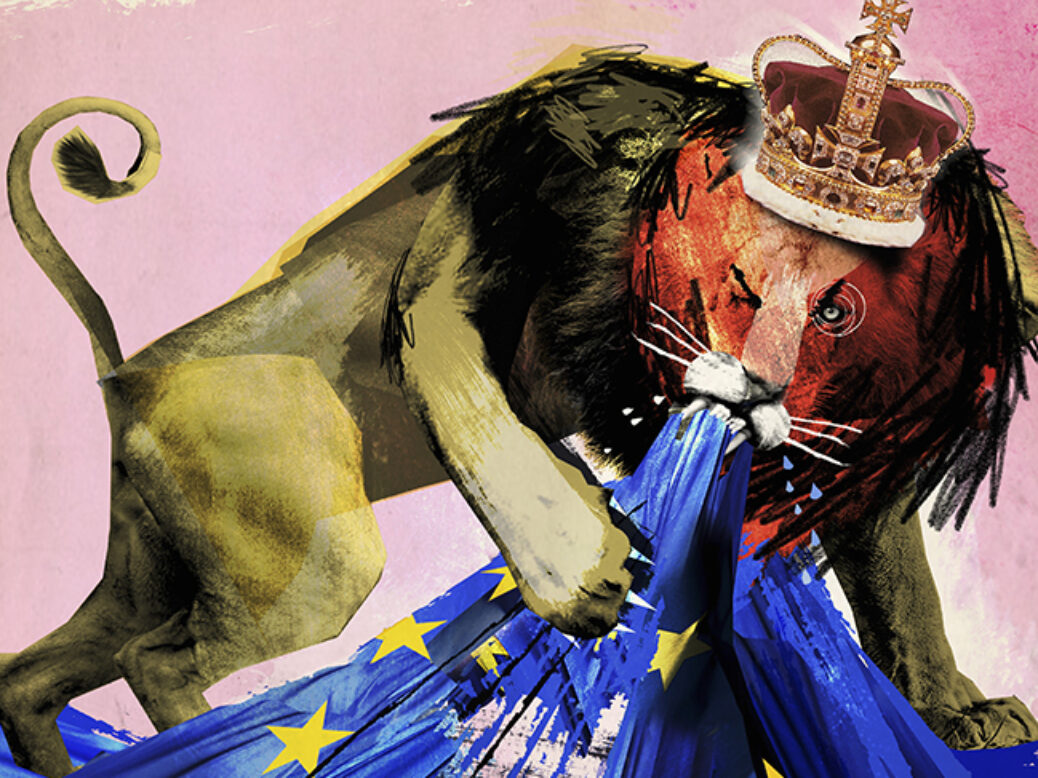
Ten years after the referendum that took Britain out of the European Union, sitting in the garden of the man who did more than any other to build the Continent we know today, and as depressed as I felt about the state of my own country back home, it was hard not to be struck by the sense that Brexit was but the first act in this wider story of Western malaise. Who now really believes in the West at all, or indeed in the America of Monnet’s
dreams; the cause for which he had asked us to be generous?
Travelling between Britain and France, listening to the same complaints of useless leadership and national bankruptcy, of listless institutions and rampant crime, it was hard to avoid the sense that we are not simply living through a crisis of governance, but of belief. What are we all doing? And in the name of what? “Capitalism?” George Smiley asks in the mournful final few pages of John Le Carré’s last Cold War novel, A Legacy of Spies, as he contemplates what he and his colleagues had fought for all those years: “God forbid.” “Christendom? God forbid again… for England then?… But whose England? Which England? England all alone, a citizen of nowhere?” No. In the end, Smiley reflected, it was for Europe. “If I had a mission – if I was ever aware of one beyond our business with the enemy, it was to Europe. If I was heartless, I was heartless for Europe.”
It is hard not to raise an eyebrow at Le Carré’s departing shot at the Brexiteers. Was this really Smiley’s motivation all along, or that of the circus? And yet, returning on the train to Paris from Houjarray the week before the anniversary of Britain’s vote to break with Europe, watching the videos of Ukrainian drones pummelling Moscow or Trump’s latest insults at Europe’s leaders at the G7 in France, or our continued weakness in the face of it all – our irrelevance – the question I couldn’t shake was not so much where we were as a country after Brexit, but where we were as a Continent or even a civilisation. What I couldn’t answer was simple: whose Europe, which Europe?
Contrary to the persistent myth that Europe does not care or think about us, Britain’s spiralling descent into disarray is a source of regular – and amused – interest for the many of our neighbours. Chatting with a British friend in Paris after returning from Houjarray, I was told that the level of curiosity about our perma-crisis was matched by a level of misunderstanding regarding its meaning. Were the Troubles starting again? Was the gov-ernment about to fall? Are you guys OK?
It is hard to judge European Schadenfreude too harshly, given the state of affairs in Britain. Since the referendum in 2016, we have had six prime minis-ters – soon to be seven. Economic growth has been lamentable, meaningful reform non-existent. We have stumbled from one crisis to the next, staring at our phones, tripping over our laces. The referendum, which was supposed to settle British politics, has done anything but. The Conservative Party has dis-appeared as a political force across the country. In Makerfield, the right was split between two populist parties that did not exist at the time of the refer-endum, both of which are calling for mass deportations, withdrawal from the European Convention on Human Rights and further disengagement from the Continent. Meanwhile, race riots have become a summer tradition, part of the tapestry of our national life. It is hard to avoid the central reality of British politics today: “the Brexit decade” was a lost one, a disaster of governance and political instability, leaving the country in a state of outraged discontent and the political class broken and, worse, out of ideas. Who has any real con-fidence that Andy Burnham – or any of today’s leaders – will be able to end the chaos?
Yet, things are little better on the Continent. When asked by his friends and family about how things had got so bad in Britain, my friend in Paris – a Remain-supporting Europhile – has started to reply with defensiveness: compared with what? With France, whose political and fiscal crises are even more intractable than our own and where drug-fuelled criminality has reached levels of violent disorder unheard of in Britain; where the next presi-dential election has a cast list of 15 candidates, with Marine Le Pen or her 30-year-old protégé favourites to succeed Emmanuel Macron? Or with Ger-many, the engine of European growth whose economy has stalled and appears unable to restart; where the radical right contains extremes even more concerning than in Britain or France and yet is comfortably ahead in the polls.
In Paris, I visited Pascal Lamy, the formidable French bureaucrat and former head of the World Trade Organisation who had been Jacques Delors’ chef de cabinet in Brussels during Europe’s last period of dynamism as the Cold War came to an end. I met him at his grand fourth-floor apartment in the city’s bourgeois 9th arrondissement. Lamy is now 79, but retains the force of his youth: slim, sharp, alert. This is a man who knows what he thinks, and he knows a lot. “I am known to be very pro-British,” he says, catching me a little off guard: “Maybe a little too pro-British for a Frenchman.” This had not been my impression of Delors’ enforcer; the “beast of the Berlaymont”; the man who had ruled Brussels with iron determination. In short, a Brexiteers’ worst nightmare. He was an Anglophile – really?
Lamy’s early interactions with the British had been pivotal in his political formation, he told me. His family was friends with an upper-class English family from Surrey called the Smithermans. The father, Colonel Philip Henry Smitherman, was an amateur painter; his wife, Rosemary, a Tory activist, but one who happened to also be passionately pro-European. In Lamy’s telling, it was Rosemary who triggered his life-long belief in Europe. Three months ago, Lamy sought out one of Smitherman’s paintings at an auction in Australia and bought it.
For Lamy, then, Brexit was also something of a tragedy, though mainly for the British. “Geo-politically and geo-economically, the UK is now part of Europe,” he says. “When Churchill said in 1948 that Britain was with Europe but not of it, that was before Mr Putin, Mr Trump and Mr Xi Jinping decid-ed otherwise. Today, there is an obvious convergence. It is inescapable. The problem is just politics.”
Lamy’s view is that once spelled out by Hugo Young in This Blessed Plot, his federalist history of Britain’s prevarications over Europe: the story of a country unable to “reconcile its past to the future it could not avoid”, as Young writes in the opening sentence. Lamy agrees. “No other country has not been invaded for as long as Britain,” he says, before adding with a smile: “Not since my ancestors arrived from Normandy.” For Lamy, the island for-tress explains the mentality. “This is a reality within British culture,” he says. “There’s something specific in the emotion.”
When I bring up Monnet, another Anglophile Frenchman, he surprises me with his scepticism. “There was a dream among the European founding fathers that economic integration would lead to political integration,” he says. “This was an anthropological nonsense. It doesn’t contend with feelings and belonging. Europe will go where it needs to go until there is a sense of belonging.” This, though, was also Monnet’s view. His grandson Jean-Marc told me that for Monnet, the Europe he had created was intended to be a “pacific revolution – a revolution of the mind”, to make us feel a sense of collective belonging.
The skill of the statesman, Monnet believed, was to find ways to build this sense of belonging; to think beyond constitutional manoeuvres or institu-tional arrangements – to think imaginatively about new ways of working together; to show the kind of generosity so painfully lacking everywhere to-day. Isn’t it incumbent on both sides in this divorce to try to find ways of living together amicably in both our interests?
Lamy is dubious. The paradox of Brexit, he says, is that Britain was always happy with European integration, so long as it remained economic rather than political. But by leaving the EU, Britain has – at the most fundamental level – chosen to leave the single market, which means there has to be a border where there wasn’t one before. No amount of generosity can get around this fact. And so, the reality is that Britain is “moving slowly, by stealth, back towards convergence”, he says. Like some kind of absurdist theatre, then, Britain and the European Union are “pretending they have di-vorced while carrying on sleeping together”, as Lamy puts it, laughing.
At the heart of the matter, Europe is being caught up in the battle for global supremacy now under way between the US and China. “Everything is dependent on that,” he tells me. Putin’s invasion of Ukraine was unimaginable without China’s tacit support, he says. Even Trump’s war against Iran was tied into this wider battle for domination. Europe, meanwhile, is nowhere. On technology, wealth and military prowess, America is pulling away.
It was for similar reasons that Tony Blair recently declared that Britain should not seek a return to Europe at all, but align itself with the United States to take advantage of the AI revolution now under way in Silicon Valley. For Lamy, the reality of this is “inevitable vassalage”. More: such a pro-spect is not realistic. “I do not see a future US-UK convergence,” he tells me. “It does fit with your political culture.” Britain, he says, is a European country with European values. It will not eat hormone-injected meat or accept America’s rapacious business practices. “When you come up against ideological choices – life preferences – you will not align with the US.” Strip away everything, in other words, and the bottom line is culture; the in-stincts and priorities of a nation or a continent – or a civilisation.
Britain is not only trapped between a past it could not escape and a future it could not avoid, but pulled between two halves of the West coming apart. Torn between Europe and America, once the constituent halves of the free world, now barely concealed antagonists unsure whether they any longer share the same values, or are part of the same civilisation. “With the Americans, we are no longer brothers, but cousins,” Lamy says as our time together comes to an end. “You do not kill for your cousin, but you do for your brother. That is the anthropological reality.”
I left Lamy’s apartment into the bustling Parisian street below, hot and bothered in the summer heat, and a little dispirited by the dizzying sense of intractability that he had set out. I had come to France filled with visions of optimism, of Monnet-style “generosity” and progress – notions that there were ways forward if only we could find a sense of shared purpose. But, if I understood Lamy correctly, he thought my ideas naive. The truth was sim-pler in his view: there was a European market; Britain had chosen to leave; it would not choose America; and nor would it go crawling back, “like the Burghers of Calais giving back the keys”, as Lamy put it with a knowing smile. We were stuck no matter how much generosity and imagination the two sides could muster.
The rest of my day in Paris did not fill me with any more hope. From meeting to meeting, I bounced between dispiriting accounts of British and Europe-an myopia. While the United States and China sped away from us, Europe continued to shrink and bicker. I heard how despite the war in Ukraine, Berlin and Paris have been unable to agree on a new joint fighter jet programme and have now given up trying. The Germans wanted to use their technological and industrial power; the French wanted to protect their defence industry’s bottom line. Britain, meanwhile, has been told that if it wants to join a new European defence programme, it will cost 10 per cent of its entire military budget – the cost of Brexit. And so it has not. And this is before the nationalists take over. Today, the National Rally lead the polls in France, the AfD in Germany and Reform UK in Britain. What hope of a generous future?
Over and again, I turned back to Monnet in my discussions in Paris. His “method” had been to find something practical that national governments could put aside their differences to work on together. During the First World War, he persuaded Britain to give up its narrow economic advantage in one specific area: the import of wheat. By competing with France over limited supplies of the grain from Canada, both sides were losing out, paying over the odds and undermining the war effort. But once the principle of collective action had been established, economic cooperation could spread. It was no good buying the wheat together if it could not be transported together, and so cooperation on shipping was required. As Perry Anderson has written, this was Monnet’s genius for “incremental totalisation”. If you can agree to put coal and steel beyond national control, then why not food and farming? And if you can agree on food and farming, why not everything else, one after another, until the Continent shares a government and a central bank and a currency? The result of Monnet’s inspiration was, eventually, the European Union: what Anderson calls “the last great world-historical achievement of the bourgeoisie”.
Could Monnet’s method still work today, I wondered? Could Europe – beyond the EU – agree to come together to build, say, the drones required to protect our skies? And if it did, could we build something new from there? I had put this to Lamy, but he was sceptical. The single market he had built remained the core of Europe, the Continent’s fundamental reality. Yes, there could be agreements reached on shared objectives which could then be built into shared institutions, but Brexit could not be wished away.
Waiting for the Eurostar home that evening – standing in a chaotic, sprawling queue caused by another round of French border controls – I couldn’t help but be depressed by the lack of ambition across the Continent. I couldn’t decide whether Lamy was a clear-sighted realist or one whose imagina-tion was stuck in the past, only able to see the Europe he had constructed and not the possibilities of something else entirely coming into being. Mon-net had argued there were three qualities required for any great project: vision, method and courage. Looking at the old capitals of Europe, it was hard to see much of any.
Perhaps I was looking at everything the wrong way, fixated with the old Europe of Monnet and Churchill, Lamy and Delors. Today’s Europe is not being driven forward by Britain, France or Germany, but by Poland and Denmark, Finland and Spain – and, of course, Ukraine, which is not even inside the bloc. Perhaps all this is a sign of Europe reinventing itself; becoming a Europe that will survive and thrive outside of Monnet’s supranational con-trols. Perhaps, even, Monnet’s genius had left us with the problems we have today: an EU that drew its legitimacy from an elite operating out of se-cluded country houses like Houjarray, which came to fear public consent for its project and which cannot reinvent itself now because to do so would involve European treaty change, which would – inevitably – be rejected by the European public. Monnet himself foresaw this danger and became “ob-sessed” by it at the end of his life, Jean-Marc told me, which is why his focus turned to the European Parliament. The challenge was always how to ask people to imagine something that had not yet been delivered.
Walking with Jean-Marc in the forest of his grandfather, I was struck by how historic the golden phase of the EU now seems, and how dominant the ghosts of Europe’s great men: not only Monnet, but Schumann and Macmillan, Churchill and De Gaulle.
Today’s leading European minds are concerned less with pacific revolutions of the mind and protecting the free world than injecting realism and power into the Continent’s failing elite: thinkers such as Luuk van Middelaar, the Dutch scholar and adviser at the Commission, who has been dubbed “Europe’s New Machiavelli”. Van Middelaar has urged the EU to snap out of its idealism and to instead come to terms with the chaos and contingency of history, in which power matters more than values, and Europe must break from America.
The ultimate lesson of Monnet’s life, I reflected, as I sat with his memoirs on the Eurostar travelling home, was that action without idealism was empty motion. He committed his later life to his Action Committee for the United States of Europe. “The question,” he wrote in his memoirs, “was: where to begin?” This, he writes, is always the only question that matters. “Once you have made a start, all you need to do is continue.” But then the kicker: “In order to begin, one needs to have clear ideas.”
Do we have clear ideas today? Monnet had a certain idea of the West. He could believe in such a thing because of the blood he’d seen sacrificed in two world wars. The grandeur of Monnet’s visions was the mirror image of his experience of Europe’s twin cataclysms. As we look at Ukraine today, there is a looming spectre of yet another cataclysmic tragedy about to unfold.
The choice, then, is becoming clearer: what do we believe? Are we still Western or are we now merely European – or perhaps we here on this island
are neither. The irony, of course, is that Donald Trump and JD Vance have their vision of what the West now means – a vision distinctly ethnic and reli-gious in tone, a vision of blood and brotherhood. But what is ours?
Back in Houjarray, sitting with Jean Monnet’s grandson in his garden overlooking his grandfather’s old cottage, toasting his memory with a cognac that bears the family name, I knew I still believed in the West in some way, deep down. What that entailed, I was no longer certain. Was it just the comforting sense of home and holidays? Must it include America? I was no longer certain of anything. But ten years after Britain voted to leave the EU, the question remains: whose Europe – ours? And if so, which Europe should we be building? Without knowing who we are and what we are defending, we have become small and mean, waiting for another Monnet to emerge to show us the way. But he is no longer here.
[Further reading: The timeline: How Starmer lost control]
Content from our partners


Related
Join the debate
Subscribe here to comment