
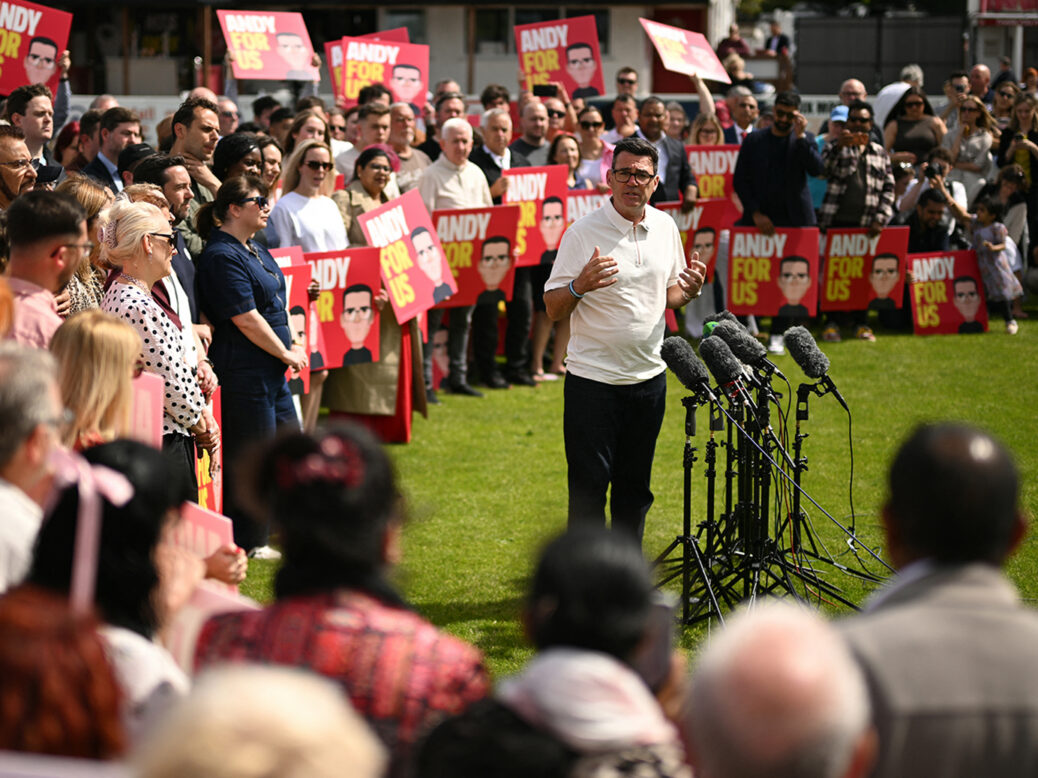
No more Mr Nice Guy? This is the question that confronts Andy Burnham on the threshold of his premiership, a threshold that now leads to an open door following Keir Starmer’s resignation. It is personal but also deeply political.
I went up to Makerfield ahead of the vote last Thursday (18 June) to help stop the neo-fascists. Getting the vote out was overwhelmingly personal. Our morning leaflet capitalised, “HE’S ONE OF US”, its message: “Vote Andy, Vote Hope Today”. For the afternoon and early evening, it was simply “VOTE ANDY BY 10 PM”. There was no mention of Labour. The last two years have completely severed what was once a tribal loyalty in a constituency that saw 75 per cent turnouts in the 1980s and a 73 per cent majority for Labour in 1997.
Andy’s videos conveyed his charisma and his presence, one of genuine, rooted enjoyment and serious commitment. Who wouldn’t want to be represented by him? In a country where disillusionment and resentment, if not hate, hang in the air, his purpose is to bring us together. At the count, his acceptance speech was a pitch-perfect warning to Labour and also to his generation of progressives in England:
“This is a final chance to change. This is what people said directly to me on the hundreds of doorsteps that I stood on. We must hear it, we must act upon it and we must get it right. There will be no second chance. But there is a chance now from this result tonight to build a new politics based on unity and hope. Turning away from the path that takes us to a divided, dark politics of the kind we see in the United States.”

A historic choice, then. Turn leftwards, towards unity and hope, and away from, as he put it last month, “40 years of being on the wrong path”. The path that saw a “draining away of economic, social and political power” thanks to “deregulation, privatisation and then austerity”, a path that “all adds up to 40 years of neoliberalism”. Such a direction means a British revolution. There have been two of them since the war with Germany and Japan that terminated the British Empire.
First, Attlee’s 1945 revolution. It gave us the social democracy of the NHS and public housing. Second, Thatcher’s of 1979. It gave us neoliberalism and private ownership. Attlee’s recruited the Conservative Party into its domestic framework; Thatcher’s was embraced, and humanised domestically, by New Labour. Attlee’s revolution was prepared during the wartime coalition. Thatcher spent three intense years planning her assault. Both, therefore, had a developed strategic direction. Which Burnham does not. At least, not yet.
Both the 1945 and 1979 revolutions succeeded, however, thanks to their historic appeals to the public. Social democracy was delivered by a paternalist class that had successfully mobilised the country for war and was determined to reward a still deferential population, which was intensely grateful. Thatcher’s revolution assaulted the legacy of now stifling consensus politics, which had lost its way. She asserted the primacy of the market to unlock choice, freedom and personal responsibility. After 1945 millions of houses were built, by Tory governments as well. After 1979, the workers could own them for themselves.
Today, few new houses are built, the young can’t afford them, existing ones are leased for exorbitant rents, while companies like Serco profit from the HMO state, a situation that generates loathing and fear, inflamed on social media. Here, then, is Burnham’s challenge. To achieve the unity he wishes he has to name its enemies. Whom he now opposes will define the unity he creates for the country. And this means that, whether by policy or by default, his government will be defined by the direction it takes on three fundamental questions: “Who knows best?”; “What kind of capitalism?”; “Our place in the world”. None call for fixed positions (the fatal lure of leftism). All demand an approach sufficiently defined for voters to understand.
Who knows best? Clearly, not the remnants of the post-imperial Establishment. Nor does the market know best, as we have learnt to our cost. Today, Burnham faces a choice between two different answers: that “we the people” know best, otherwise called democracy, or that a strong state knows best. Despite their apparent centrism, the latter is apparently the view of the current – hopefully departing – denizens of Starmer’s Downing Street. Under the influence of the tech bros via the Tony Blair Institute, they dream of vaporising the regulations that frustrate their will.
The momentous nature of this choice cannot be under-estimated. In a powerful description of the UK’s multi-layered crisis, “What Britain Won’t Face”, Tom McTague denounced the country’s drift and delusion, that have ensured the government’s bad management which has immiserated its own people for decades. What is needed, he declares, is “a plan” that can get a grip on the state, so as to assert “an idea of Britain that all who live here can call home”.
He’s right that an overall conception is needed. But his focus on the state comes close to the delusional obsession with its power that is shared across the political class from Jeremy Corbyn to Dominic Cummings. Its latest emanation is Ryan Wain of the Blair Institute calling for a “stronger centre of government”. Of course, we need better government. But as Burnham and Steve Rotheram show in Head North, we need a better system of government, that decentralises power.
The core problem with the British state and its political system is that it is an elective dictatorship. Inevitably, its first priority, as with all dictatorships, is to cover its backside. Historically, its singular accomplishment was that the skill of occupants ensured popular consent to their rule. Always, loyalty was combined with grumbling. It was not democracy. But by international standards it was exceptionally legitimate, in that the people consented to their rulers – a relationship symbolised by our police being unarmed.
In this century, however, multiple causes have destroyed this unique legacy of consent: bad wars based on lies, followed by shameful defeats; the financial crash; an endless list of terrible scandals for which none are punished; the Brexit disaster; austerity; indebtedness; water companies that are looting our savings while poisoning our rivers. All thanks to elective dictatorship. The answer cannot possibly be more, or “better”, dictatorship. It has to begin with honest democracy.
This is simply the starting point, not a panacea. To show he means it, assuming he does, Burham should legislate immediately for a citizens’ assembly with a brief to decide on an electoral system that makes everyone’s vote count and retains constituency MPs. This is not rocket-science. It won’t take more than three months. The outcome can then be voted into existence by parliament for the next election. No talk about “commissions”, please, or the long grass of manifestos. Unless the rupture of consent is addressed straightaway, the right will pounce. Empower voters now; what could be more legitimate?
What kind of capitalism? According to the Financial Times, one “executive” said businesses were against Ed Miliband becoming chancellor because, when Labour leader, he had the nerve to distinguished between “predators and producers”. My bet is that this executive is in finance. The few business people I know are all too aware of the distinction and how productive companies are starved of capital.
But statements like this are a sign of what Burnham will be up against. To create a progressive, popular unity he has to attack corruption and its predatory consequences, above all by capping political donations and stopping those from unincorporated entities. Free our democracy from big money. Insist on the transparency of all influence. Voters across the spectrum support this. It would be immensely popular.
There is much to say here. Again, the key point is to set a defining direction, above all by making corruption an enemy. Empower voters relative to the market. Set about unwinding a “welfare” system that subsidises cheap wages and high rents. Take our water back from the thieves who are poisoning it. A crucial step will be to break the power of the so-called “Lords”, now close to becoming a protection racket, and expel any member of our legislature who is paid by lobbyists.
These policies are not expensive, but they turn decisively towards a new path, one that also signals the place we want to occupy in the world. They point to a unity that is not soft, diffuse and inclusive of the corruption injected into Labour by Mandelson and his crew. They signal that our home is here and belongs to the people of these islands. This includes the English. It was the English whose votes made Brexit happen, in part because, without a parliament of their own, they blamed their sense of dispossession on Brussels. John Denham’s heroic, patient arguments make an unassailable case that there will have to be an English parliament.
It can’t be legislated immediately, in the way that Burnham can ensure the swift adoption of PR and the cessation of corrupting donations. But “Andy’s call” for a politics of place points towards it. After all, what is “our place” for most of us, if it isn’t England? Which poses the need for a written democratic constitution so as to become a normal country. Again, not a magic solution, merely a precondition to finding our contemporary home in our European continent. Especially since, as Burnham skilfully notes, we are no longer at home in America’s hegemony.
Is there a word, a concept, to sum up the revolution Burnham points towards? In the 1980s, the political thinker, Raymond Williams called on the left to replace the notion of socialism, with its focus on production, with “Livelihood”. This, he argued, includes consumption, embraces the environment and personal security (or what we now call precarity), and is centred on people having a sense of generations as well as voice, while it also breaks from regimented notions of class.
Such a call for a tangible, rooted democracy would depth-charge neoliberalism. Can it find a place in our tradition-laden politics? The late David Marquand – like Williams a radical, post-war thinker, though of a younger generation – argued that it can. In his masterful history Britain Since 1918, he showed how four traditions have laced through all the major parties since the 19th century. Two of these, “Whig Imperialism” and Labour’s “Democratic Centralism” have now clearly bitten the dust. Two remain: “Tory Nationalism” and “Democratic Republicanism”.
The latter, with its call for personal liberty and self-government, is the tradition of Livelihood. It has always played a role in English political affairs, since John Milton was Secretary for Foreign Tongues in Cromwell’s Cabinet. But while Britain was an imperial country, it could never be the shaping force. Today, especially as we separate ourselves from the US, the way to democratic livelihood is open. It does not require the callousness of Thatcher. The aim is inclusive and social. But it will need Burnham and his team to be tough and determined to root out and replace the Mandelson legacy.
As politicians go, Burnham does seem to be a nice guy. This cannot define a successful premiership. Embodying a new political culture of listening and inclusion is welcome. But it has to be accompanied by an adamantine rejection of the old Labour culture which his now parliamentary colleagues want him to perpetuate. “No second chance”, is the verdict on the doorsteps. A line has already been drawn by the voters. He has to build a team that understand this and can impose the consequences on a governing order desperate to perpetuate whatever it can of the status quo.
[Further reading: What Britain won’t face]
Content from our partners


Related

Join the debate
Subscribe here to comment