
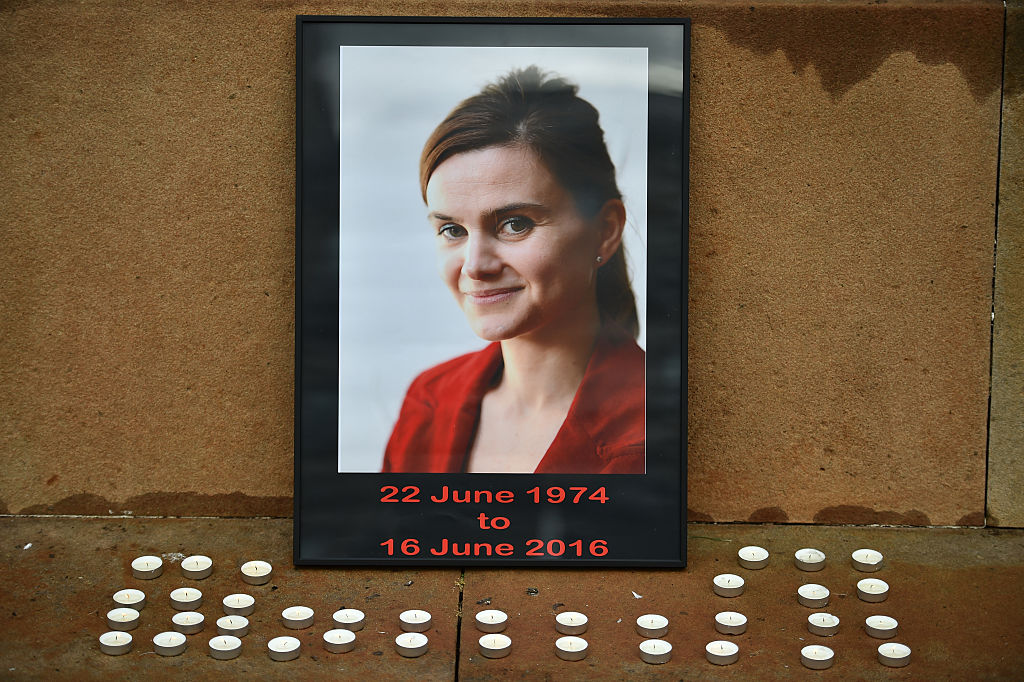
Ten years and one day ago, the average MP had many things on their mind – their constituents, their party’s policies, and their future career track. What they did not have to worry about every time they left their house was the possibility a member of the public would murder them in the street.
The assassination of Jo Cox changed that mental calculation. For the first time since the Troubles, when the IRA killed Ian Gow in 1990, a sitting MP had lost their life in the course of their electorally mandated duties. On 16 June 2016, the member for Batley and Spen was shot in the head and chest with a modified rifle and stabbed 15 times while on her way to a constituency surgery days before the EU referendum. Her murderer was a neo-Nazi white supremacist who shouted “Britain First!” as he carried out his pre-meditated attack. A week later, Nigel Farage would claim that the EU referendum had been won by the Leave side “without a bullet being fired.”
In another world, her death would have been a reckoning, a sober imperative to take the heat out of politics and remember Cox’s own rallying cry, in her maiden speech as an MP, that “we have more in common than that which divides us”. It would have knocked the nation out of its myopic hysteria, a grave admonition that the people in public life are still that: people.
This is not the world since 2016 – as Kim Leadbeater, Jo Cox’s sister and her successor as Labour MP for Batley and Spen (now Spen Valley), has pointed out. “People were made to see people who disagreed with them as their enemies rather than their neighbours – and I don’t think we’ve ever fully recovered from that,” she said in an interview commemorating her sister’s death.

Instead of that reckoning, we have seen a decade of heightened vitriol. Five years after Jo Cox was killed, the Conservative MP David Amess joined her on this bleakest of lists, stabbed in his constituency surgery in an attack that was treated as Islamist terrorism. His death, like hers, was condemned as an attack on democracy, but it didn’t stop the trend.
“The volume, breadth and tempo of threats against elected representatives is unprecedented,” Dan Jarvis, then security minister now Defence Secretary, told parliament barely three months ago. He was there to update the House on the government’s work tackling harassment and intimidation of MPs. The situation is so serious police have launched a new national democracy protection unit. According to data from the National Police Chiefs’ Council, reports of crimes against MPs have more than doubled since 2019. Reports of threats to kill have tripled.
Speak to any MP – but particularly female MPs, who face vastly more abuse than their male colleagues – and they will tell you of the risks to their personal safety they consider on a day-to-day basis. Some have been advised to change their routes into parliament or their constituency offices. Some have had to install extra security cameras and panic buttons around their homes. Some even worry about their children being targeted on their way to school.
Threats against our politicians are not new – prime minister Spencer Perceval was shot dead in the House of Commons in 1812. But the sheer volume of what MPs now have to contend with has changed the game. Twitter, now X, launched almost exactly ten years before Jo Cox was murdered. Its effect on all aspects of our politics has been seismic. Turbocharged by a social media platform that simultaneously fuels division in echo chambers of escalating venom and makes public representatives more visible and easier to contact than ever before, online death threats have become so commonplace many are not even reported to the police. MPs become inured to them, like fish who do not perceive the water around them. It can take something dramatic to jolt them out of the sense that this is normal.
I spoke to a female parliamentarian recently who had made a jokey comment on a radio show only for it to be taken out of context and clipped up on X with a caption suggesting she was laughing at victims of a horrific scandal. The tsunami of hate she received, much of it from outside the UK, was so intense she was advised to take increased security measures. Another admitted she had told her family to stop posting photos of her grandchildren online, fearing for their safety if they were identified.
“In recent years perpetrators of abuse have been emboldened by a perception that threats and intimidation in politics are becoming more accepted,” reads a House of Commons report from October 2025 on the security of MPs. “This is not helped by social media platforms normalising the idea that MPs and candidates should be expected to endure more abuse than people in other professions by showing greater tolerance for abusive content that targets politicians and other public figures.” The fact the government continues to use X, a platform where MPs face daily abuse and where mere months ago the AI tool Grok enabled users to digitally strip them down to their underwear, is proof of the humiliation and harassment we expect our representatives to endure.
All of this has an impact. It limits who even considers stepping into the public realm. As Janet Royall, Labour peer and chair of the Jo Cox Foundation, recently told the House of Lords in a debate about local councillors, “No one should have to risk their safety to serve in public life, yet that is exactly what is happening across the United Kingdom, with damaging consequences for our democracy.” And it limits how those who do step forward interact with the public, perpetuating the sense that our politicians are aloof and out-of-touch.
Both these trends further exacerbate the hatred of public figures, as though their remoteness and detachment from “normal life” makes them fair game. MPs become dehumanised, not fully-fledged people with interests and personalities and small children, but mere cyphers for the ideas they represent. Cyphers at which it is acceptable to hurl abuse. To threaten. To track down and shoot with a hunting rifle or stab in the chest.
So ten years on since the life of Jo Cox was tragically and brutally cut short, what have we learned? The political climate still encourages us to see people who disagree with us as enemies, with online platforms that make it possible to profit out of hate, to hell with the civility and sustainability of public discourse. The consequences for those who actively fuel that climate are minimal; the collateral damage manifests as degraded mental health and openness of those in public life, always wondering whether or not to take seriously the latest person threatening to kill them. And our politics – our democracy – is bitterer, darker and less vibrant as a result.
[Further reading: Westminster’s WhatsApp deletion drive]
Content from our partners



Related
Join the debate
Subscribe here to comment