
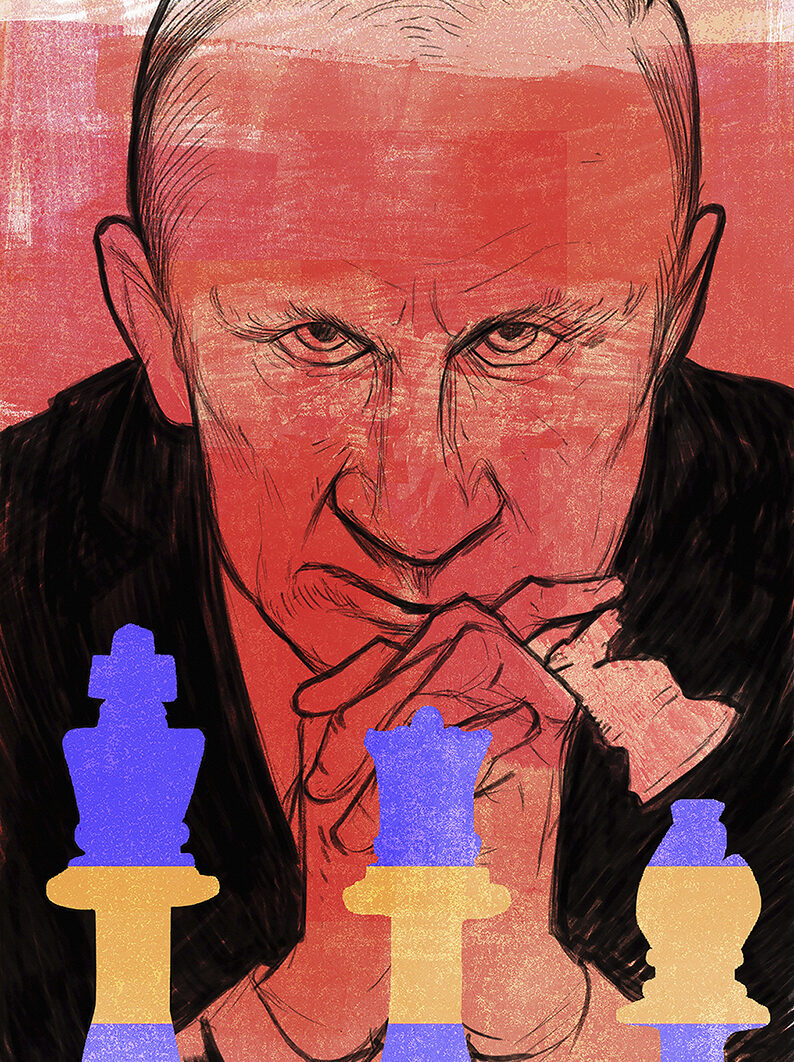
When the German political scientist Carlo Masala started working on If Russia Wins: A Scenario, an international bestseller that was translated into English and published in the UK last year, he wanted to challenge Europe’s conventional wisdom about Russia’s war against Ukraine. As he saw it, too many people were clinging to the belief that Vladimir Putin could be assuaged by some form of territorial compromise, “and then everything will be over and we can probably go back to normal.” That approach was dangerously complacent, he told me in a recent interview from the University of the Bundeswehr in Munich. Masala thought: “No, we won’t go back to normal, because Russia has ambitions which go far beyond Ukraine.”
Masala has drawn on his academic research, discussions with military experts, government officials, and participation in tabletop wargames to work up his “scenario”. It imagines the following. A peace deal along the lines currently being discussed is enacted. Ukraine is forced to surrender around 20 per cent of its territory and renounce any prospect of joining Nato. In return, Kyiv is promised a reconstruction programme financed by the World Bank and an international peacekeeping force to monitor the ceasefire. In reality, this only means the repeated skirmishes across the demarcation line that follow are reported to the United Nations in New York; there is no agreement among the western powers to mount a military response. Russia rachets up its repression in the occupied territories of the Donbas while the rest of Ukraine is plunged into a worsening economic crisis that drives more of its citizens to flee to the EU and reignites the country’s domestic political struggles. Volodymyr Zelensky calls an election in an attempt to shore up his authority, and loses.
Over the three years that follow, Masala charts an all too credible course. European leaders quietly abandon their earlier resolve to build up the continent’s defences, citing budgetary pressures and the need to avoid provoking Russia into a dangerous arms race. Those calls are strengthened by the election of a new president of France from the far-right Rassemblement National (National Rally) in 2027. More improbably, Vladimir Putin steps down, handing over power to a young, western-educated economist who bears a striking resemblance to Kirill Dmitriev, one of the main intermediaries for the Trump administration’s ongoing negotiations with the Kremlin. Yet Putin retains an ambiguous role as the head of the “New Russia Foundation” and it soon turns out that the new president’s overtures to the West with promises of renewed engagement, a return to arms control, and domestic reform, are a ruse. Behind the scenes, a secretive group of senior officials is planning an operation to test Nato and prove that the alliance’s Article Five commitment to collective defence no longer exists, culminating in a Russian military assault on Estonia in March 2028.
This is not fantastical. Multiple European intelligence services have warned in recent months that Russia could be in a position to attack a Nato country within the next three to five years. The Netherlands’ defence minister Ruben Brekelmans told the Wall Street Journal earlier this month that Russia was already noticeably expanding its presence along Nato’s eastern flank, increasing its strategic inventories, and would be “able to move large amounts of troops within one year.” Speaking by video from his book-lined study at the University of the Bundeswehr [German federal armed forces], where he is a professor of international politics and director of the Centre for Intelligence and Security Studies, Masala warned that too many Europeans were far too sanguine about Russia’s intentions and its military capabilities.

“You hear people saying that Russia is not crazy enough to attack because they know they can’t win a war against Nato, look at how much difficulty they are having in Ukraine,” he said. According to this line of reasoning, Putin will ultimately be forced to recognise the limits of his military capabilities and settle for a ceasefire in Ukraine that leaves him with de facto control of the Donbas, which he can present to his domestic audience as a significant victory. But this assumes he is fighting this war primarily for territorial control and ignores his repeated emphasis on resolving what he calls the “root causes” of the conflict, which includes fundamentally altering Europe’s security architecture and reversing the process of Nato enlargement that followed the collapse of the Soviet Union.
“If you go back to the letter the Russians wrote to the Biden administration and to Nato headquarters in December 2021, they laid out that one of their goals was basically to reverse the European security architecture back to the status of 1997 [before the first wave of post-Cold War Nato expansion began in 1999],” Masala explained. Putin understands that Nato will never agree to expel those countries, which include Poland, Hungary, and the Baltic states, but if he can sufficiently weaken the alliance and prove that its mutual defence clause is hollow, he will have achieved an important strategic victory.
This does not mean waging a full-scale war against Nato that Russia would lose. The more likely scenario is not columns of Russian tanks rolling into Poland, but rather a limited attack on a Nato member that challenges the alliance to risk a major military confrontation with Russia to come to that state’s defence. “They just need to test Nato’s determination to invoke Article Five, and that means using a combination of hybrid and military means against one of Nato’s soft underbellies,” Masala said. “Not by tomorrow, even the Russians do need some time to regenerate their forces, but in the foreseeable future, they might then put Nato to the test, and this is what I think people really misperceive if they look at Russia’s ambition connected to this war.”
Nato has several such “soft underbellies” that are located close to Russian territory and have Russian speaking minorities that Putin might disingenuously claim to be protecting, as he has done in Ukraine. Masala focuses his scenario on the small Estonian city of Narva, which is located on the Russian border, giving the country’s forces the opportunity to rapidly retreat if necessary. A fictional Russian general invokes the example of Nazi Germany’s remilitarization of the Rhineland in 1936, when Hitler sent troops to reoccupy the demilitarized zone bordering France and Germany in breach of the 1919 Treaty of Versailles, with the intention to withdraw if the Allied powers pushed back, which they did not. Similarly, in this scenario, if Nato decides to mount a significant military response, the Russians have the option to pull back quickly with minimal losses. But if the operation succeeds, Article Five will be rendered meaningless.
In the book, Russian soldiers capture Narva within a matter of hours, raising the Russian flag above the city by sunrise, while marines disguised as tourists seize the sparsely populated island of Hiiumaa off the Estonian coast. This means Russia can now target Nato forces arriving by sea and threaten to blockade the Baltic states. Meanwhile, Russian diplomats launch their own offensive, insisting this is a limited operation to protect the rights of Russian citizens in Estonia. Moscow’s ambassador to Washington visits the White House to claim that his country is engaged in a humanitarian mission, but also signals that all options – meaning nuclear weapons – are on the table if Nato attempts to intervene. When the members of the alliance convene at Nato headquarters for an emergency meeting to consider Estonia’s request for assistance, the US president, who is unnamed but unmistakably Trump, repeats his familiar complaints about Europe’s failure to pay enough for the continent’s defence and declares that the US will not support military action against Russia in any form. He is “not prepared to risk World War III for Narva.” Without unanimous support, Nato’s secretary general can only ask Estonia to withdraw its request to invoke Article Five. Leaving the meeting, he acknowledges to the waiting reporters that it is a “dark day for the alliance”.
What makes Masala’s scenario so compelling – and unnerving – is that it is so plausible. The imagined role of the US, culminating in the refusal of the American president to commit forces to a Nato counterattack, is entirely consistent with Trump’s approach to the war so far. (To be fair, Biden also worried repeatedly about the danger of the conflict escalating into “World War III”.) Masala sees two distinct dangers now ahead. The first is that Putin, along with other autocrats such as Xi Jinping in China, have learned an important lesson about the potency of nuclear signalling. “If I were Putin, I would say that I can win any confrontation against the West just by nuclear sabre rattling,” Masala told me. “This is basically what he has done since the third day of the war back in 2022 [when he ordered Russia’s nuclear forces to be placed on a ‘special regime of combat duty’] and he achieved what he wanted. Societies went hysterical. Politicians were extremely cautious.” The second danger is that Putin now assesses he has a strategic window of opportunity to undermine Nato with Trump in power.
“If I were Putin, I would be drunk for a week,” Masala said of Trump’s recent behaviour, which has included repeated threats to seize Greenland, undermining Nato from within, and threatening America’s closest allies with various forms of economic coercion. “The US president is doing what [Putin] has tried to achieve for the past 10 years. He’s driving a wedge into Nato by threatening another Nato ally with the use of force. This changes the fundamentals of Nato – the signal you send out to the potential enemy is that Article Five is eroding.”
Emmanuel Macron has been calling for European “strategic autonomy”, to reduce the continent’s dependence on the US, since he first came to power in 2017. Last February, shortly after JD Vance’s inflammatory speech at the Munich Security Conference, where he claimed that Europe’s greatest threat came “from within”, and following Trump’s threats to impose 25 per cent tariffs on the EU, the incoming German chancellor, Friedrich Merz called for Europe to “achieve independence from the US”. Merz, an avowed Atlanticist, said that it was clear that “Americans, at any case the Americans in this administration, do not care much about the fate of Europe,” warning that it was “five minutes to midnight” for the continent. Speaking at the Munich Security Conference this year, the German Chancellor doubled down on that message, warning that the international rules-based order “no longer exists” and revealing that he had started talks with Macron about developing a European nuclear deterrent.
Beyond the stirring rhetoric however, the continent has serious capability gaps to overcome if it intends to take on more responsibility for European defence from the US. “We are extremely weak when it comes to air defence,” Masala said. “We don’t have any deep strike capabilities, although we are on the way to develop them… and then there are other things like ISR [Intelligence, Surveillance, Reconnaissance] capabilities, and strategic air transportation and air refuelling capabilities, which we have, but not in sufficient quantities to be able to defend ourselves against a Russian aggression.”
He characterised Germany’s current approach to these issues as “schizophrenic”. The Merz-led government clearly understands that “we are in a kind of pre-war situation, and they are fully aware that if Ukraine has to capitulate, this will degrade European security.” Public opinion polls show that more than 60 per cent of Germans regard Russia as the greatest threat to European and German security. But this hasn’t translated into sufficient action. “We’re doing quite a lot to rearm our Bundeswehr [Germany’s armed forces], which has been neglected for the past 30 years, but if you look at weapons system deliveries into Ukraine, this is dropping, both from Germany and on a European level.” While German citizens clearly recognise Russia as a military threat, “they are not really willing to become resilient in such a way that they’re ready to pay a price which might come with a military confrontation with Russia.”
Yet what has changed in recent weeks, even amongst the most staunchly pro-American circles in Germany is the recognition that the US in its current form cannot be relied upon. “I’m a bit optimistic because I see that things are now going in the right direction,” Masala said. “Before Davos, there was a lot of talk, but now we see more action, with European countries thinking about how to pool their resources, how to be more powerful together.” The aim, he stressed, should not be for Europeans to attempt to replicate the capabilities of US, “just to be better and stronger than the Russians, which I think we can achieve in a few years.”
The nightmare situation, Masala said, would be for the Trump administration to announce an immediate withdrawal from the continent’s security architecture, making clear that neither Article Five nor the US nuclear umbrella could be relied upon. “But if we can keep the US engaged in Europe, in one or the other way, especially with the nuclear guarantee, we need three to five years to achieve a status where we are able to deter the Russians from any future aggression.”
The Kremlin is unlikely to wait for Europe to get its act together. Asked whether Russia already considered itself to be at war with Nato, Masala replied, “yes, absolutely.” Russia was currently waging two wars, he said: “one kinetic against Ukraine, and one with non-kinetic means against most of the European member states of Nato, which we usually call hybrid warfare.” In recent months, however, that hybrid campaign has intensified in both geographical scope and scale. “You can see the drone incursions into Poland, the fighter jets in Estonian airspace, the cable hacking in the Baltic Sea, so the Russians are becoming more and more reckless,” he warned. “They are already at war against the West.”
[Further reading: Anneliese Dodds: “I felt Peter Mandelson was a clear blackmail risk”]
Content from our partners



Related
Join the debate
Subscribe here to commentSorry but this is nonsense. Russia made many attempts to ally with Europe which were repelled. The war in Ukraine was engineered by the West which refused to honour the agreement not to push NATO to Russian borders. The Biden family antics in Ukraine reveal exactly what they were after. Russophobia in Europe is being fuelled first to absolve our collective conscience for feeding countless Ukrainians into the meat grinder, and second as a distraction from the fracturing of the EU and the appalling leadership of its unelected elites. We also need an excuse to divert funds from social welfare to weapons manufacture.
Russia does not have the military capability to defeat the country of Poland much less the entire continent of Europe. In the last year, even as American military aid has been withdrawn from Ukraine, Russia has made glacial progress. Poland has a similar sized population and vastly more economic wealth. They could stalemate the Russians. Throw in the resources and population of Western Europe and the west would win a conventional war. A nuclear war, would see both sides lose.