
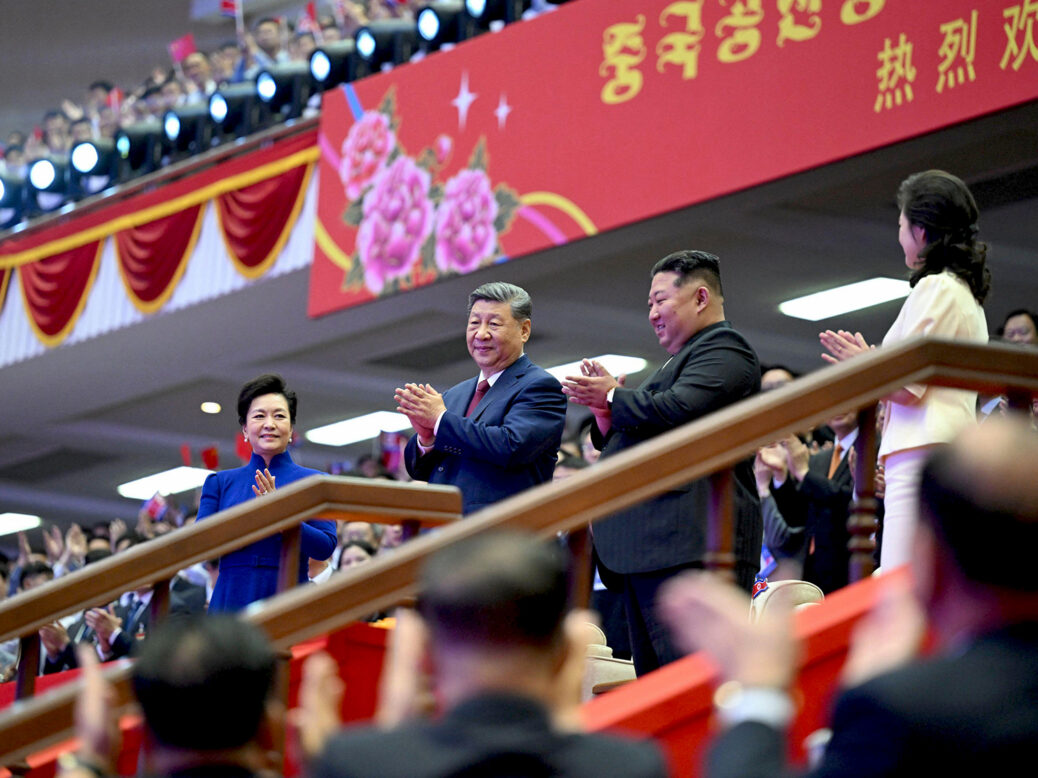
Despite the lavish ceremonial welcome in Pyongyang on 8 June, where Kim Jong Un and Xi Jinping clasped hands in front of cheering crowds waving flowers, beneath giant portraits of themselves, the relationship between the two autocrats is complicated. During their first five years in power – Kim became North Korea’s leader after his father’s death in 2011; Xi was anointed general secretary of the Chinese Communist Party in 2012 – the two did not hold any meetings, despite being each other’s only formal treaty ally. When Xi made his last visit to Pyongyang in 2019, Kim was clearly the junior partner, his sanctioned and impoverished state utterly dependent on the economic lifeline with China. But seven years later, after a series of profound geopolitical shifts, the Xi has returned to North Korea with the world, and Kim’s place in it, transformed.
North Korea is now a de facto nuclear power. Ten years ago, Chinese officials routinely denounced Pyongyang’s nuclear and missile tests, and in 2017 voted with Russia at the UN Security Council and the US to impose wide-ranging sanctions. Now, such concerted action is unthinkable. During a visit to Pyongyang in 2024, Vladimir Putin affirmed North Korea’s right “to strengthen its own defence capability” and signed a defence treaty, resurrecting their Cold War partnership. Putin’s war on Ukraine has presented a crucial opportunity to Kim, who has sent ballistic missiles, artillery shells, and even North Korean troops to Russia, in exchange for badly needed hard cash, millions of barrels of oil, food aid, and sensitive military technology.
Kim’s deepening relationship with Putin has strengthened his hand in relation to China. When he last hosted Xi in 2019, the North Korean leader was in a precarious position. His much-hyped diplomatic offensive, which yielded summits with Donald Trump in Singapore and Hanoi, petered out in February that year, when Trump concluded that a deal was not within reach. When Covid arrived the following year, Kim sealed his country’s borders, cutting off vital trading routes with China – which accounts for roughly 95 per cent of North Korea’s trade – and plunging his population into even greater hardship. But he continued to pump money into weapons programmes, making a bet which paid off when Russia invaded Ukraine and the few commodities North Korea had in plentiful supply were suddenly in demand.
Kim’s rising stature was evident at a military parade in Beijing last year to mark the 80th anniversary of the end of the Second World War, when he strode into Tiananmen Square alongside Xi and Putin at the head of the invited leaders. Like his grandfather Kim Il Sung during the Cold War, the North Korean leader presumably hopes to play off Moscow and Beijing against each other and secure support from both. At a time when Xi has significantly curtailed his overseas travel – he made just six foreign visits last year – it is striking that he made Pyongyang his first trip of 2026.

Ahead of the summit there were some suggestions that Xi might increase the pressure on Kim to give up his nuclear weapons, or at least to halt further development. After Trump’s visit to Beijing last month, the White House said that he and Xi had “confirmed their shared goal to denuclearise North Korea”. But the Chinese readout merely stated they had “exchanged views” , and the idea that Xi planned to take Kim to task was always wildly optimistic. Xi would still prefer that North Korea did not have nuclear weapons. Chinese officials have long been concerned that this will destabilise the region, emboldening Pyongyang to take more provocative actions and prompting rival powers such as Japan and South Korea to seek their own nuclear weapons, particularly as they lose faith in US security guarantees. But Beijing has always lacked the capacity to convert its sizeable leverage over Pyongyang into meaningful action, preferring to tolerate the current regime to the possibility of its demise and the worrying prospect of a unified Korean Peninsula, allied to the US.
Following the US-Israeli strikes on Iran, which had not yet developed nuclear weapons, Xi surely understands that the prospects of Kim agreeing to abandon his arsenal – never great – are now vanishingly slim. As are the chances that he will choose to trust his survival to a future nuclear deal with the US, which Iran had previously signed. Kim has made clear that he will only countenance further talks with Washington if it drops its demands for denuclearisation. Presumably to underline the point, he visited a new nuclear fuel facility last week and vowed to build up North Korea’s nuclear forces “at an exponential rate”.
Yet it is not all bad news for Xi. While he now confronts the prospect of a nuclear North Korea, and the loss of some strategic influence to Russia, this visit was also a chance to emphasise his own central role in global affairs and to draw a contrast with what he portrays as US decline. Within the past six months, he has welcomed a bevy of foreign leaders to Beijing – including Trump and Putin – and now visited Kim, positioning himself as a rare world leader who can command an audience in both Washington and Pyongyang. During a period when Trump appears intent on burning down America’s alliances, Xi seems determined to shore up the alignment of revisionist autocracies that spans Russia, North Korea, and – assuming it emerges from the war with the current leadership intact – Iran. Regardless of his personal misgivings about Kim and the volatile regime next door, that is reason enough to go along with the choreographed display of bonhomie in Pyongyang.
[Further reading: Trump is making America’s 250th birthday all about himself]
Content from our partners

Related

Join the debate
Subscribe here to comment