
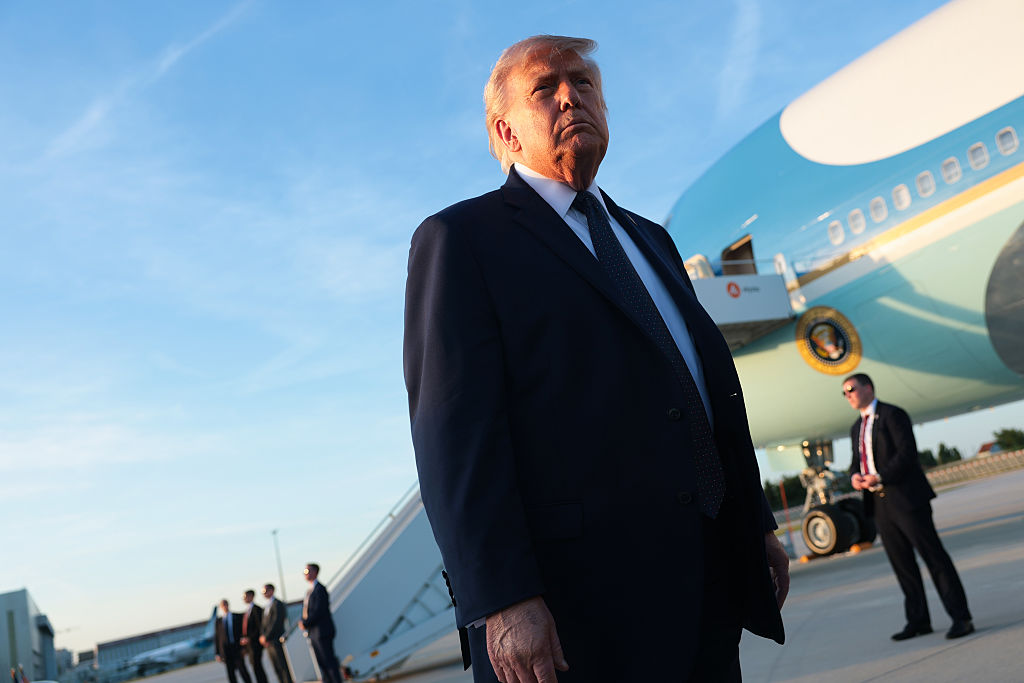
Over a candlelit dinner with Emmanuel Macron at the Palace of Versailles on 17 June, Donald Trump signed an agreement intended to end the war with Iran. The formal signing ceremony had been expected to take place in Switzerland on Friday, with vice-president JD Vance representing the United States, but either Trump could not wait, or he could not abide the prospect of ceding the limelight to his second-in-command. The White House duly released footage of Trump appending his signature with his trademark black marker, secretary of state Marco Rubio hovering awkwardly behind him, with the caption: “Peace through Strength.”
The reality on the ground is likely to be neither. For all the triumphalism emanating from the US president, who insists that his war has achieved every conceivable objective and the initial war aims he set out on camera never existed – a kind of victory through amnesia approach – this is a humiliating climbdown. Where Trump once boasted that there would be “no deal with Iran except UNCONDITIONAL SURRENDER” and promised the Iranian people that the “hour of your freedom is at hand,” he has since been forced to confront the limits of military force and settle for the least worst option available to extricate himself from an unwinnable war.
Versailles was not exactly an auspicious location for Trump to sign the document. The last peace agreement to be signed at Versailles – the 1919 Treaty of Versailles between Germany and the Allied Powers at the end of World War I – not only failed to deliver a durable peace, but arguably set the stage for World War II. Never one to concern himself with such trivial matters as history, however, Trump may simply have been drawn to the gilded architecture and infamously opulent interior as an impressive backdrop that would look good on TV.
The details of the agreement Trump signed – formally known as the Islamabad Memorandum of Understanding – reveal the extent to which he has been forced to back down and abandon his earlier goals. The heady talk of toppling the Islamic regime in Tehran in the opening days of the war have been replaced by a sober paragraph committing both the US and Iran to “refrain from interfering in each other’s internal affairs”. Trump tried to brazen out this about-turn in Versailles, insisting that he had “never cared about regime change,” even though he had previously recorded a video urging Iranians to take over their government. He said the US was now dealing with “very rational” and “smart people” in Tehran who were “nice to deal with” and “not radicalised”. (In fact, the surviving regime is generally held to be more hardline than its predecessors and to have been emboldened by its resilience during the war, throughout which it continued executing its own citizens.)

Gone, too, is any prospect of putting a definitive end to Iran’s missile arsenal – initially articulated as one of the core aims of the war – which was not mentioned in the document and Trump has since defended as an entirely reasonable form of deterrence. “I mean, they have to have some because other people have some,” he explained to reporters in Geneva. “Missiles aren’t the problem… they hurt a little location, but they don’t blow up the planet.” Israel’s prime minister, Benjamin Netanyahu, already aggrieved at being strong-armed into halting, at least temporarily, his war against Hezbollah in Lebanon, is unlikely to share Trump’s sanguine view of those capabilities, and could well derail the deal if he decides to reignite the conflict.
The Trump administration is heralding the commitment by Iran to reopen the Strait of Hormuz – which was fully open before the war – and to resume negotiations over the country’s nuclear programme. (The last round of negotiations took place on the eve of the US-Israeli attack in February.) It is notable that the text of the agreement specifies that vessels can transit the strait “with no charge for 60 days only,” suggesting that a new regime of tolls, perhaps dressed up as administrative fees, could then be introduced.
Iran has agreed to “discuss” the issue of nuclear enrichment and to find a “mutually agreed upon” mechanism for down-blending its current stockpile of highly enriched uranium, under the supervision of the International Atomic Energy Agency. This suggests that Trump has also conceded his earlier demand that Iran must give up the entirety of its nuclear stockpile as part of any agreement and commit to transfer the material beyond its borders, perhaps even to the US. The text also states that Iran “reaffirms” its commitment not to procure or develop nuclear weapons, presumably to underline the fact that Tehran has made the same declaration on several previous occasions – including in the preamble to the nuclear agreement signed with the Obama administration in 2015, which Trump tore up during his first term.
In return, the US will lift its naval blockade of Iranian ports, issue immediate waivers to allow Iran to resume selling oil and release Iranian funds currently frozen overseas. The mechanism for doing so is not clear – the document says the two countries will “mutually agree on procedures related to the release of these funds during negotiations” – but if this goes ahead, it could give Tehran access to an estimated $24 billion worth of frozen assets and undermine one of Trump’s core critiques of the Obama-era nuclear deal, which he has castigated for a similar agreement to release frozen funds. The US has also promised to “terminate all types of sanctions against the Islamic Republic of Iran,” according to an “agreed-upon schedule” and as part of the “final deal” which is now to be negotiated. This could provide a powerful incentive for the leadership to agree to restrictions on its nuclear programme – perhaps on similar terms to the 2015 deal – to secure relief from the international sanctions that have devastated the economy in recent years. Such a deal might be more palatable now that Tehran has discovered a powerful form of deterrence in its ability to close the Strait of Hormuz and hold the global economy – and US petrol prices – to ransom.
But the Iranian regime has form for stringing out negotiations and key officials may well take the view that they can stave off a return to conflict through periodic talks and extensions of the current agreement. The document includes a provision to extend the current 60-day timeline to achieve a final deal “by mutual consent,” which might well prove attractive to the Trump administration too, unless a palatable deal can be found in the short term. The main element both Tehran and Washington seem to agree upon, for now, is that neither side is eager to resume the war.
Then again, they are not the sole protagonists. Netanyahu could yet upend the détente if he refuses to abandon his assault on Lebanon. Vance issued a stark warning along those lines on 18 June, urging the Israeli leadership not to risk alienating “the only powerful ally” they have left “anywhere left in the entire world”. Yet Trump could also overturn the deal if Tehran decides to play hardball during the forthcoming negotiations and he comes to believe he is being publicly humiliated by Tehran. He is already facing considerable blowback in Washington from critics of the deal and will not want to risk being perceived as weak. As it is, all that has been agreed for now is the vaguely worded Memorandum of Understanding – a concept of a peace plan and an undertaking to return to talks – rather than a comprehensive agreement to bring a permanent halt to hostilities.
After three months of conflict, the loss of thousands of lives, including 13 US military personnel, and with the economic consequences still reverberating around the world, Trump seems to have merely succeeded in fighting his way back to a slightly worse version of the status quo that was in place before the war. It was still the right decision to cut his losses and sign the agreement that was on offer, rather than continuing to double down on a war that he never should have started and had no plan to win. But far from a vision of “peace through strength,” he has offered a profound display of calamity through hubris, with the formidable power of the US military undermined by his own strategic incoherence and arrogance. Perhaps the Palace of Versailles was a fitting venue after all.
[Further reading: Donald Trump’s definition of “beauty”]
Content from our partners
Related
Join the debate
Subscribe here to comment