
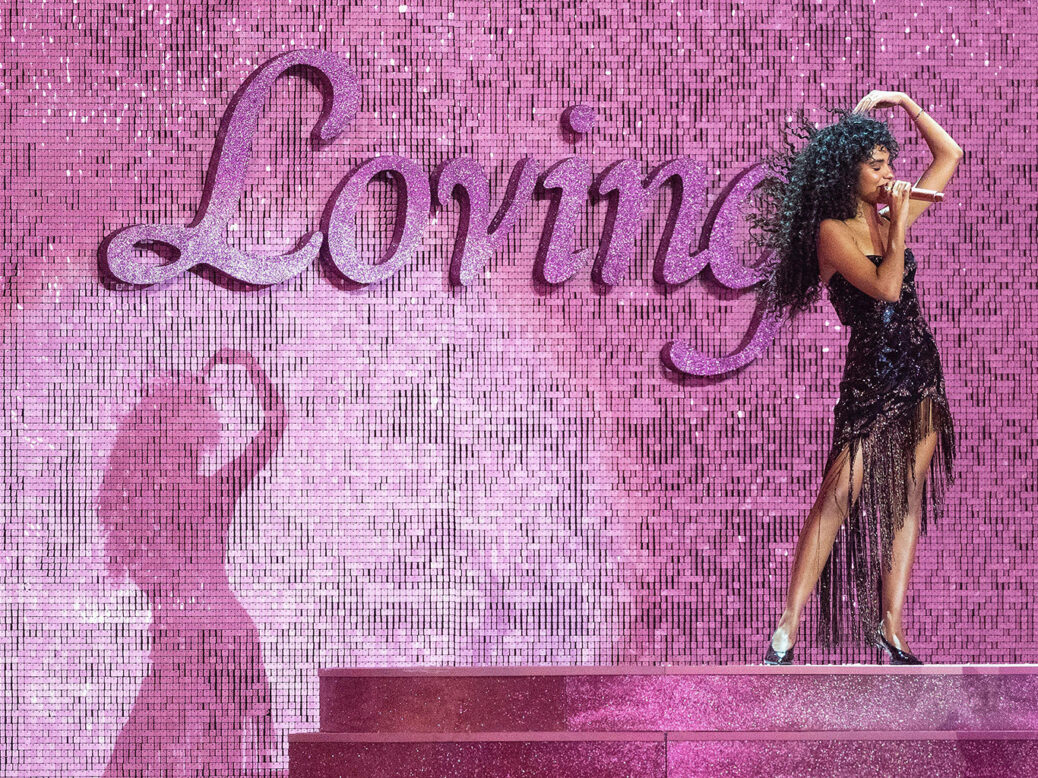
At London’s O2 arena, the Olivia Dean T-shirts (a soft-focus vignette of her face, the cover of her last album) are often paired, by the majority female crowd, with a white boho maxi skirt. This audience, at least on the night I attended – one of an astonishing six sold-out nights – is very wholesome. There is no other word for it.
The 27-year-old Dean’s second album, The Art of Loving, is Tapestry (1971) by Carole King for anyone too young to remember Carole King: a beloved record of the kind that would, if we still bought much vinyl, be carried to college possessively under the arm. It won Album of the Year at the Brit Awards this year.
Dean wrote her collection of songs “to try and define love and what it means”. She was inspired by the theorist bell hooks, whose famous 1999 work, All About Love, is lurking there in the record’s name. Early Joni Mitchell echoes, too, in the title track, where she talks of “something lost, something gained…” But Dean, whose barrister mother Christine once served as the deputy leader of the women’s equality movement, is a 21st century symbol of a Natural Woman. Her career was nearly derailed by the pandemic: she moved back in with her parents to “work on her social media”. Dean actually claimed the word “messy” before Lola Young got to it (it was the name of Dean’s debut album in 2023). She says things on stage like, “this is a song about trying to perfect – which is rubbish, you just need to be you.”
This kind of mantra is the flashpoint of the big gigs these days – the real moment of communion in the vast megachurch of an arena show. Dean’s audience knows every word of her songs, and if she wanted to, she could stop singing for large chunks of time and just point the mic at them instead. While vulnerability – uncertainty, balance, growth, muddling through – may be her lyrical stock-in-trade, and the secret to her enormous appeal, she is flawless in every way. And of course, we want her to be flawless, too.

Watching Dean, I thought about how robust, how consummate, how self-contained so many of our biggest stars are now. Her smiling ease, her hair teased by a wind machine, reminded me of Diana Ross. Yet the London drawl (“no questions aaaasked”) and the post-Winehouse cheeriness (“My Grampa’s in the audience!”) makes it all seem so ordinary, so much closer to home (Dean recently called Ticketmaster “disgusting”). She is a Brit school kid who was in the same class as Raye, who also did six nights here a few weeks ago, with her own twist on soul. We never moved on from the Sixties soul revival which began in the late Noughties – it was not a brief trend, but a dominant shift in the mainstream pop sound, made even more ubiquitous by the Simon Cowell shows, and their influence on the way people felt they ought to be singing. Early in her career Dean used the co-writer Eg White, who also wrote with Adele and Duffy. While the soul revivalists of the late Noughties still seemed to be knocked about by the demands of fame and the intensity of their performance careers, you watch Olivia Dean’s timeless display of professionalism and suspect she’ll still be going in ten years’ time, just playing to an older audience.
This sense of something watertight and semi-permanent comes from the music itself, which aims to synthesise the whole of pop, from nuanced Fleetwood Mac-type soft rock (“Nice to Each Other”) to Al Green-like pure soul (“Let Alone the One You Love”); from Burt Bacharach (“So Easy [To Fall in Love]”) to her turn on an acoustic guitar, flanked by two male friends: for some reason this moment took me back to watching stars like Sonny and Cher on The Smothers Brothers Comedy Hour.
Music this well-written and well-produced can’t go out of fashion. The set looks like something you’d have seen on TV 60 years ago too: so classy, nothing particularly high-budget – just a stepped riser and a soft orange curtain (through which she is first seen, silhouetted), two experienced-looking female backing singers, a slick brass section (Gen Z can tolerate sax solos), and only three costume changes, of which no particular deal is made.
There are no major close-ups of Olivia Dean’s face, I noticed, and the gig wouldn’t look particularly good on a mobile phone (the pixel-heavy, blockbuster-style arena shows of artists like Beyoncé, by contrast, are made for one). Dean’s movements are fluid and willowy, with a touch of Stevie Nicks’s arms here and there. She does not sing with that trendy flick and breathiness so many people favour – the kind of voice that sounds as though it is always about to break – and, in fact, you simply take for granted the work she is doing. While everyone’s legs on stage may be paddling furiously beneath the surface, the show itself glides on.
Fans have described seeing Olivia Dean as “healing”. At one point she gets a bit teary about her own success, and everyone cheers.
[Further reading: The Devil Wears Prada 2 is pure guilty pleasure]
Content from our partners



Related

This article appears in the 06 May 2026 issue of the New Statesman, Tis but a scratch
Join the debate
Subscribe here to comment