
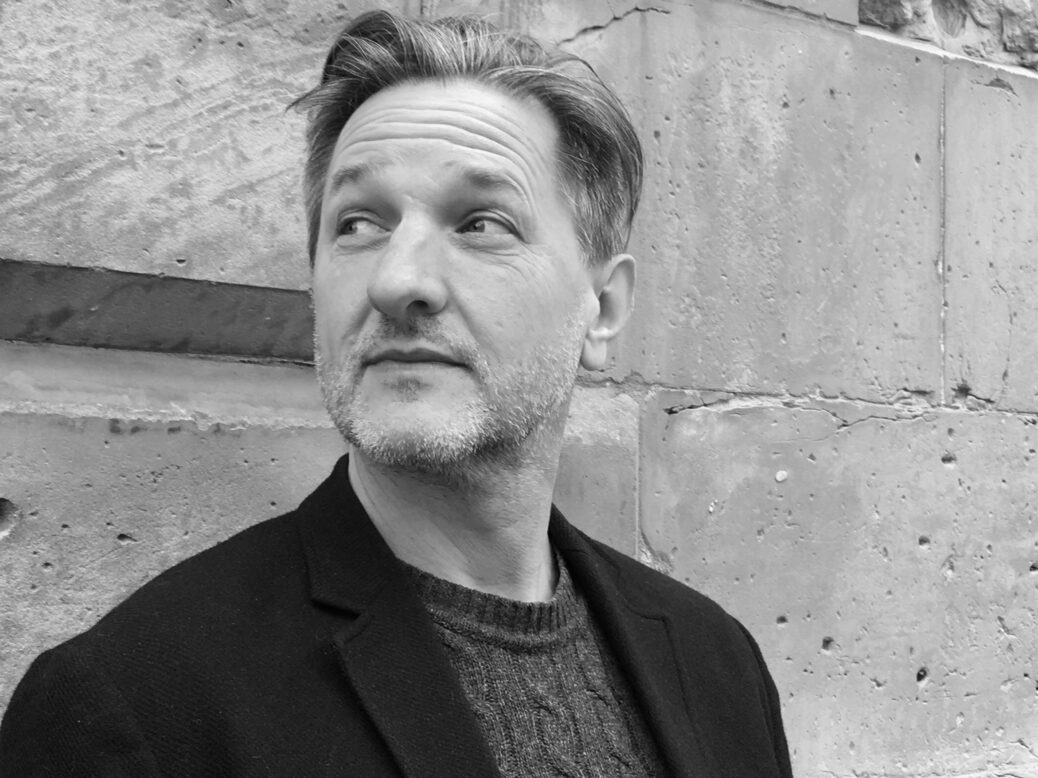
CD Rose writes labyrinthine stories about missing people and lost art. His 2014 book The Biographical Dictionary of Literary Failure celebrates doomed writers – one such author eats his own words in the name of artistic achievement, dying of ink poisoning in the process. Who’s Who When Everyone is Someone Else (2019) follows an unnamed academic, who has previously achieved “modest success” with a book called The Biographical Dictionary of Literary Failure, on a mysterious journey to Europe. The anonymous protagonist is an expert on Maxim Guyavitch, a cult author of lost works who may not actually exist. Rose’s third book, The Blind Accordionist (2021) completes the semi-trilogy: it is subtitled “Nine Stories by Maxim Guyavitch” and appears to be the “lost” work the academic from the previous novel was looking for.
Rose’s short story collection, Walter Benjamin Stares at the Sea, was shortlisted for the Edge Hill Prize in 2025. Rose was born in Manchester and has worked as a teacher and writer in Italy, Lebanon, Morocco and Russia. He currently lives in the north of England.
Emily Lawford: The Goldsmiths Prize was set up to reward fiction that “breaks the mould or extends the possibilities of the novel form”. What can an “innovative” approach offer the reader (and writer) that a more conventional novel might not?
CD Rose: An innovative approach should offer different ways of seeing, hearing, reading and thinking the world, and make possible different ways of being in it.

That said, it’s not really about the “offer”, though – it’s more of a demand. “Innovative” approaches ask more of the reader, and often offer no easy rewards. You may be asked to read more carefully, more slowly, or to re-read. Your time will be needed. You might not find closure, or resolution, or revelation. A book with an innovative approach will not be a love letter to anything. It will not tell you about “what it means to be human.” It will deliver no message. It cannot be easily summarised. It will demand your close attention, and might leave you bereft and adrift. But, Lord, you will have experienced something.
We Live Here Now felt like a cross between a short story collection and a novel. You’ve written in both forms – which do you find easier?
Apart from the rare occasions when a story simply appears and squats on you and will not leave until you have written it down, neither form is exactly “easy”. I find the difference is in how they present themselves. Short stories arrive like a beautiful pebble the size of the palm of your hand, an intricate and tiny clockwork mechanism, or a perfect pop song. Novels are like massive clouds which lower overhead, or ongoing physical ailments, or endless complicated journeys in which safe arrival is never guaranteed. For different reasons, both can be impossible to pin down.
You seem to know the idiosyncrasies of the art world well. What drew you to write about it?
Some time ago, not ever so long, I had some very close brushes with the art world. I found it fascinating, so glamourous and so tawdry at the same time. The amount of money that was swirling around was frankly astonishing (especially when compared to the world of literature, where a vegan sausage roll and a bus fare is often the most you can hope for.) And the people, oh, the people. They had to be written about.
(That said, I do need to say that We Live Here Now is most definitely not an “art world satire”. The art world does a good enough job of satirising itself, and I have endless respect for those who need to follow the steep and craggy pathway of an artistic calling, often for so little return.)
What are the artists you admire most in real life? Are they remotely like Sigismunda Conrad?
I like so many, and they’re all different. Were Conrad real, I’d certainly be interested in her work.
I enjoyed Kasha’s description of the value of art: “Dad had made his money from money, after all. That was the purest thing, only, art was better: art was respectable, no, not merely respectable, actively admirable. Art was solid. Art lasted. Art could be discreet. Art would never talk. Art had no value, and could be worth millions.” Does any part of you agree with her view?
Kasha began as a figure of mockery, but the more I wrote about her, the more I got to like her. She’s a cog in the grinding machine, but a knowing and self-aware one. The question here is that of “value”. How do we define or measure “value”? The book is partly an attempt to address this question, but it has no clear answers, I’m afraid.
Tell me about a piece of art, literature or music that was important to you when writing this book.
The works of Hito Steyerl, Trevor Paglen and Jill Gibbon were motive forces in its conception; the music of Éliane Radigue, Thomas Köner, Vladislav Delay, Philip Jeck and Chris Watson in its production; the pictures of Francesca Woodman and Paul Strand in its focus. Art, literature and music are the constituent elements of We Live Here Now, so the ones that were most important to me during its writing form its very fabric and made it into the book itself.
The novel begins and ends with essays from Che Horst-Prosier, a fictional critic. His conclusion is vague: “Some of us are writing for the general reader. What can we tell them?’ Not much.” What effect should these bookends have on the reader?
Horst-Prosier is a fabulator as much as a critic. He’s trying to work out what role criticism has to play in today’s world (as well as deal with some of his own issues). His two review-essays here might form the handles of a carrier bag, if the bag in question were that of Ursula K Le Guin’s essay “The Carrier Bag Theory of Fiction”. They provide a kind of container for the rest of the pieces.
You’ve said before that you’d internalised Elif Batuman’s suggestion that “The short-story form can only accommodate a very specific content: basically, absence.” Is that why there are so many disappearances in this novel?
Probably, yes. Though Batuman’s idea was there long before I read her. It took a good critic to focus and crystallise many of the ideas I’d been working with. Disappearances, gaps, absences, lacunae of all kinds provide us with so much space in which to fabulate.
Why do we need the Goldsmiths Prize?
Cultural prizes are bunk, of course: art isn’t a sport, and needs collaboration and co-operation far more than competition. That said, however, the Goldsmiths is exceptional in this respect as it is for everyone who is out there now, in a tiny study, backroom or library, hunched over a laptop, wrangling language and narrative into new shapes; everyone who is listening intently then arranging instruments or sounds or simply banging rocks together and howling while recording the results; those who are mangling and rebuilding form, and colour, and light, and language; those who are casting spells on paper, who are re-imagining ways of being using all the resources language can offer, those who seek to re-enchant and be re-enchanted. It is for those drawing on the unknown, obscure and difficult, and not being afraid to do so in producing work that may be obscure and difficult and remain unknown; for those who have had no access to formal training, or not been made welcome by it. It is for sundry awkward misfits and working-class autodidacts, the finest of us.
What past British or Irish novel deserves a retrospective Goldsmiths Prize? Why?
Guillermo Stitch’s Lake of Urine. Taking the constraints of the terms and timeline of the prize into account, Stitch’s novel is one of the few I’ve read over the past decade that made me think What the hell is this? What am I reading? In a good way.
“We Live Here Now” by CD Rose is published by Melville. The winner of the 2025 Goldsmiths Prize is announced on 5 November. Read more interviews with the shortlisted writers here.
Content from our partners



Related
Join the debate
Subscribe here to comment