
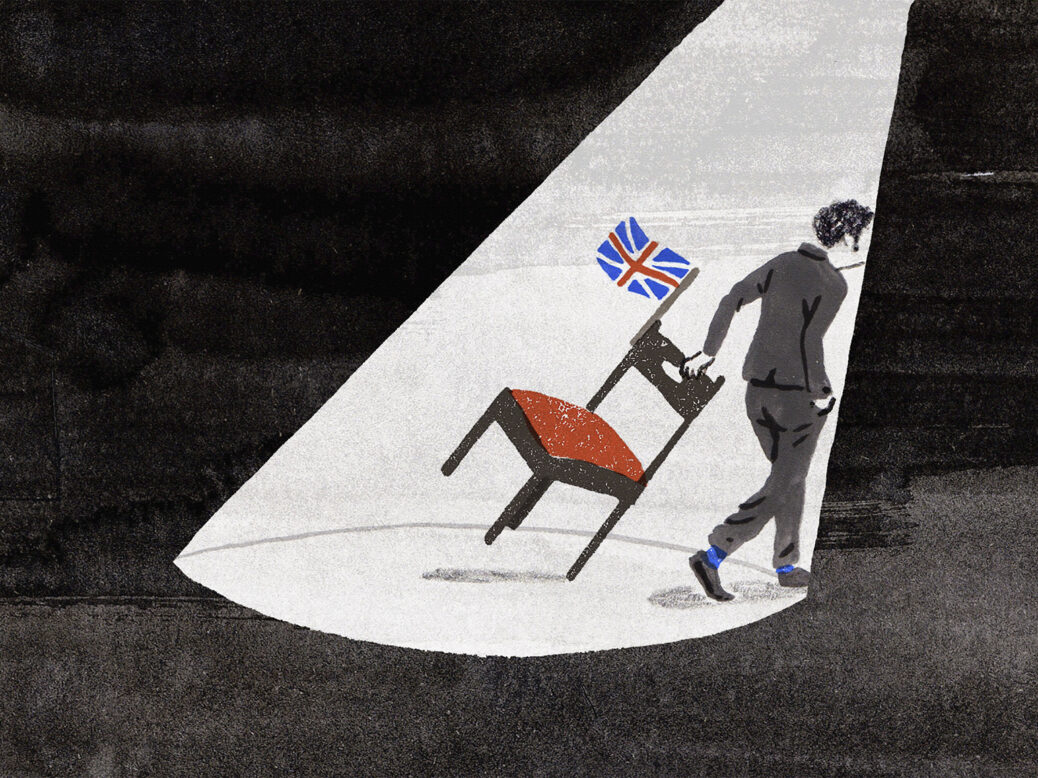
No one in Britain knew how to mark the tenth anniversary of Brexit. And while British politics still seems to be grappling with its consequences, including the regicidal instincts it unlocked in our parliamentary parties, the debate around Brexit remains as contentious as it is confused. The incoming prime minister, Andy Burnham, is being urged to rejoin the EU from some quarters, having won a by-election in which he was forced to cosplay a Eurosceptic in homage to the memory of the referendum. And part of the problem is that contemporary political discourse tends to reward simple partisan narratives, which invariably bias towards single-cause explanations. An answer to the question “Whatever happened to the UK?” will struggle to incorporate the notion that Brexit was just an additional dent in the curve: hefty, but following a clear trend.
Burnham was onto something when he lumped Brexit in with austerity, privatisation and deindustrialisation as “the four horsemen of Britain’s apocalypse”. It is clear that Britain’s malaise – a stylised fact no longer widely refuted – is overdetermined. But it can be tricky to disentangle each horseman from the larger story of political-economic decline. A closer look at some of its cardinal symptoms, however, helps to clarify Brexit’s role within it.
The most striking feature of the British economy after the great financial crisis is what might be termed “Britain’s little valley of tears”, a gaping hole in real wages that opens up after the financial crisis and only closes around 2020, 12 years later. Today, the wage level only sits 2 per cent above its 2008 baseline. Had it been allowed to return to its pre-crisis trend sooner, it would likely be around a third higher. The reason that it wasn’t has much to do with one of the most remarkable policy errors in modern economic history.
The austerity programme enacted by Cameron and Osborne was, by any standards, one of the most intense in modern history. It hit where it hurts most, in the form of long-run public spending cuts to infrastructure, welfare expenditure and state capacity. What truly set it apart was that it was unforced: Britain’s public finances were generally healthy, its borrowing costs low and sterling not under pressure. It is not altogether surprising that, in 2022, ten out of the 15 poorest regions in North-West Europe were in Britain.

The outcome of the referendum is inseparable from this debacle. For one, as the research of economist Thiemo Fetzer and others has suggested, austerity, by worsening regional inequalities, created a reservoir of protest voting that the referendum could mobilise. More importantly, however, both austerity and Brexit were driven by the same impulses: they were both reactions to an ongoing crisis and shaped by how the governing elite interpreted the underlying causes. The fiscal cuts were ultimately an ill-disguised attempt to permanently reduce the footprint of the state, particularly in welfare provision, based on the spurious notion that this was holding back competitiveness and economic dynamism.
It is even less obvious what problems Brexit was purporting to address. What is clear, however, is that it was not just the result of a party-internal squabble over the questions of sovereignty and immigration; it was also motivated by an idea of economic rejuvenation. The EU’s regulatory apparatus was deemed “inimical to creativity, growth and progress”, as Michael Gove put in his speech a few months prior to the vote. Nigel Lawson suggested that an exit would liberate the UK economy from “excessive European regulation” and “restore the conditions for a flexible economy”. The most coherent “left” case for Brexit instead saw Europe’s neoliberal strictures as the impediments for Britain’s industrial revival.
Brexit, like the Trumpian lurch into protectionism, was a politically convenient misdiagnosis: better to indict the country’s trade relationships rather than admit that that fault lies with the national growth model. It had, after all, served some people rather well. One of these people, Lawson, was never one to miss a chance to be on the wrong side of history: as Chancellor in the 1980s, he had already been at the forefront of an effort to address fears of national decline by prescribing the wrong treatment. The choice to bet the house on finance and the private provision of public goods has proven a key inflection point.
We must discard the notion that the healthy productivity growth figures prior to the financial crisis meant that this bet was paying dividends. As Andy Haldane, the Bank of England’s former chief economist, has argued, much of that growth was in fact illusory, driven by excessive, uncompensated risk-taking and debt accumulation in the financial sector. And as the financial sector grew in size, credit growth was channelled largely into mortgage lending, starving industrial finance and entrepreneurial ventures, while firms began to increasingly direct their own surpluses away from productive activity and into more-profitable-and-less-risky financial asset accumulation. Meanwhile, the privatisation of public providers in “demand-inelastic” sectors, where quasi-monopolies mean customers can’t realistically switch providers – such as energy, water, housing, transport, care – encouraged rent extraction.
This transformation begot what John Maynard Keynes described as the “outstanding evil”, namely the “destruction of the inducement to invest”. Productive investment is what drives growth in the long run. A country that wants to raise living standards while ensuring it can sustainably service its national debt needs to maintain adequate levels of capital formation – that is, investment in the things with which the economy creates more things: equipment, buildings, intellectual property, and so on.
In the UK, the structural floor for this dynamic is uncommonly low and has been for decades. As a share of its domestic output, private and public investment have been lower than in any EU economy throughout the entire 21st century. Only a long-stagnant Italy, mauled by the euro crisis, dipped lower for a brief spell. Arguably no wealthy country struggles more to invest and build. The low wage and investment levels and the failure to provide key goods are the primary symptoms of the UK’s malaise. And they are related: why invest in expanding your capacity if consumer demand growth is muted and why invest in labour-saving (read: productivity-enhancing) technologies if the cost of labour is growing poorly? And, given low productivity growth, how can wage increases be justified?
Brexit is not responsible for this dynamic. But it intersects with it in a destructive and measurable way. Investment, having picked up after 2010, stagnates after the vote. On a narrower measure, perhaps the clearest indicator of whether or not the private capital stock is growing (private non-financial net investment), Britain is still below its pre-referendum levels ten years later. Wages, too, had picked up in the preceding years: austerity tapering off, oil prices dropping and sterling appreciating all conspired to push real wage growth close to its pre-2008 trend. This trend too was snuffed out halfway through 2016. If austerity killed the recovery from the crisis, Brexit killed the recovery from austerity.
A proper accounting therefore sees Brexit as an aggravating factor, another act of self-inflicted national impoverishment that has made the country lonelier and less consequential on the world stage. While the losses cannot be recuperated, it is worth asking whether they can be cut. Should an incoming Labour government led by Andy Burnham expend the political capital on rejoining the EU?
As a paper published on 18 June by the Centre for European Reform makes abundantly clear: nearly every sector in the British economy has seen its trade reduced since the separation became official in 2020. But eliminating the tariff border – rejoining the customs union, that is – would do little to redress this picture. The only plausible course is to rejoin the single market, which would entail resubmitting to the European regulatory framework.
This would plausibly include the free movement of goods but also, depending on the shape a new single market membership would take, of services and people. Anything short of rejoining the EU wholesale and making budgetary contributions would seem unlikely to be accepted but the current crop of member states. The political consequences of pursuing this path would be incendiary, and a large share of the civil service’s capacity would have to be devoted to it.
Unlike his immediate predecessor, Burnham will be taking up office in No 10 with a coherent plan of economic transformation. The intellectual scaffolding for Manchesterism at the national scale is widely believed to owe much to the work by progressive think tank Common Wealth. At the centre is the notion that Britain’s shortfall in productive investment in essential sectors is structural rather than cyclical and that the binding constraint is not planning, regulation or savings supply but the cost of capital under private ownership.
This is the real deal. Why waste time and effort on what is ultimately a side show? This is how Brexit needs to be understood. An act of economic vandalism, surely. But one that resembles spray-painting graffiti onto a dilapidated wall of a factory long closed down. Rather than being the cause of the malaise, it simply completed the wreckage of the effect.
[Further reading: How to trivialise Brexit]
Content from our partners



Related


Join the debate
Subscribe here to comment