

It is hardly surprising that renewed calls are being made to declare the obscenely euphemistic “rules-based international order” defunct and to abandon the legal norms associated with it. The conflagration in the Persian Gulf is escalating into an all-out regional war. Its aggressors seem gleefully disinhibited in their use of force, indifferent to the human toll and wider repercussions, brazen in their criminal disregard for diplomacy and international law. The US and Israel are operating at will and their allies seem either unable or unwilling to constrain them.
As the Canadian prime minister Mark Carney recently stated with remarkable (if self-serving) candour, the old order allowed for the application of international law “with varying rigour depending on the identity of the accused or the victim”. The events of recent years have thrown that order’s hypocrisy into sharp relief: wars of aggression and campaigns of ethnic cleansing and genocide are being waged by states that routinely invoke the very legal principles they stand guilty of violating. For the traditionally nationalist right, this will not have prompted much rethinking. On the left, however, it seems to have deepened the notion that the international legal order aids, rather than constrains, the most extreme forms of state violence. This stands at odds with the fact that, increasingly, no attempt is being made even to invoke the law. Surely hypocrisy is preferable to pure anarchy – but does international law meaningfully constrain state power? This question is intimately linked to how we think about the nature of international politics and the real dynamics of political action more generally.
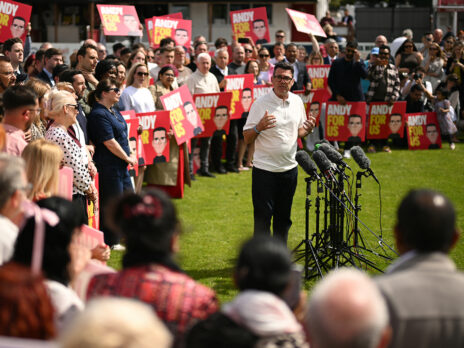
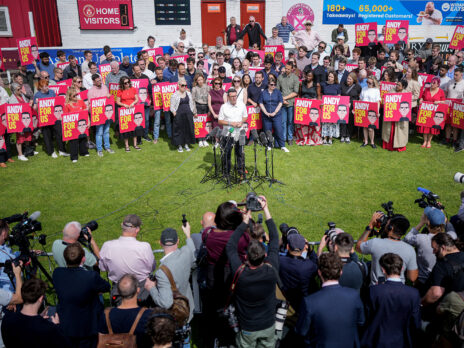
The beginnings of an answer can be found closer to home. On 13 February, the High Court of Justice in London announced its ruling on the legality of the former home secretary Yvette Cooper’s decision to proscribe the activist group Palestine Action as a terrorist organisation. Judicial review of the proscription had been granted by Justice Chamberlain shortly after Cooper’s announcement in June 2025. Chamberlain, who rejected attempts by the Home Office to have the case thrown out, was then unexpectedly removed from the case at short notice. The Ministry of Justice and the judiciary refused to comment; in fact, it was not the first case related to Israel and Palestine in which he was replaced. More awkwardly, the senior administrative judge who removed Chamberlain assigned herself to chair the replacement panel.
At first glance there is nothing unusual in this. When it comes to challenges to government policies that reflect the interests of the US and Israel, the legal systems of their most steadfast European allies have tended to bend. It therefore merits attention that the panel declared the proscription to be unlawful. It constituted a “very significant” discriminatory interference with the right of freedom of speech and freedom of assembly – as enshrined in the European Convention on Human Rights (ECHR). The ruling demonstrates the practical force of the convention in UK domestic law via the Human Rights Act of 1998. Rather than being another cold reminder of the long arm of great-power politics, then, it confirms the potential of international law as a social force or what the Marxist historian EP Thompson called “an unqualified human good”.

Thompson coined the phrase in his 1975 social history Whigs and Hunters, in which he traces the origins of the notoriously repressive Black Act of 1723, a law originally passed to crack down on poaching which allowed the state to assemble punitive powers. After laying out in great detail how the law legitimates ruling-class oppression, he ends by extolling its virtue. The law is an instrument of class warfare not just for the rulers but one that can and should be repurposed by the ruled into real constraints on power. The Black Act was a piece of domestic law, but in his later nuclear disarmament activism, Thompson actively appealed to international legal treaties. But he did so without endorsing the hypocrisy of interstate diplomacy and the legal order’s role in entrenching global economic hierarchies. His internationalism was one that rejected legalism while taking seriously juridical “norms” (as they are more correctly referred to at the international level) as a tool of political mobilisation from below.
Today, Thompson’s view on the matter is not widely held. Outside of the centrist-liberal mainstream, in fact, international law generally enjoys poor standing. One of the most erudite exponents of the left critique is the historian Perry Anderson. In an essay in the New Left Review, published shortly after the beginning of Israel’s latest campaign against Gaza in October 2023, he comprehensively lays out the origins of international law as an implement of Western hegemony from the mid-16th-century onwards. The core of the argument, derived from Carl Schmitt and Thomas Hobbes, but principally from legal philosopher John Austin’s “command theory of law”, holds that international law is “doubly indeterminate”: in content, because rules can mean whatever the powerful need them to mean, and in execution, because there is no sovereign authority to enforce them.
The second condition of Austin’s axiom is crucial: within nation-states there is always a determinable sovereign to enforce the law, and as authority passed from crowns to peoples, so came the legitimate power to change it. “In relations between states,” Anderson writes, “neither condition holds.” Thus, in the absence of a sovereign enforcer, the argument propounded by Thompson and critical legal theorists for the domestic sphere – that juridical rhetoric is “performative” and seeks to bring about the world it invokes – doesn’t hold for interstate politics. Instead, it serves as ideological “mystification”, in the Marxist sense of the term: it obscures or disguises the real social relations of domination and exploitation that underpin it.
This view is emblematic of the left critique of international law. It contains a necessary if obvious rebuke of the self-serving idealism of liberal internationalism. It is plausible, but only superficially so. One issue is the inconsistent arrangement of different spheres of the law: no distinction between private and public law is offered, whereas international and domestic legality are delineated neatly. Anderson’s respondent Martti Koskenniemi sniffs out the implications of the first point: much of what constitutes international law is in fact private law, such as investment law, based on public law instruments, such as the 1958 New York Convention. It allows for claims by multinational corporations against nation states. And far from being absent, the mechanisms for enforcing these claims are very powerful indeed. But public law too is evidently enforceable, as when the butchers of Yugoslavia or Sudan are dragged before the International Criminal Court (ICC) in the Hague or when countries are hit with withering sanctions for leading wars of aggression.
It takes little talent to point out that this system is almost comically skewed towards the most powerful alliance of states and the monied elites. But the observation that enforcement is asymmetric is as true as it is trivial. It is equally trivial to point out that, at the national level, the most powerful factions will have the greatest purchase on the legal process. Dispersion of the legal power is a domestic condition too; it’s not clear that the unilateral sovereign enforcer that Anderson conveniently defines as the necessary condition for law to exist as law actually exists in the form presupposed by Austin. It is wrong, therefore, to presuppose that the content of the law, wherein everyone has the same rights and obligations, is irrelevant. The Palestine Action case is one counter-example, but it is an instructive one. It shows how stark power asymmetries between and within states inflect judicial processes and decisions over which popular sovereign control is virtually non-existent. The unexpectedly favourable ruling reflects both legal substance and the fact that the tidy distinction on which Austin’s command theory rests is illusory: the ECHR and other international treaties reconstitute the domestic legal systems in which they are embedded. At heart, the argument against international law is also an argument against domestic law in “bourgeois capitalist democracies”, which is indeed how Marx himself formulated his critique of the law as a superstructural mask of class power.
The fuzziness of the international-domestic distinction should also soften views of the ICC as a Western neo-colonialist tool: the majority of African defendants, for instance, were referred to the court by their respective countries. But it also explains why, despite overt assurances by European states to their US and Israeli allies, Benjamin Netanyahu feared the enforcement of an outstanding ICC arrest warrant enough to choose a circuitous flight route from Tel Aviv to New York for the UN General Assembly meeting last September. And, by all accounts, the Israeli government’s “Wings of Zion” parked in Berlin airport is empty but for its crew. It seems that, by necessity, compliance with international law – in cases where states don’t comply for reasons of self-interest, reputation and habituation – is secured not just through coercion, but through an iterative interplay between diplomacy, civil society activism and the domestic legal obligations that arise from treaty obligations. Where compliance is possible through mechanisms other than “command-and-sanction”, the absence of a central enforcer doesn’t provide sufficient grounds to dismiss international law as lofty idealism.
In fact, under the right circumstances, the lofty hypocrisy of international law can amount to a collective virtue, where the constraints don’t just provide cover for a decision but shape decisions themselves by narrowing the field of politically feasible actions. This, ultimately, is exactly the argument Anderson sought to refute. The hypocrisy of international law, he later wrote in Le Monde, is not the “the tribute vice pays to virtue” but rather “the counterfeit of virtue by vice, the better to conceal vicious ends”. This reflects one of his defects, one that could be termed “reasoning by aperçu”: disguising analytical flaws with sexy turns of phrase. The clever inversion of the Rochefoucauldian maxim glosses over the fact that if international law were mere mystification and not based on any notion of moral progress attained through historical struggle, then there would be nothing to counterfeit and no one to deceive.
The obvious retort would be that this is how mystification works: the effort of counterfeiting is rendered profitable if the currency is widely accepted. But as Thompson and his intellectual heirs (in the field of critical legal studies for instance) argue, this is exactly the basis on which it can be used against power. For the law to function as a legitimating ideology, it cannot simply be a naked force dressed up in wigs but has to maintain a degree of genuine universality and procedural fairness. This holds true even when the asymmetry of power and the gap between enforcement and norms are sufficiently extreme to prevent enforcement indefinitely. Did it matter that the Iraq War was illegal if the US and its allies proceeded in defiance of any restraints? Surely. It is this century’s premier example of the law not aiding but preventing the concealment of “vicious ends”. The illegality of the war became a powerful political fact, shaping domestic opposition, international alignment and incurring long-term legitimacy costs to American power.
These costs have been increasing rapidly. Neither the US nor Israel have made any attempt at multilateral coalition-building or ensuring the legality of their actions in Iran, relying instead on moral suasion, atrocity propaganda and outright bullying to get their allies in line. But this system is straining the weight of its contradictions. The war against Iran comes just over a month after the US threatened to annex the sovereign territory of a European state. The Greenland affair had prompted an unusually strong response by the otherwise compliant Europeans, which not just forced Donald Trump to back down but spurred wider debates on dismantling the Atlanticist ties. These have now resurfaced. Pedro Sánchez and Emmanuel Macron are openly condemning the criminality of American and Israeli but also Iranian conduct, without lapsing into moral equivalence. They have concurrently led efforts to uncouple from the US militarily. The costs could prove substantial: Sánchez has denied Trump use of Spain’s Rota naval base for purposes deemed illegal under international law. This base is crucial for US “forward deployment” in the Mediterranean. Like Macron, Sánchez is domestically embattled, but he is emboldened by the overwhelming public opposition to the war and the legal order he can invoke.
[Further reading: How politics went hyper]
The discussion boils down to how we assess the efficacy of appropriating legal norms to constrain state power relative to the ideological cover they supposedly provide. What the critique of international law implies, in other words, is a theory of geopolitics. The framework implicit in the mystification argument is a kind of “left-realism”, in which international law is treated as a form of liberal idealism. The work of international relations historians and theorists such as Peter Gowan and John Mearsheimer provides a common reference point. While they differ on the details – particularly the role of domestic politics and history – they treat power competition as the basic grammar of international politics. International anarchy, that is the lack of a legitimate enforcer of the law, compels states to maximise their power relative to others. The supposed virtue of this anti-idealist framework lies in the absence of explicit normative prescriptions. This separation of “is” and “ought” is supposed to guarantee a more unvarnished description of political reality.
This view is naive in the extreme. Realism’s statements about the world are often more definitional than descriptive. In practice, it simply defines states as power-maximising actors under conditions of anarchy, then “discovers” that states compete for power in anarchy. This circularity makes it unfalsifiable: cooperation or attempts at piecemeal normative change (through, say, legal norms) can always be dismissed as naive or as disguised power-seeking, and raw power prevailing read as a confirmation of the framework. It is fashioned to be insulated from its own critique (that norms are always shaped by power) by starting from a point of abstaining from idealism to avoid mystification.
The result is a powerful status-quo bias. By presenting contingent political arrangements as structural necessity, realism tends to foreclose on real alternatives and naturalise the interests of great powers as timeless laws. That places it further away, not closer to, political reality. The framework for inter-state politics on which the left critique of idealism relies is not an antidote to ideological mystification but a more potent and reactionary form of it. It fulfils the same function as idealist hypocrisy but is shorn of any universalistic moral content on the spurious grounds that any such content is naive and dangerous. This is how the proponents of left-realism can, for instance, be led to sincerely believe that Russia was provoked into invading Ukraine, in what Anderson’s colleague Susan Watkins referred to as a “desperate defensive gamble against the advance of US military power”. Whatever Russia’s territorial ambitions, its pursuit of regional hegemony is seen as a rational survival strategy in the face of a Western imperialism cloaked in the language of legality and democratic virtue.
In his influential interwar history The Twenty Years’ Crisis, historian EH Carr cautioned against this vulgar form of realism. While he shared Anderson’s deeply sceptical view of liberal idealism (Carr resented Woodrow Wilson’s catastrophic influence between the wars) he at least recognised the constitutive role of the dialectical interplay between power and moral purpose. It is hard to support the notion that this tension has not led to the gradual decline in the violence and coercion between and within states in recent centuries. Realism without such purpose, Carr wrote, “is nothing more than the thought of old age”, the resigned and cynical posture of someone who has given up on any normative aspirations.
Surely what matters is our aspirations are intellectually grounded. Or, more crudely: the conflation of “is” and “ought” is not the primary concern. Rather, it is the need to furnish political action with an accurate representation of political reality and plausible mechanisms by which it can be reshaped, which was what Carr’s “critical realism” intended to do. This necessarily involves accepting both the contingency of political outcomes and the mutually constitutive relationship between politics and ideas, whether these are philosophies of history or juridical norms.
This view of political reality is borne out by any substantive discussion of the law. Yes, power is the decisive factor in international politics. The law invariably favours the great powers. But they can, nonetheless, feel compelled to justify their actions by invoking it. The process of invocation is not costless, and the constraints are real precisely because not all justifications are equally available. And the extent to which norms are enforced depends on the extent to which these costs can be made real. What the left-realist critique ends up as is an implicit call not to contest this process, lest we become complicit in mystification. This amounts to a premature abdication of duty to pursue normative progress in the international system – beyond, presumably, just waiting for capitalism to end and hoping that imperialism ends with it.
The counterfactual isn’t addressed either. What would the world have looked like without this process? For one, the Palestine Action activists may have ended up serving long jail sentences despite the triviality of their offences. In the larger scheme of things, we are already seeing this world. When it comes to use of force, the US administration has become entirely unfettered from legal constraints at home and commitments to collective hypocrisy abroad. While there is more continuity between Trump and his predecessors than many care to admit, his second term has seen an upwards lurch in the willingness to use military force. The unchecked aggression against Iran is but the latest example. It is both the symptom and the cause of a political climate that has markedly degenerated. Certain conversations simply don’t happen anymore. “By what right do you think you can invade and annex Greenland?” can now be met with a simple, “What do you mean?” On what grounds does one then argue against the territorial aggrandisement by a stronger power? “Please don’t”?
This left-realist abdication can be read as a form of disenchantment: a fatalistic response to the political powerlessness of the left and grand failure of political projects in the face of state power. This fatalism isn’t new. The 20th century is replete with thinkers who fell prey to their pessimistic zeitgeist. One great example is Max Weber. His brand of “political realism” would go on to greatly influence international relations theorists such as Hans Morgenthau, the father of “classical realism”, from which contemporary realists such as Mearsheimer descend. But Weber’s canonisation was premised on historical luck. Perhaps counterintuitively, historical outcomes are not in fact a great measure of the potential of political ideas. Believing otherwise requires a strong belief in determinism and a dismissal of counterfactual outcomes.
The catastrophic events of the interwar period were by no means predetermined. But they retroactively validated Weber’s fatalism. It is often overlooked how ideas are removed from the very specific historical contexts they were formulated in. Weber wrote amid great disillusionment following the First World War. Hobbes and Schmitt, on whom Anderson draws heavily, both wrote during unprecedented war and upheaval, namely the English Civil War and the Second World War, respectively. Austin’s bizarre and utterly refuted style of legal positivism was heavily influenced by his proximity to early utilitarian philosophy. Treating their ideas as timeless historical truths will invariably yield a distorted view of the world. And here lies the rub: left-realist disenchantment obscures rather than illuminates the real historical dynamics of political action.
Beyond the sense of disenchantment, Anderson seems to share Weber’s historical determinism and his methodological nationalism. His fixation on the nation-state subverts his ability to imagine constructive political action within new institutional form such as political activism with recourse to international legal norms). This inability is worsened by an overly schematic and abstract reading of history, not as a messy and contingent process of social transformation, but as a structurally determined process in which political actors have little generative capacity to begin with.
It was EP Thompson himself, in his 1978 essay “The Poverty of Theory”, who criticised Anderson for this very tendency. On the matter of the law: if Thompson can be accused of a romantic overinvestment in the normative surface of institutions whose real logic is determined by great-power interests, Anderson can be accused of dismissing too easily the constitutive nature of juridical norms and the social agency they afford, and ends up trading one form of mystification for another. This conceit, as HLA Hart concluded his scathing critique of Austin’s command theory, serves “only to conceal the facts, that here if anywhere we live among uncertainties between which we have to choose, and that the existing law imposes only limits on our choice and not the choice itself”. It is telling that Anderson’s engagement with Hart is limited to a catty footnote that leaves the substance of the argument largely untouched.
As for Weber: the destruction of imperial Germany left him, by his own admission, “politically very clueless”. Among contemporary “left-realists”, this level of self-awareness would be welcomed.
[Further reading: Churchill knew the relationship was never special]
Content from our partners



Related

Join the debate
Subscribe here to comment