
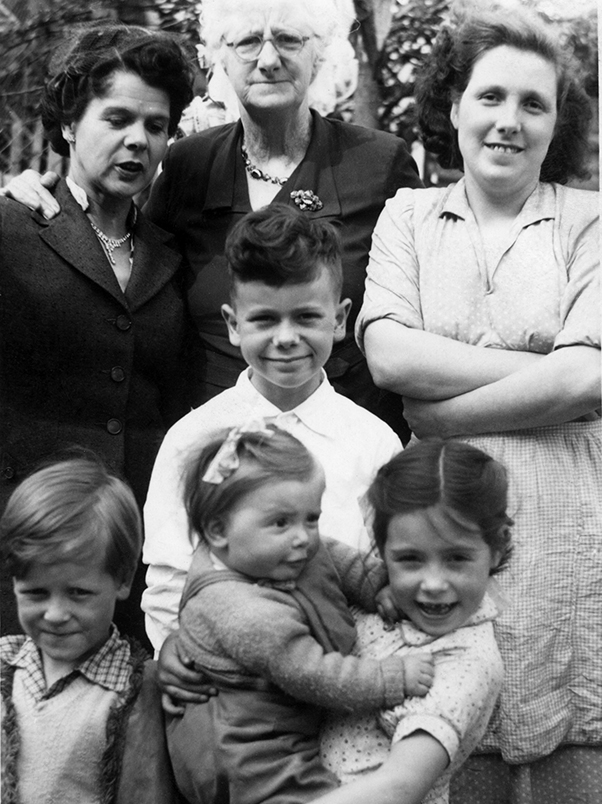
In the lottery of life, it has proved modest good luck to be born in England in 1955 and come of age in the 1970s. The acute postwar austerity was over, rationing had ended, homes were accumulating the gadgets that rendered lower-class lives a little less uncomfortable. Opportunities had widened for clever, underprivileged girls who then benefited from the progressive reforms provoked by early feminism and demands for inclusion. The “modern” world was shrugging off the deference that still clung to the immediate postwar years. Negotiating a collective and personal history, the academic and writer Alison Light’s Red, Red Robin is a memoir of a moderately happy existence in a moderately supportive family in a scruffy town neither deprived nor prosperous. It starts (and ends) in Portsmouth, the “home” that Light leaves to study at Churchill College, Cambridge.
Chronology is out of fashion in modern life-writing, which tends to skip about and rely on objects as scaffold, but this memoir pays some attention to it. Taking many detours into the past of parents and kin, Light traces her development from a “bad baby” through her show-off years, sibling encounters, a transforming grammar school and public library, the yearning adolescent delight in girlie fashions, teen magazines, pop idols and songs. Words form a leitmotif – parental sayings, community ditties, childhood anecdotes, slang euphemisms of an earlier time:
“Women’s troubles” were a lingua franca among the aunts, the main topic of their “chinwags”, although lapsed wombs, heavy periods, stretchmarks, varicose veins and other miseries meant little to me (cancer was never named). Sex had its own vivid vocabulary… a woman might be “up the spout”, “in the club” or have a “bun in the oven”.
Such expressions give way for young Alison to the abstractions of the Cambridge years. We are told about the arts curriculum, that FR Leavis included George Eliot in his “great tradition” of the English novel and that “Lisa Jardine and Roy Porter were fired-up intellectuals, who crossed traditional disciplines”. The book circles back to the Portsmouth “home” to deliver more and more detail about a place which, with this accumulation, almost dares the reader to find humdrum. As new consumer goods arrive, they are lovingly recorded: “scratchy Izal replaced sheets of newspaper, until that too was replaced in turn by softer toilet ‘tissue’ in pastel shades”, while shiny new materials, Formica and melamine, entered the kitchen along with the bad-tempered spin dryer evicting the laborious mangle.

Two objects have memorable chapters: the doll’s house, refurbished across generations and doing duty for “home” itself, and the trunk acquired for young Alison to go “up” to Cambridge, to move mentally and physically from the life her parents gave her. Light writes:
I was born into a working-class body, the runt of the family, but I shall die in a middle-class body, changed by science and money. If the body is a historical document, it is a palimpsest, written on and rewritten over the years.
Note that English habit – perhaps quaint now? – of labelling ourselves, above other identities, by class.
Red, Red Robin is a book by a dedicated materialist historian commenting on the history of her youth. Experiences are immediately contextualised and given sociological value, rarely left ambiguous or unresolved. With so much accretion, the life emerges more as social witness than unique experience, with a self formed by place, class, education and inheritance.
Light’s previous work, including the splendid Mrs Woolf and the Servants, has combined the personal and the collective. Here, the personal is fleshed out but, in keeping with the attentive attitude to recording and commenting, the memoir is devoted less to the drama of disclosing a valued inner self than to providing facts and details of a world outside: house, city, parents and extended family.
The trajectory of the clever female baby boomer is not uncommon. The recounting here is made memorable by the sheer amount of retained material – the schoolgirl diaries hoarded into adulthood, the scrapbooks, letters, comics and ornaments, delivering the texture of an urban childhood of the 1960s and early 1970s.
Yet, despite so much available material, the memoir repeatedly reaches back to the dramatic years of the Second World War, experienced not by Alison but by her parents and grandparents. They intrude their greater drama – perhaps authority, even authenticity? – into her own life which lacks such conflict. The war with its “finest hour” rhetoric has the status of an origin story pulling together a nation no longer allowed pride in empire. It is less a global struggle (Light’s father did not serve abroad) than a physical calamity for the bombed seaport of Portsmouth. Within the family, the war becomes palpable in a “rough grey army blanket with red stitching” which migrated from bed to bed.
The older generation’s recollections of wartime Britain and its aftermath of scarcity and aspiration give texture to Alison’s own childhood, along with reanimated tales, habits and songs that form generations. Memoir and social history mingle in nostalgia – if the word can be used for what was not personally experienced. Light understands the process: “family lore becomes foundation myth,” she notes; “memory defeats chronology”. As late as chapter eight the book focuses on the experience of wartime evacuees.
The mingling of past and present, of different generations and kin beyond the nuclear family, gives density, even ethical purpose, to the book; it adds perspective to an “ordinary” life. However, it risks suggesting that the drama of the weightier past is needed to undergird a thinner present.
Why write a memoir? There’s some narcissism in the decision, of course. When social media manipulates and fashions identity, and when it encourages us to tell “our” story, it is easy to be self-indulgent – less easy to do what I take Light to be doing. She is suggesting that the past shouldn’t just disappear but also that it lingers, the old joy and sadness, customs and songs remaining not only in survivors’ heads but also somewhere beyond: the past becoming a living if ghostly presence in the culture. It is a rather unfashionable insistence on understanding a self as influenced by causes and consequences, by shared detail, refusing confessional excess or inflated inwardness. Loyalty is to accuracy. It’s a dignified choice and it is perhaps frivolous to want more introspection, but the choice of method does risk factual overload.
Alison Light has written extensively on Virginia Woolf as novelist and diarist and she is aware of Woolf’s scepticism about memoir and its certainty about witness. In The New Biography, Woolf warned against the seduction of accumulating facts, insisting that the solidity of dates, habits and external circumstance – the “granite” of life – must be held in tension with the trickier “rainbow” of consciousness. Without both, life in memoir would not live. Light’s work is rich in the “granite”, delivering a sense of material and popular culture, but perhaps without quite enough “rainbow”. The text lacks a central drama that requires resolution, glaring ambiguities, or the usual claims of “misery memoirs”, and a coherent, textured life emerges, but not a gripping book.
Red, Red Robin is a social memoir, showing us how an ordinary life is formed at a particular historical moment. It is a goodbye to parents who only towards the end of the book are delivered as separate beings with emotions that cannot be explained and quickly contextualised; their unknowability is guarded while their formative influence remains.
The book will speak most directly to readers who recognise its world and agree or reject its detail as typical, or who share Light’s belief that explanation can substitute for exposure. Virginia Woolf might have wished for fewer facts and more moments of being, fewer returns to inherited myth and greater trust in the authority of lived perception. Yet she would, I think, also have recognised the integrity of the undertaking. Alison Light shows us that all of us live according to different pasts, our lives a matter of genes, temperament and historical timing. Like so many of us, she has a habit of saying goodbye to a childhood self and place while showing in moving detail how impossible it is to say this only once.
Janet Todd’s most recent book is Living with Jane Austen (Cambridge University Press)
Red, Red Robin: My Long Goodbye to Home
Alison Light
Weidenfeld & Nicolson, 336pp, £22
Purchasing a book may earn the NS a commission from Bookshop.org, who support independent bookshops
[Further reading: How Charles Darwin humbled mankind]
Content from our partners



Related


Join the debate
Subscribe here to comment