
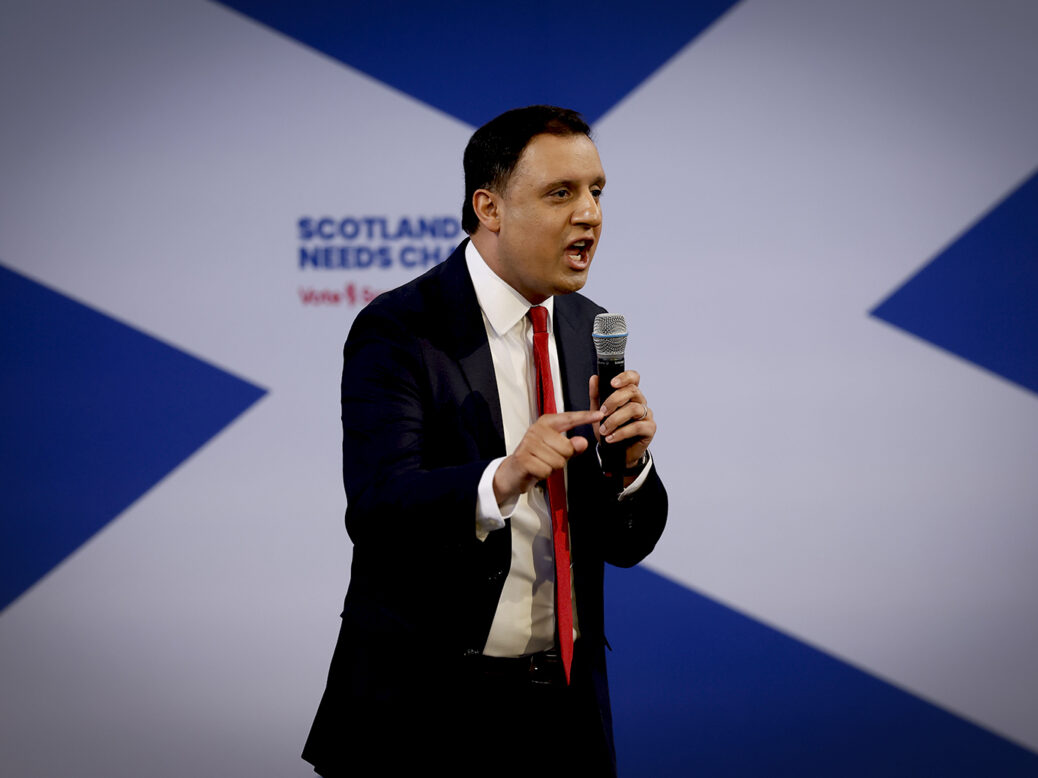
At an emergency services roadshow on the edge of Loch Lomond, ambulances, police vans and fire engines line up outside a row of souvenir shops. There’s the cacophony of crying toddlers, and then on top of that there is the cacophony of their older brothers and sisters being lifted into the cockpits of the vehicles by policeman and paramedics to turn the sirens on and off, and on and off. I am sat on a low wall grinding my teeth because this is where Anas Sarwar has told me to meet. Then the next emergency services vehicle arrives: the bright red Scottish Labour battle bus emblazoned with a picture of his smiling face. Despite high hopes and a strong showing in the 2024 general election, the fortunes of Scottish Labour have fallen fast along with the national party and Sarwar’s dream of becoming first minister – only recently within touching distance – seems to be slipping away.
The bus came out of the body shop a few weeks before polling day to take Sarwar around the country, or more accurately the central belt of the country. Despite its massive sweeping landscapes, Scotland’s population distribution makes it one of the most urbanised countries in Europe. Most of the voters Labour is targeting live in this strip of towns and cities. The central belt was Labour’s great success in 2024, when the party won 37 seats, mostly from the SNP, on a 16.7 per cent swing – its best result since 2010. Two years on, the party is struggling to consolidate those wins into MSPs and control of the Holyrood parliament.
The bus is already strewn with evidence of use, including discarded Irn Bru bottles (Sarwar himself is avoiding the stuff). He is announcing a new mental health policy and the press team want to get him snapped in front of an ambulance. He is also the most naturally adept baby-kissing, hand-shaking Scottish politician of his generation and so a venue full of families running about seemed the ideal location.
When he leaves the bus to pound the streets on foot, Sarwar is accompanied by the whirring levitation of a camera drone operated by his personal social media manager. He has an easy manner and is happy for most of his interactions with the public to be captured on camera – his team were particularly chuffed about a chance encounter with a Glasgow pensioner and Sarwar megafan that became part of an election broadcast.

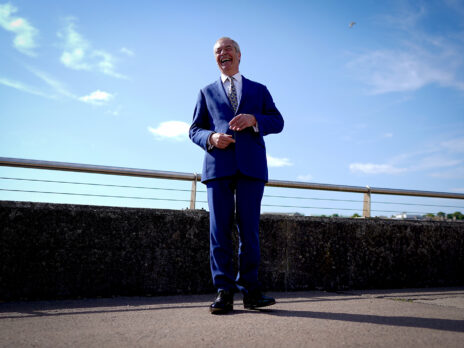
The story that has loomed over this election for Scottish Labour is Sarwar’s decision to publicly disavow Keir Starmer before campaigning even began. His allies say he had been pondering it for a while and that a weight lifted for Sarwar when he said out loud that Starmer should go. There were elaborate theories at the time that he had done this as the starting gun in a UK Labour leadership challenge by Wes Streeting, with whom he is politically closely aligned. But it seemed more obviously a simple electoral calculation: in a first for a UK Labour leader, the Prime Minister is now less popular in Scotland than Nigel Farage, and Sarwar had no choice but to distance himself. Labour MSPs describe Starmer as “electoral kryptonite”. Reform UK now thinks it is in with a chance of winning second place, an extraordinary turnaround for Farage, who was once considered a toxic totem of English nationalism north of the border (his party is benefitting from the collapse of the Conservatives).
In the campaign Sarwar has faced a strange dynamic where Scottish Labour, so long derided as a “branch office” of the UK party and considered suspect by some for its English links, suddenly had its leader being questioned by the press about whether his relationship with No 10 as first minister would be so bad that it could harm Scotland. Sometimes you really can’t win.
“Look, I said what I said, I stand by it and I don’t recoil from it,” he tells me on the bus, “Obviously, it was personally difficult, but politically liberating in many ways. I’m the one that’s standing in front of the people of Scotland asking for their trust and support, and I think it’s important that they can see unequivocally that my loyalty is not to a politician somewhere else or to a politician in London. My loyalty is to Scotland because I’m standing to be Scotland’s first minister, and this country’s got so much amazing talent, ability, resource, potential has been strangled under an SNP government, and changing my country is my number one priority.”
His open lack of loyalty “to a politician somewhere else” has helped him swat away the SNP’s opening gambit of the campaign, which focussed heavily on punishing Labour for the unpopularity of the Prime Minister. The joke in Labour is that John Swinney is a Scottish nationalist who thinks he’s running in an election in England.
Despite the break with Starmer, Sarwar still has close links to cabinet – Douglas Alexander was up in Edinburgh for his manifesto launch, where the pair high-fived, and Wes Streeting has praised him as the greatest Scottish Labour leader since Donald Dewar. He is withering while still being polite about Starmer and Rachel Reeves, saying as first minister he would like them to stay behind their desks and keep investing in Scotland.
Every poll since the election began has had the SNP ahead. Some at the start even predicted an outright majority for them at Holyrood, which is rare under the electoral system, though the margin has tightened. But hopelessness is not setting in. I’m told internal Labour polling shows that up to 40 per cent of voters remain undecided and they could make all the difference. Some might call this optimism, others fantasy.
Sarwar thoroughly enjoys mocking journalists who make firm predictions about the result. He delights in reminding us that we were wrong about the death of Scottish Labour in the 2021 election, wrong about the by-elections in Rutherglen and Hamilton, which Labour won, and wrong about the scale of Labour’s victory in 2024. “I get why you do it,” he says. “That’s your role, to ask questions, to have hypotheticals and put hypotheticals to us, to commentate. I’m a participant, not a commentator. My job is to try and influence the result of the election by earning people’s trust and arguing for the outcome I want. Rather than talking about the outcomes that other people might want, I’m going to focus on the outcome I want, which is to change the first minister to have a Scottish Labour government.”
His only firm prediction is that Reform will never win, either in Scotland or the UK at large. “I genuinely don’t believe they’re going to win,” he says, dismissing their politics as “divisive poison”.
And yet, of course, he will need them if he is to achieve his goal and become first minister. With six parties fighting it out and an additional member system that throws up peculiar results, the possible outcomes in this election range from an SNP outright majority to a collective majority of the unionist parties: Labour, the Lib Dems, the Conservatives and Reform. In that latter eventuality, Sarwar will put himself to be first minister by a vote in the Scottish parliament and he will need Reform MSPs to back him.
Whenever he is pressed about this, he gives a politician’s answer. He tells me: “I’ve been unequivocal, there’ll be no deals, no stitch ups, no secret pacts, but I’m going flat out to win this election, and my job is to persuade people in this election campaign, rather than to commentate on what might or might not happen. Ultimately, the people of this great country will decide.”
And yet Malcolm Offord, the Reform leader, says Sarwar has been trying to stitch together just such a deal. Sarwar calls him a liar. We will find out when Holyrood decides the next first minister. One of Sarwar’s closest allies tells me, cheekily, that there is much Sarwar could do with the first minister’s powers without requiring Reform’s sign off – even if he was elected off the back of Reform votes. In Scotland and the rest of the UK though, the Greens and the nationalist parties would have a field day at the prospect of Labour governing in an informal confidence agreement with Reform.
And so Scottish Labour, flushed with optimism only two years ago, is now faced with a range of fairly miserable options. Yet Sarwar and his team remain in high spirits. The camaraderie of that team has been meshed together by long hours. He has them working in the office until 10pm, even on Fridays. One senior Labour figure tells me that I should think about Sarwar as an entrepreneur running a startup. The thinking is this: the party was reduced to nothing in the 2015 general election wipeout, in which he lost his own Glasgow seat, and he has been trying to rebuild it from the ground up ever since. Old tensions within the party, for example the suspicion from Scottish MPs that the MSPs were interlopers on their patch, have melted away. “It’s a uniquely united team,” one of his lieutenants tells me.
Well, that’s what they say publicly. Members of his shadow ministerial team are playing nicely while the campaign goes on. In private, it’s a different story and there will be hell to pay if Reform’s dreams come true and Labour slips into third place. Sarwar is quite sanguine about the rough-and-tumble of Scottish politics. He has set himself the daunting task of becoming first minister. But will he be toppled if he fails? “I’m determined to win, to be first minister and do the hard work to deliver for this country! Look, I’ve been doing this job for five years. I think I’ve done a good job in bringing our party together. I think there’s no doubt, having been a Labour politician now for 16 years on the front line, there’s always criticism, but I want to bring our party together and deliver the change our country needs.”
As far as the criticisms go, even people who like him say he can be a tell-people-what-they-want-to-hear politician. Some in Labour even use the term “slippery”, and use his repudiation of Starmer as an example of that (“it would have seemed a bit more authentic if he’d done it last year, not just before the election,” said one).
But Sarwar’s basic problem is not a lack of skill, energy or appeal. It’s that he’s running in a national election in Scotland on a change agenda, when he already won a national election on a change agenda in Scotland two years ago. Two years on from the July 2024 red wave, Scotland doesn’t feel anything has changed. Unfair, perhaps: Scottish Labour will remind you that public services, the stuff people are really fed up with, were run to earth by the SNP and the Tories, not Labour. The result has not been a resurgence for Labour but across-the-board apathy: turnout is expected to be appalling, perhaps even in the low 50s.
Sarwar’s pitch is to make that case for a second go. There is only one group of voters who he has really written off, and that’s those who are dedicated to independence and will vote SNP for that reason alone (one senior Labour figure says the party estimates that it 30 per cent of the population). “I think there is clearly a core of the electorate that even if they disagree with the SNP’s performance, may well still vote for them, partly because of the constitution,” Sarwar says. “I don’t support independence. I don’t support a referendum, but I know many people who do support independence, who might at some point in the future, want a referendum, but still think this government in Scotland’s not up to much. I’m saying to them, let’s work together right now to make our country better right now and then, if Scotland choose a different destination in the future, that’s for future generation of Scots to choose.”
[Further reading: Britain is still breaking up]
Content from our partners

Related

Join the debate
Subscribe here to comment