
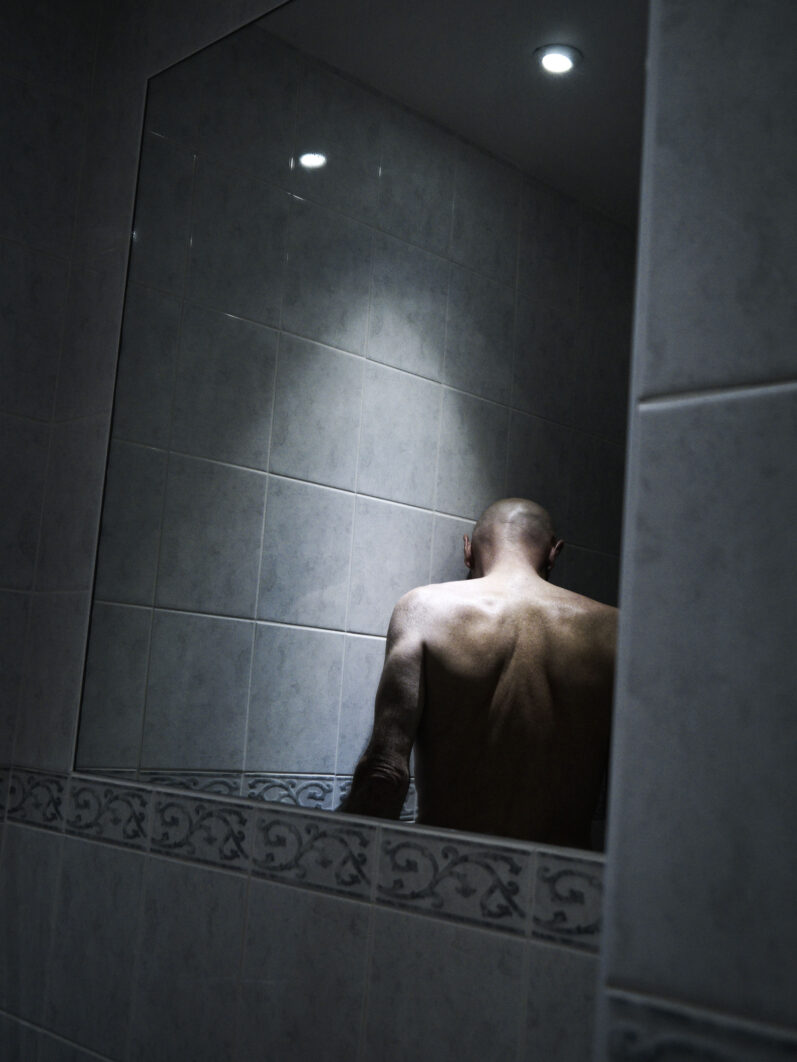
A young man stands in front of the bathroom mirror and studies his face. The lighting is bright and unforgiving. He turns his head left, then right. His jaw is sharp, his skin clear, his features even. He could pass for a model or a minor film star. He leans closer to the glass, scanning for irregularities: the slope of his nose, the projection of his cheekbones, the set of his brow. His expression is clinical. After a moment, he steps back, reaches for a small hammer resting on the counter, and begins striking himself high on the cheeks. The blows are controlled and deliberate. He believes they will make him beautiful.
The young man is Clavicular (real name Braden Peters), a 20-year-old American livestreamer who has dedicated himself to the art of looksmaxxing, an extreme self-improvement movement that originated in male incel forums in the 2010s. He says he began taking anabolic steroids at 14, before his body had fully developed, in an effort to accelerate muscle growth and widen his frame. He claims to have smoked crystal meth to make himself leaner, and to engage in a practice known as bonesmashing (striking his cheekbones with a hammer to heighten them). He also believes he is autistic, although he has never been diagnosed.
His online name is a reference to the clavicle. Within looksmaxxing forums, shoulder width is a fixation; a short clavicle is considered a genetic limitation to achieving the broad, muscular frame that signifies dominance. To call yourself Clavicular is to signal an ironic awareness of bodily constraints while doing everything you can to surmount them. I wonder if Clavicular can see the irony. He has spent a lifetime adjusting his superficialities, only to forge an existence where he is imprisoned by them.
He is, in his way of life and his philosophy, an example of the male gaze turned inwards. The evaluative stare that feminist film theory once located in men’s appraisal of women now fixes on his own face and torso. He becomes both spectator and spectacle, assessing himself according to a hierarchy of traits ranked and debated by other men. The sociologist Raewyn Connell describes masculinity as a hierarchy structured around what she calls hegemonic masculinity, the culturally exalted form that subordinates other masculinities. Within that framework, Clavicular’s project reads as a strategy for mobility. If hegemonic masculinity prizes height, breadth, leanness, and facial symmetry, then looksmaxxing becomes a method of climbing the ladder. His self harm is reframed as investment. Each blow of the hammer is an attempt to convert flesh into status.

The core tenet of incel culture is that unattractive, low status men are doomed to a life of involuntary celibacy. Clavicular’s origin story is that he was once ugly, but through extreme looksmaxxing has become beautiful. It’s a peculiarly American narrative, the Protestant work ethic made flesh. Except where the traditional American dream promised that hard work would lead to prosperity, Clavicular forgoes traditional labour. Among looksmaxxers, those who work regular salaried jobs are dismissed as “wagecucks”. Clavicular is paid by his fans to exist and to be experienced. He lives the life of a beautiful woman, as imagined by a man.
In doing so, he embodies many of the misogynistic stereotypes circulated in the manosphere. He refuses conventional labour, treats beauty as his primary occupation, and expects to be paid for his presence. The figure that incel forums deride, the woman who profits from her appearance, is reproduced in male form. It recalls Susan Bordo and her analysis of how female bodies have historically been fragmented into fetishised parts. In Clavicular’s content, his clavicles, jawline, cheekbones, and waist are isolated, measured, and discussed as detachable units of value. The male body is subjected to the same partitioning gaze.
Earlier this year Clavicular was filmed with Nick Fuentes and the Tate brothers, singing along to Kanye West’s song “Heil Hitler” in a nightclub. Fuentes, a white nationalist streamer who has become increasingly influential among young Republicans, endorsed Clavicular as a “total Chad”. Both speak to the same disaffected young men who feel they have been robbed of something that was rightfully theirs. They are two sides of the same coin, the incel and the looksmaxxer. Although Fuentes frames withdrawal from women as ideological purity and Clavicular pursues female attention with intensity, each is vying for status among men. Women function as instruments in a contest whose true audience is male.
And he has formed a subculture around his personality. His videos are posted with captions like: “Clavicular was mid jestergooning when a group of foids came and spiked his cortisol levels. Is Ignoring the Foids while munting and mogging Moids more useful then SMV chadfishing in the club?” The language, incomprehensible at first glance, is part of the subculture’s trapping. Roughly translated it means: “Clavicular was zoning out when a group of women caused him stress. Is it better to ignore women while gaining status over other men, or is it better to go to a club and trick people into believing you are desirable?” The vocabulary allows those in the know to describe the minutiae of awkward social interactions while maintaining an ironic distance. It also provides an in-group. Looksmaxxers are seeking a sense of belonging. The more obscure the terminology, the stronger the boundary between those who belong and those who do not. For young men who feel excluded from traditional pathways to status, this manufactured community offers what the mainstream has denied them.
In an interview with conservative commentator Michael Knowles, Clavicular elaborated on his beliefs. “Your looks are going to improve your quality of life in a number of different ways, whether it be in the workplace or overall opportunities presented to you.” Key to this philosophy is the Halo effect, that people will think better of everything you say or do if you’re good looking. “Your overall wellbeing if you’re an unattractive person… nobody even wants to look at you in the elevator, no one wants to shake your hand or acknowledge you,” he says. “It’s horrible for your mental wellbeing.” Studies in social psychology support the existence of attractiveness bias. Clavicular extends this insight into a totalising worldview. Appearance becomes the master variable governing all outcomes.
It is telling that Clavicular became interested in looksmaxxing as an insecure, spotty teenager, before he had properly gone through puberty. Many boys who feel awkward at 14 grow into their faces and bodies with time. It is possible he would have become handsome without chemical intervention, had he allowed himself to mature normally instead of beginning steroid use in adolescence. He represents a cohort of Gen Z doomers who are cynical about lives they have not yet lived. Convinced they are locked out of status, intimacy, and prosperity, they seek new means of self-realisation.
“What’s more likely for the average guy… to ascend from maybe slightly below average to above average through looksmaxxing, or for them to achieve the desired amount of wealth for a supermodel to date them?” Clavicular asks Knowles in their interview. “It seems we should be telling people to go the looks route.” Just as the incel hates women because he anticipates their rejection, young men are checking out of the economy because they believe they cannot have the same lifestyle their fathers had. The parallel is structural. Both rejections produce the same solution: become beautiful. If women won’t desire you, become so desirable that you no longer need their desire. If the economy won’t reward you, become so aesthetically valuable that you don’t need a job anymore.
There is a radical economic element to Clavicular’s worldview. He is not merely an influencer monetising attention. He articulates and embodies a philosophy in which beauty is the primary form of capital and the ultimate hedge against precarity. Work and education are secondary to bone structure and body fat percentage. In this schema, the marketplace of desire supersedes the labour market. Under looksmaxxing, sexual insecurity and economic insecurity go hand in hand. Clavicular argues that social media has radically increased hypergamy, allowing the most handsome and successful men in the world to directly message any woman. “Now we’ve got people like professional athletes DM-ing them on Instagram and flying them out. So you’re not just competing with the top chads within a 15 mile radius, you’re competing with the entire world.”
It’s easy to see who Clavicular’s audience are: a downwardly mobile generation of young men obsessed with appearance who increasingly feel it is more realistic to be beautiful than it is to be rich. Economic life is more insecure, and a well-documented crisis of masculinity is emerging as a key phenomenon of 21st-century life. Many men have fled to the manosphere in response, and Clavicular has become a minor phenomenon within this context. He has been profiled in the New York Times, appeared on The Adam Friedland Show, and slang such as mogging has migrated beyond niche forums into wider online parlance.
In the New York Times profile, published earlier this month, Clavicular takes a young woman on a date. Dates are a staple of his content stream, allowing young male fans to live vicariously through him. But despite it doesn’t go anywhere, with Clavicular telling the Times that knowing that he could have sex with a woman is in some ways better than having sex. Sex, he says, is “going to gain me nothing”. Looksmaxxing, due to its origins in incel culture, is both obsessed with being wanted by women and loathsome of them. The group that incels think the least of is also the group whose attention they need the most. But it’s not because they care about what women think. Being desired by women is downstream of the thing that really matters, the respect of other men. Sex is incidental to the status it confers.
Clavicular’s tragedy is that he gave up early on a slower and less spectacular path. The male gaze he absorbed from the culture around him did not dissipate when he turned it on himself. It intensified. He learned to scrutinise his own face as harshly as his worst enemy would and so narrowed the range of futures available to him. The inward gaze promised control and ascent within masculine hierarchies, yet it foreclosed the possibility of growing up normally.
But there is another version of his life that never happened. A 14-year-old boy with acne and narrow shoulders who never finds himself on online bodybuilding forums. He finishes school. He grows taller. His skin clears. He learns, slowly, how to talk to girls without an audience watching. He lifts weights at a local gym without filming himself. He has awkward years and survives them. By his early twenties he is good-looking without knowing the exact measurements of his cheekbones. He has not struck himself with a hammer. He has not needed to.
[Further reading: Down with the “positive male role model”]
Content from our partners



Related

Join the debate
Subscribe here to comment