
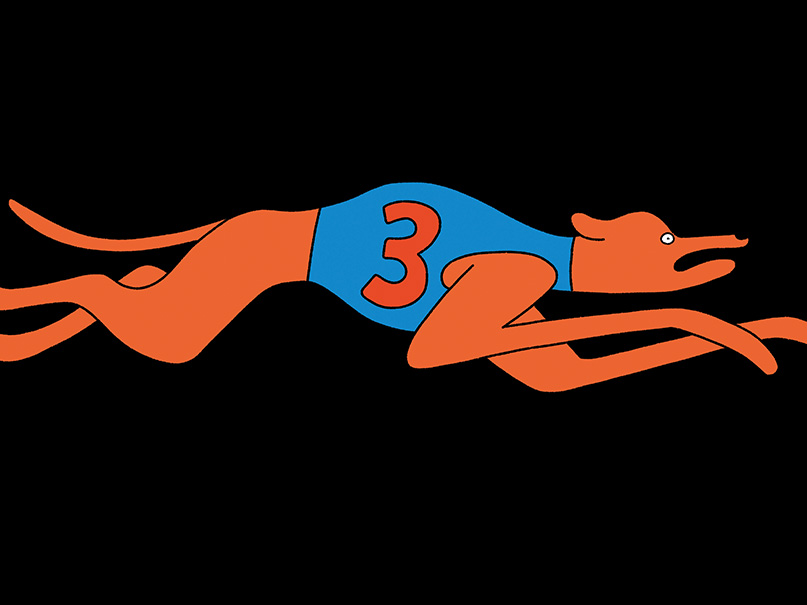
Zinedine Zedog stood poised at the edge of the greyhound track, 23kg of muscle and nerves. Her narrow black chest rose and fell. Zedog was built for speed – ears pinned back, eyes forward, tail low. A cluster of Frenchmen pressed against the rail of the Romford race track, fists clenched. “Come on, Zizou!” one shouted, voice cracking. “Allez Zedog!” another roared.
The gates clanged open and the pack burst forward in a blur of canine and sand. For a second, it looked like chaos – legs tangling, bodies jostling. Zedog ran hard, her black coat slashing a line across the track. Greyhounds can reach speeds of 72km per hour, the velocity putting a huge amount of pressure on their slim bodies, straining as they take each bend.
“Allez, allez!” the Frenchmen screamed, voices driving the dog forward. But it wasn’t enough. By the first bend Zedog was already chasing, and by the final turn she was well behind. She pushed through the line, finishing the 400m race in 24.47 seconds – second last. Behind the rail, reality set in. The Frenchmen sighed and laughed. Hands went up in resignation. “Ahhh, Zizou…” one muttered, shaking his head.“C’est fini,” another said quietly.
They were here on a stag do, inspired to come to the track by the 2000 crime film Snatch. “Uhhh,Brad Pitt, Guy Ritchie,” one said, adding his best impression of an Irish traveller in the film: “Do you like dags?”

Greyhound racing in Britain began in the interwar years, arriving from the United States in the 1920s and quickly embedding itself in working-class culture. By the 1940s it was one of the most popular spectator sports in the country, second only to football in attendance. Tracks sprang up across London – Walthamstow, Wimbledon, White City. But the sport has been in steady decline for decades. One by one, the capital’s tracks have closed, redeveloped into flats, retail parks or left to rot. Today, Coral Romford Greyhound Stadium stands as the last in London. Refurbished for £10m in 2019, it soldiers on.
In Snatch, the world of illegal boxing, caravan sites and small-time bookmakers overlaps with greyhound racing culture, all of it a shorthand for a rough-edged, pre-gentrified city. Much of that London has been smoothed over by redevelopment. In Romford, on the city’s fringes, some of those vestiges linger on. A brochure in the stadium contains adverts for a Father’s Day breakfast (complimentary bottle of Sol included), “retired” greyhound adoption (“not rescued”, the ad makes clear), the “dog and bitch of the month” (Velvet Rolo and Whizzy Gogo, respectively), and the track’s World Cocktail Weekend celebration on 16 and 17 May (drinks £8.99 each).
No one mentions dog racing’s ugly side. Between 2017 and 2024, over 4,000 greyhounds died: some from track injuries, others euthanised due to treatment costs or lack of profitability. And despite generating over £800m in betting turnover, the industry underfunds rehoming, leaving charities and the public to cover most of the costs. There have even been doping scandals; with dogs reportedly given cocaine.
There was a Hogarthian atmosphere inside the stadium. Trays of shots lined the bar. A woman in a brown pleather dress holding a bedazzled clutch walked past to stares from the mostly male punters. I asked one about the dogs being on drugs. “Who isn’t, mate?” he said, bursting into laughter. Another leaned in to tell a woman he liked her leopard-print trousers. Emboldened by her smile, he asked if she’d like to see his leopard-print thong. She declined.
I approached a group of men in their late twenties wearing glasses, corduroy shirts and brown derby shoes. I asked what brought them to the races. “We’re degenerate gamblers,” said Jamie. His friend Ben cut in. “I don’t think we’re representative – we’re young professionals. A lot of the people here are, erm…” – he gestured limply with his hand – “… locals.” He said he’d first come to the dogs with his book club. “We read Post Office by Charles Bukowski, and in that he goes to the horse racing, and we thought we’d discuss the book somewhere appropriate, so we came to the dog track as it’s cheaper than the horses.” Jamie said he worked in the local hospital. “This guy at work told me there was only one cultural icon in Romford, and it’s dog racing.”
The locals agreed. Terry, a stout blond man in his early forties, was at the races with his wife and four kids. “I’ve been coming here since I was a kid, I came here with my nan and grandad 30 years ago, maybe even longer,” he said. The stand they used to go to was knocked down to make way for the car park. “You mention this to anyone and they’ll always go, ‘My nan and grandad went to the dogs,’” he said. “The problem is our nans and grandads are gone now.” He was pessimistic about the sport’s future. “It’s just a shame there’s not more dog tracks – some people haven’t experienced this. It’s nice it’s still going. Walthamstow has been closed for years, and it’s flats or whatever it is now. I imagine as soon as developers get hold of this, this’ll be gone.”
A handful of independent bookmakers lined the track. I spoke to Brian, a short man with thin grey hair who had been a bookie for 40 years. He bobbed up and down as he spoke, eyes darting towards prospective gamblers. He summed up the draw for him in two words: “The atmosphere.” His appeal to punters was also simple: unlike the tills inside, the odds are fixed and it’s cash only.
“When you’re a bookmaker you’re gambling on every race,” he said. “So there’s a lot of excitement, but hopefully the odds are in our favour”. Business is quiet at the moment, though. “Everyone is affected by petrol, things like that, so it’s on a little bit of a lull.” When he started off the crowds were bigger and there were more bookmakers, but now much of the industry has moved online.
Near him stood another ageing bookie, Doug. A long man with a long face, he was philosophical about the sport’s decline. “It’s different now. It’s not so much the gambling in places like this, it’s more the kids – as you can see, it’s all young people. Most of the business is done online now. The internet has taken over. It is what it is.” Profits are also down. “Nothing’s like how it was,” he said. “It’s just a sign of the times. Years ago it was the second most popular for crowds after football. It’s just a fun night out now. It’s about having a meal, having a drink, having a good time.” He looked forlorn. “They spend more on a pint than they do on a bet.”
There was a rhythm to the races. Every 20 minutes the lights dimmed inside and attention snapped back to the track. Pints were refilled, betting slips folded and unfolded and tips passed between strangers. The Frenchmen, long past disappointment, threw their arms around each other, shouting and grinning, their allegiance shifting from dog to dog with theatrical conviction. Old London pressed up against the new: young professionals rolled cigarettes beside men who have been coming for decades, children clutching pound coins ran between tables. Like so much else in the city, the tradition feels as though it’s slipping away. But while the lights are still on, and the odds tempting, the old dogs keep being coaxed into one more run.
[Further reading: St George’s Day can’t contain the new English nationalism]
Content from our partners

Related
This article appears in the 29 Apr 2026 issue of the New Statesman, The cover-up?
Join the debate
Subscribe here to comment