
No politician can afford not to “do God” anymore. Across Britain the question of faith is increasingly unavoidable. A religious turn seems to be occurring, among younger generations in particular, with both church attendance and belief in God apparently on the rise. The Bible Society’s “The Quiet Revival” report found a “dramatic growth” in church attendance, by as much as 50 per cent between 2018 and 2024, most significantly among those aged 18-24, whose attendance quadrupled. They also reported a wider embrace of God and more positive attitudes toward faith and renewed spirituality amongst younger generations.
It should be noted that other studies, for instance the British Social Attitudes survey, continue to suggest a declining proportion of adults self-identifying as religious and regularly attending church services. The last census recorded that fewer than half of us continue to identify as Christian. But whether it is nationwide or not, this turn is concentrated in important places, on the right and left of politics. For one, Christianity is richly represented at the top of the Labour party. From Bridget Phillipson (Roman Catholic) to Jonathan Reynolds (a self-identifying Christian socialist) to Wes Streeting (who says he loves the “smells and bells” of high Anglicanism), this Labour government is quite the opposite of the self-consciously secular image of Tony Blair’s early administrations. For much of the government, if not the country too, this fortnight, from Advent to Epiphany, has been a genuine festival of faith.
What are we to make of the centrality of belief in our modern society and politics? Could it reflect a search for meaning and purpose in a society disfigured by uncertainty? Does religion offer a sense of community, identity and stability in a world turned upside down? Might its origins lie in the effects of pandemic when we were forced to confront our mortality and reconsider life’s purpose? Does it reflect a broader eschatology, concerns regarding relentless conflict and war, or fears around environmental or technological degradation? With faith now guiding not only our Cabinet but some of the most dangerous forces in our society, these are not hypothetical, seminar questions. No prime minister, whether that’s Keir Starmer or a successor, can afford to avoid them.
A glancing view at popular cultural discussion will show that we have long retreated from the era of muscular, even evangelical, secularism associated with the writers Richard Dawkins, Daniel Dennett, Sam Harris and Christopher Hitchens, thinkers who confidently asserted a new age of reason and disinterested scientism. Two decades ago, this trend was in vogue, a response against the religious fundamentalism behind 9/11. But in hindsight it seems more reactive than progressive, part of a more general hubristic belief in the benefits derived from a liberal democracy built around market economics.

Today, notwithstanding the contested empirical basis of any religious turn, it is religious convictions rather than secularism that appear culturally ascendant. The trend is captured by high-profile professions of faith from figures as diverse as Ayaan Hirsi Ali (one of the original New Atheists), Jordan Peterson, and various soccer players, rockstars and dodgy comedians. In intellectual culture, the same can be found: Tom Holland’s history Dominion, which argues for a Christian basis to liberalism, as well as to our very concept of the “secular”, has become a staple of discussion. And religion has even reached the politics of the street. Most obvious is the far right’s adoption of Christian language, imagery and crosses. Tommy Robinson himself has taken up the cry of “Jesus is King.”
Yet if faith is increasingly central to politics, it is not exclusively Christian. The carnage and inhumanity in Gaza spilled into domestic politics last year with the election of several Independent Muslim MPs, foreshadowing the possible emergence of a distinct UK Muslim political movement. (One of the groups behind the MPs is suggestively called The Muslim Vote.) We can also identify an aggressive, growing Hindu nationalist politics in many of our cities. A new frontline is emerging where various denominations are mobilising politically in defence of what is considered sacred.
But what has most often accompanied this phenomenon is a language of racial superiority and geographical separation. Most notable is the growing far-right drumbeat around exclusion, forced migration (even for settled citizens), and impending civil war. Flags have become signifiers of racial purity and physical rejection as much as national identity, intimately linked to preserving a certain religious heritage. We should not underestimate the significance of the moment. The traditional interpretation of the purpose of politics – indeed the ancient definition of what constitutes politics – is one defined around competing approaches to how we organise society. These are alternative visions of justice visions that seek to maximise either human liberty, welfare or virtue.
Politics is instead being significantly reset around competing visions of what is sacred rather than considered just. For many on the right the cause of this conflict is simple and politically functional. It is both the consequence of and response to mass immigration, which, by importing so many believers, has also imported the politics of belief. While simplistic and wrong, this needs to be contested. So what might be an alternative interpretation of this religious turn, and the connected political appropriation of religion? For the left the answer must be found in something more universal and material: the sense of an ending, specifically one linked to the political revolution of the late 1970s.
Thatcherism embraced a global market while deindustrialising at home. It promised a liberal democracy forged on inclusive economic growth, sound money, social mobility and the end of class politics. The promised revolution in economic thinking would usher in cultural and social reconciliation and ensure political stability.
Today it delivers none of this. Economically, we are consumed by the enduring cost of living and housing crises. Until very recently wages and productivity had been below their level at the time of the financial crash. Modern liberal democracy has ushered in oligarchy, crushing inequalities and intergenerational rupture. Social mobility is rewinding. Our public realm lies in decay. We drown in culture wars that threaten postwar advances in civil and human rights, and tolerate schisms in education, class and geography that divide the country. We are living through a historic turning point where politics is being upended, a process accelerated by modern technologies that only corrode our shared culture.
A political resolution to this crisis is far from conspicuous. The mainstream parties are helpless, as culpable for this process as they are its casualties. Once powerful incubators of democracy, they no longer have the mass memberships or associative structures to bind together a disparate population. A consequent decline in our ideological traditions, deepening political alienation and institutional distrust would make our present landscape fertile terrain for any religious revival. But all this is compounded by a material reality, the growing distance between the lives modern liberal democracy once promised our citizens and the lives they are forced to actually live. This drift is particularly connected to the vicious and chauvinistic forms of religion we see on our streets. The inability of liberal democracy to deliver what was once promised, and the sense of grievance that results, empowers extremists to use religion to scavenge on those who feel angry or lost.
How might we confront this “faith washing” of extremism? It requires a very different public conversation, one built around the lives we wish to live, how we live together, our obligations to one another, and what gives us individual and collective purpose. This is a new sense of justice, one that is unafraid of conceptions of the good life. And to articulate it will require faith literacy amongst our political leadership, a spiritual rearmament to challenge the political soullessness that has made room for religious extremism. Secular humanist notions of material and procedural justice are too underpowered in this regard.
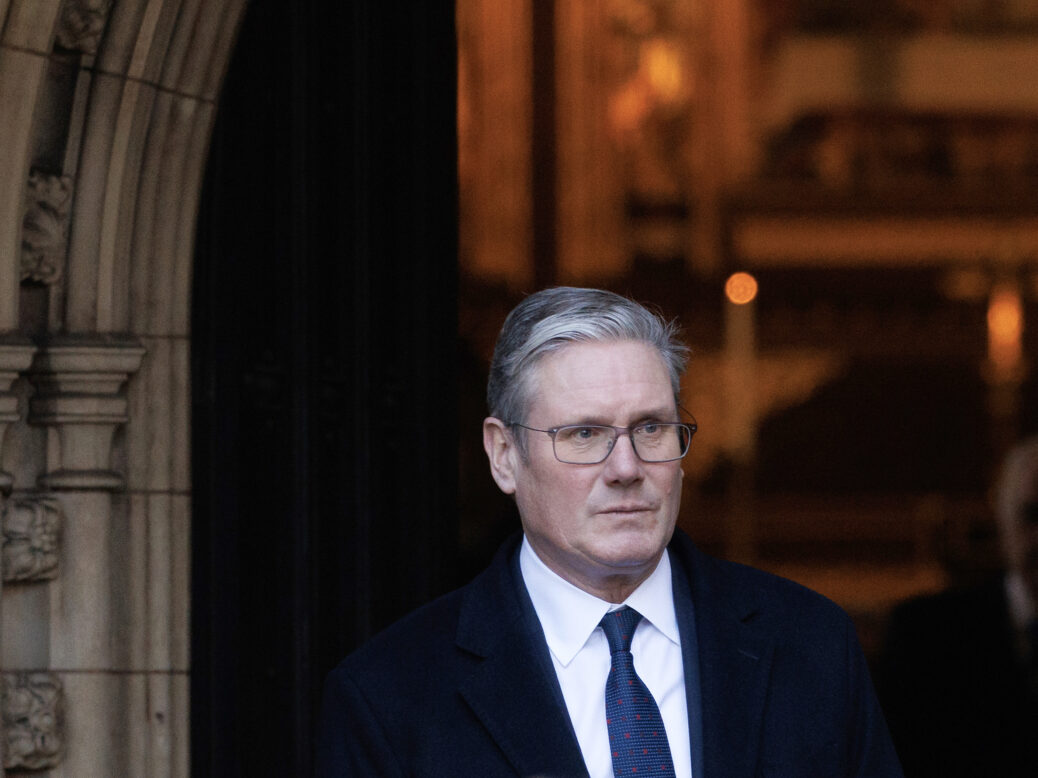
Keir Starmer’s most recent conference speech was a significant intervention. In that October rallying cry, he spoke of a “fight for the soul of our country”, of the need to revive the sense of a “common good”, and of “serving an interest that is more the yourself”. But rather than a single speech, the need to forge a revived humanism and reject the use of religion as a prop for ethno-nationalist politics should become the overarching purpose of his government. This is difficult territory for Labour. Its traditionally utilitarian focus on growth often involves a suspension of ethical questioning. Within the government, despite the believers in its ranks, there is limited space for engagement around faith and the public realm. Keir Starmer is possibly the first openly atheist Prime Minister in British history, one who declared there is “no such thing as Starmerism and never will be” and who boasted of leading a government “unburdened by doctrine” on the day he took office.
This technocratic outlook has been found wanting inside the Labour party and out. It is notable that aspiring Labour leaders Andy Burnham, Shabana Mahmood and Wes Streeting have all in recent weeks referenced their respective Catholic, Muslim and Protestant beliefs, tacitly accepting the new emerging political-religious current. But political leadership in this area would also demand honesty from within our various religious denominations regarding extremism – both theologically and organisationally. It requires us to reassess traditional approaches to inter-faith dialogues and consider new forms of community organising to challenge modern extremism.
But Labour should take courage from its historical alliances with faith. Spiritually informed movements for social justice have always emerged to deal with the moral imperatives of their time. Abolitionism was primarily driven by Quakers, and later in Parliament by Anglican and Evangelical reformers. Beginning in 1802, the movement behind the Factory Acts, early forms of workers’ protection, was led by a combination of Evangelicals, Methodists and Quakers, alongside utopian socialist spiritualists such as Robert Owen. We could trace the history of human rights back to the religious concerns of the Levellers or Diggers, or the origins of trade union movement back to the nonconformity of the Tolpuddle Martyrs.
The Labour party, which famously owes more to Methodism than Marx, emerged from a context of late 19th-century ethical socialism, rooted within dissident nonconformity and spiritual movements. This tradition has never died, and is visible at the top of party above all. Look to the early leaderships of Keir Hardie, Ramsay MacDonald and George Lansbury, or the three-times Labour leader Arthur Henderson, a lifelong Wesleyan lay preacher. Later, it lived on in the Congregationalist background of Harold Wilson, the Baptist origins of Jim Callaghan, and the self-confident religious leadership of John Smith. Tony Blair’s spiritual concerns, shrouded in office, became apparent with his conversion to Catholicism, while Gordon Brown’s Presbyterian upbringing and temper was never any secret.
Labour has resources to draw on, both in its history and current personnel, to confront the growing challenge of religious extremism. The question is whether it has the self-confidence to do so. If not, in a country clearly hungry to believe, there will not be a vacuum of faith but a clash between rivals, one that will wrench our politics in new and dangerous directions.
[Further reading: How the far right co-opted the cross]
Content from our partners


Related
Join the debate
Subscribe here to comment