
When you’re Palestinian,” Sarah Agha says, “every choice you make is political.” Agha is both a prominent pro-Palestinian activist and an actor currently starring in the Hardacres, the period drama based on the series of novels by C L Skelton, whose finale airs tonight on Channel 5.
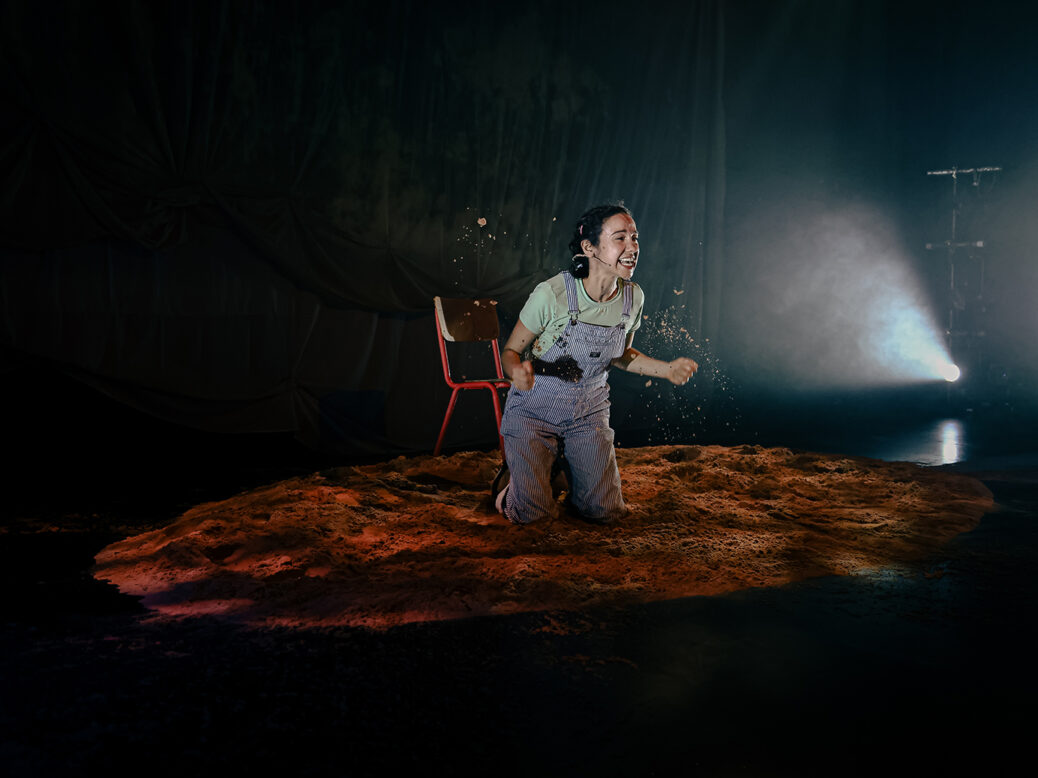
In her recent one-woman show, A Grain of Sand, produced by Good Chance, Agha plays Renad, an 11-year-old Palestinian girl who is separated from her family during the IDF bombing of her neighbourhood, as she attempts to find them in the shattered landscape of Gaza. “We’re in this unique situation where not only am I playing a child, but it’s a war child, and a war that is incomparable with any others,” Agha says.
Renad experiences the horrors both directly and through the mythologies and stories passed down to her by her grandmother, giving the show a touch of magic realism. Central to this plotline is the Al-Anqa, a phoenix-like bird that guards the land, dies in fire and is reborn in its ashes.
“Having the mythology and the folklore and the storytelling, not only is it a coping method for the child… but for me as a performer, it really helped me carry myself and the audience through those darker moments,” Agha says.

Many of those stories are comedic, presenting the familiar joy that children and grandparents get from mischievous tales about bodily functions. In one story, a lady’s unexpected and powerful fart – emitted in front of a high-ranking political advisor, known as a vizier – has the power to grant her riches while her jealous sister’s weak and forced fart results in a wealth of scorpions and snakes. Even during a bombardment, Renad’s grandmother asks her shaking grandchild, “is the washing done?” as a way of distracting her and breaking the tension. Agha is drawn to the idea of using humour to explore darker themes and provide relief within a story as distressing as Renad’s. “The handful of moments where we allow the audience to laugh, and I’m able to laugh, even if it’s for a split second, I think they help us,” she said.
The play was directed and written by Elias Matar with Agha co-devising. It draws on A Million Kites – a collection of testimonies and poems by the children of Gaza, which also feature as extracts throughout the performance, putting the responses of children at the forefront. In one, a seven-year-old recounts what she misses about her home, and said, “If I could go back and take something? I would take my whole house and leave.”
“You want to use your imagination as much as possible and picture the story that you’re telling so it feels like a truthful performance,” Agha says. “But because this is also based on truth and heavily documented real life events, it was essential to familiarise myself with as much as there was written about these events.” This included watching raw footage and videos produced by children, doctors and journalists in Gaza. “Everything felt very familiar and very raw,” she says.
Agha was born to a Palestinian father and an Irish mother, and grew up in London. She trained with the National Youth Theatre and studied Theology and Middle Eastern Studies at Trinity College Dublin. Her father, Mahmoud, was born in the Al-Dalhamiyya village in Palestine, but the family were displaced during the Nakba in 1948 when he was two and then again when the Israeli Defence Force (IDF) occupied the Golan Heights in 1967, where the family had moved. Mahmoud emigrated to the UK in his twenties, but the rest of his family now live in Jordan. It is a story Agha explored with Rob Rinder in the BBC documentary The Holy Land and Us, which was broadcast in March 2023.
While A Grain of Sand focuses on the story of one child and one family among some two million people, the sense of scale comes across in the vivid descriptions of attacks by the IDF and the chaotic aftermath. At the end of the show, a list of the names of Palestinian children known to have been killed in the genocide are projected onto the backdrop. The scale is vast – it is impossible to tear your eyes away. “What we can fathom and what we can picture is one child, one family and one name,” Agha said.
“The purpose of the show is not to evoke sympathy from an audience, at least not sympathy alone. I really hope it encourages people to act, whether it’s protesting, whether it’s writing petitions, whether it’s donating to charities, whether it’s learning more about the boycott,” she said.
Agha does not describe herself as an activist, although she doesn’t reject the label. “I always look at activists involved in direct action or the activists on the ground in villages like Masafer Yatta that we saw in the documentary No Other Land, or the activists in the Freedom Theatre who are literally risking their life when they do theatre,” she said. “I look at them, and I think they’re the real activists.”
On 28 June, Agha will host an evening of short films she has curated from across the Arab world as part of the Arab Film Club, which she founded in 2020. Among the films are two Palestinian short films including Bafta-winning The Present (2020) by Farah Nabulsi and the premier of Gaza Bride 17 (2025) by Waseem Khair.
Longer-term, Agha wants to focus more on writing to give herself agency over the stories she is telling. “It’s been a long time since I’ve had the opportunity to plunge into comedy, and I really miss it,” she said, adding that she has lost count of the number of times she has had to reject roles as a hijacker or as a daughter of a terrorist.
“I’m just an actress who happens to be Palestinian. And when you’re Palestinian, you either have to reject your identity entirely and pretend that pain doesn’t exist, which is near impossible, or you accept it, and every choice you make is political,” Agha says.
Over 1,000 Palestinians have been killed by the IDF since the start of the US-brokered ceasefire in October last year, and there is still no credible plan to reconstruct Gaza. The choice the rest of us have is whether to act or not.
The finale of season 2 of the Hardacres airs on 18 June. The Arab Film Club: An Afternoon of Shorts and Q&A will be hosted on 28 June at the Southbank Centre.
[Further reading: Banning people for their ideas will backfire on Britain]
Content from our partners

Related


Join the debate
Subscribe here to comment