
It’s still just about warm enough to wear skimpy swimming trunks. Having asked ChatGPT the hottest hour of the day, I’m stood at the deep end of a glistening, 50m outdoor pool perched between a pretty harbour hosting huge grey naval ships and a tree-lined parkland, wearing what Australians cheekily nickname “budgie smugglers”. I never once wore them in the UK; almost everyone does here. I inhale deeply and drink in the view. It’s the final day the public outdoor Andrew (Boy) Charlton pool is open before it closes for the southern hemisphere’s autumn / winter season.
There is a common joke, around this time of year, about the “last good day”. “Quick, let’s go swimming, I reckon this’ll be the last good day before autumn bites.” The joke is that, on this island, the “last good day” never really arrives. Australians are used to living in the sun. Theirs is a relatively rich country with world-class public services, wonderful weather and high quality of life. Its major cities top global liveability tables. It’s not without its problems, but for a very long time, the country has been #blessed. It has lived up to its nickname: the Lucky Country. From 1991 till 2020, Australia enjoyed one of the longest streaks of uninterrupted growth in the developed world in recent human history, stalled only by Covid. The great financial crash hurt Australia, but nowhere near as much as it hurt other developed nations. Almost three decades of glorious growth as pretty much every other country battled through various recessions and crises.
The voting system – compulsory, preferential-ranking voting – is widely regarded as superior to first past the post and ensures politics is mostly won and lost in the centre, while punishing extremism. Australia has also enjoyed a run of progressive wins in the past few years: a female PM, Julia Gillard, whose parliamentary stand against misogyny went viral in 2012 and inspired a whole new generation of Australian feminists; a landslide “yes” result to a national postal ballot on same-sex marriage equality in late 2017; now a Labor PM with a huge majority is in his second term and eyeing a third.
In the election one year ago, Anthony Albanese didn’t just defeat his opponent, Peter Dutton. The Australian public so roundly rejected the leader of the opposition’s lurch to the further-right of his conservative party that he lost the seat he’d held for 24 years. He was the first sitting opposition leader in Australian history to lose his own seat. Things looked so rosy that UK Labour invited Albanese to its Liverpool party conference in September 2025 to give a speech about defending democracy from right populists.

But half a year is a very long time in politics. In Australia today, the colour red might less evoke Labor’s proud progressivism than a traffic-light halting, an alarming warning, or even bloodshed, previously unthinkable in a country where mass murder gun crime was thought of as, bar one awful incident in living memory, practically unheard of. The Bondi Beach massacre in December, the deadliest-ever terrorist attack on Australian soil, put to bed the comfy belief that Australia’s remote geography insulates it from “over there” global grievances. Other clouds, too, appear set to darken Australia’s long summer. The “over there” grievances are breaching the shores.
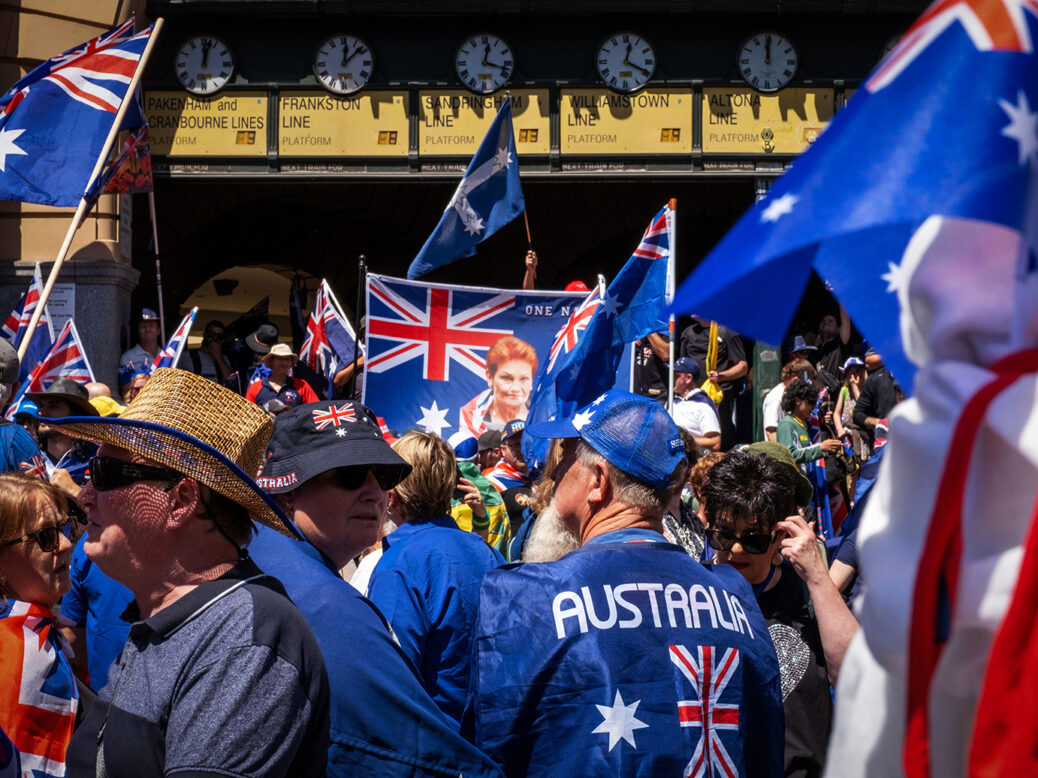
Mainstream conservative MPs are defecting to far-right populist party One Nation, led by Pauline Hanson. Not just any MPs, either. In December, the former deputy prime minister of Australia, Barnaby Joyce, defected from his party to join One Nation. Hanson remains leader. She first entered parliament in 1996, warning Australia risked being “swamped by Asians” who, she argued, form ghettoes and don’t assimilate. Her targets since have included Indigenous Australians, African migrants, asylum seekers and Muslims. Famously, when asked by a TV reporter if she was xenophobic in 1996, her two word response became a catchphrase with which people mocked her: “Please explain.” It was used as evidence of her lack of intellect, poor vocabulary and a racism so ignorant, she didn’t even know the official word for it. Since then Hanson has survived a prison spell for electoral fraud (later overturned on appeal), a drag queen parody “Pauline Pantsdown”, and dismissal by the political establishment.
What began as sneering mockery of someone seen as unrefined and uneducated has now been reclaimed and weaponised against the very people who used it to laugh at her. “Please Explain” is now the name of Hanson’s own YouTube channel and the perfect phrase to challenge political correctness perceived as going too far, which she parodies through cartoons. When Trump was first elected in 2016, she cracked open champagne outside the Australian parliament. The same year, Hanson returned to the lower house for the first time since losing her seat in 1998.
Now, the once-fringe Hanson is back from the political wilderness and sits in Australia’s upper house as a senator. Emboldened by Trump and Farage, her political stunts have become more outrageous. She has twice worn the burqa to parliament, part of her campaign to have it banned. In March, the far-right party won its first lower house seat in a state parliament outside of the notoriously conservative Queensland. In April, Australia’s richest person, mining magnate and notorious conservative Gina Rinehart, gifted a $1 million aircraft to One Nation. As Hanson posed next to the private jet, describing it as “sexy”.
All these currents surfaced on 9 May, at a by-election triggered by the resignation of Australia’s first ever female opposition leader Sussan Ley. Ley’s seat, Farrer, had been held by the conservative Liberal-National Coalition party for 77 years. One Nation won by landslide, its first-ever win of a lower-house seat in the federal parliament. The protest vote mood was clear. Pundits described a “political earthquake”. One Australian political commentator observed: “The Liberals are being humiliated. For the second time in two months, One Nation is relegating to third place the party that ruled Australia for two-thirds of the postwar era.” He concluded: “Australia teeters on the brink of populist uprising led by a longtime racist.” Other longstanding positive conditions are somewhat evaporating. Not only are Australians feeling the pinch of the dual cost-of-living and fuel crises, but they now also have nearly the highest inflation in the developed world (4.6 per cent).
Pondering this I wonder, as I swim, if Australia really has seen its last good day. As I finish my 15-lap swim of the Olympic Pool, a few hours before it closes for four months, an off-white autumnal cloud has obscured part of the sun. It is, I fear, not the last time I’ll shudder as the sun slowly dims.
[Further reading: Paging Prime Minister Farage]
Content from our partners


Related
Join the debate
Subscribe here to comment