
Caroline Lucas
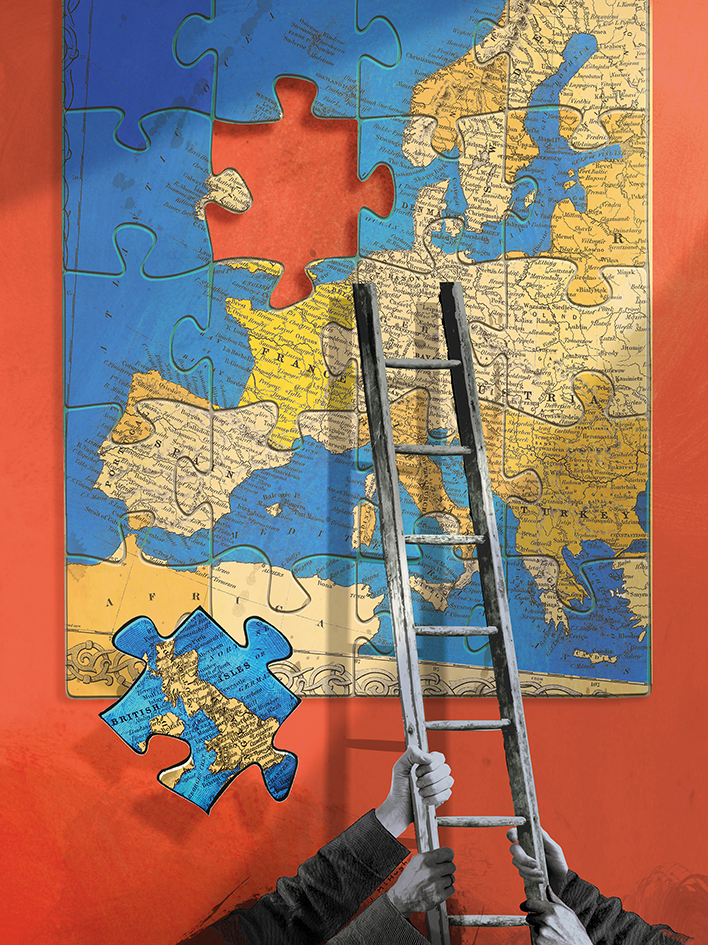
On 11 May, following the disastrous results of the local elections, Keir Starmer delivered a speech in which he said he wants to “put Britain at the heart of Europe”.
I very strongly believe that we should rejoin the European Union. The discussions of what that would look like should begin immediately. We need to consider whether we would rejoin the single market and the customs union. But the aim should be that by the next election we are at a point where we can start negotiations to rejoin the European Union.
There are people who will say, “But what about the vote to leave ten years ago? Surely it’s undemocratic to seek to overturn that?” Yet it is odd to me, as someone who has been around politics and the electoral system for a long time, that there is somehow just one vote you are not allowed to reverse, while every other vote that takes place every three or four years is capable of being reversed.
But we can, and we should, hold another vote. The world has changed so much, as have voters – if only as a result of demographics, which is a delicate way of saying that more than six million people have died in the UK since the referendum of 2016, the vast majority of whom were older and thus both more likely to vote and more likely to vote Leave.

But there are also around six million young people who have become eligible to vote since 2016. The veteran political analyst Peter Kellner has crunched the numbers on this. He has found that the combined impact of shifting demographics and people who have changed their minds since 2016 converts a 1.3 million majority for leaving the EU into an 8.1 million majority for rejoining. So by refusing to reconsider the vote, we are privileging the wishes of the dead over the views of living voters.
People might also argue that rejoining the single market means allowing the free movement of people as well, as if that is inherently a bad thing. But throughout the Brexit debate, I was proud to say I stood for free movement; I think the ability to live, work and travel across 27 other member states is a gift, and one that we should embrace. Even if that is not your position, the fact remains that the vast majority of possible immigration from, say, eastern Europe has already taken place. Most of those countries are experiencing labour shortages now, and so employment demand is surging. Meanwhile, a country like Poland is on course to be richer than the UK by 2035. The idea that there will be millions of Europeans queuing up to come to the UK, while no Britons consider leaving, is simply not supported by the facts.
Others argue that the EU may not want us back – especially if there is a risk of a Reform government after the next election. But this is another argument in favour of proportional representation, rather than a reason not to try to rejoin. If we had a fairer voting system, we would fireproof our democracy and our creaking governance structures – and then the chances of a Farage-led government would be diminishingly small. It would also reassure our EU colleagues that we are serious about rejoining, and that it would not be a decision that could be easily overturned by a change of government.
I would be the first person to admit that the Remain campaign in 2016 was absolutely, unforgivably terrible. It was top-down, led by the wrong people, and technocratic. We were harping on about how much your groceries were going to cost, while the other side were using visceral, emotional language to talk about our sense of national identity and taking back control. Today, it could be a very different conversation. I imagine a campaign fronted by young people and small business owners – the citizens who have directly suffered from the impacts of Brexit.
We should also recognise that not everyone who voted for Brexit was voting purely on the issue of the European Union. That may sound controversial, but when I went around the country in the aftermath of the referendum, visiting places that had voted overwhelmingly to Leave, I was struck by the fact that so many people felt they simply had not been listened to for a long time. They felt that Whitehall might as well have been on another planet for all the relevance it had to their lives. This was acute in England, where we don’t have the same kind of political institutions that represent English identity like Scotland and Wales do.
You can make a very strong case that Brexit was primarily an English-driven phenomenon, and I think that was rooted in a sense of powerlessness and anger. So the referendum on the EU was the one opportunity people felt they had to express that anger.
The United Kingdom is not the only place that has changed over the past ten years; the wider world has too. There is the existential threat of the climate crisis, and we are facing a very different geopolitical reality in many respects. The US president and the White House are increasingly unpredictable and transactional in their approach to foreign policy. The old order is not coming back; as Mark Carney, the prime minister of Canada, has argued, this is not a transition but a rupture. If we had a government that was serious about putting the country first, then it would commit to rejoining the EU.
While there is a strong economic case for rejoining the European Union, my argument is not just a transactional one. It is about where we think our future lies. At a time when war is being waged in Ukraine and our defences seem so fragile, it is clear that our greatest chance of security lies in working with our closest neighbours. What we have seen over the last few years in the United States should underscore that our allies, and those with whom we have greater shared interests and solidarity, are in Europe – not those who talk about taking control of Greenland.
People do not want to worry all the time about the future. People want a sense of safety and a sense of belonging to something bigger than themselves. That is what the European Union can offer us.
Caroline Lucas is the former leader of the Green Party, a former MEP and co-president of the European Movement
Anand Menon
Any serious debate about Brexit and rejoining the EU must reckon with the very difficult trade-offs involved, the most obvious of which is that Brexit is costing us a lot of money. We now have evidence to show that, without a doubt, there has been a significant economic cost to being outside the European Union. Some estimates put the figure as high as 8 per cent of GDP. While it is likely not this extreme, there is no doubt it is a significant amount. If there were any other policy costing us the money that Brexit is costing us, it would be a policy we would reconsider.
We must also consider the fact that, in a time of geopolitical uncertainty, geography is very important. It may seem obvious, but it is a significant principle to bear in mind when it comes to foreign policy. We share interests with countries near us in a way we do not with countries that are far away. We will end up having to work more closely with European countries. This is partly due to Donald Trump, but even after he leaves office, Europeans are likely to have to look after themselves more. We are not facing a comfortable status quo.
Keir Starmer is currently involved in talks with the EU. The government estimates that the deals they are negotiating could yield about 0.3 per cent of GDP – if everything goes well. Yet these discussions are not going well thus far, and there’s no guarantee we’ll see any gains.
There are good reasons to be frustrated with the status quo. But I also don’t trust the projections about shifting public opinion in the UK towards the EU. Any debate about rejoining – or even about a closer relationship with the EU – that does not spell out the trade-offs involved will produce a misleading answer. Would you like to be in the single market? That sounds appealing – if it makes us richer. But would you still want it if it meant accepting freedom of movement, contributing significant payments into the EU budget and no longer being able to set the rules for large parts of our economy? Suddenly, it becomes a very different kind of trade-off.
If you sit in a focus group with voters today and say the word “Brexit”, half of them are likely to hide under the table with their fingers in their ears, humming to themselves. They never want to hear the word again as long as they may live. There’s a collective sense of post-traumatic stress disorder from Brexit in this country. But one thing voters seem to agree on is an unwillingness to go through another referendum again.
The question for any political party will be if they’re willing to go into the next election campaigning on an issue that no one wants to talk about. That strikes me as bad politics. Consider also the fact that at the end of May this year, new net migration figures will be published and they’re very likely to be close to zero. There is a real possibility that the UK’s debate over immigration is going to change quite profoundly between now and the next general election because we will no longer be seeing hundreds of thousands of immigrants coming into the country. Under those circumstances, would a Labour government really want to push the one issue that Nigel Farage will be able to use to motivate his base? It would be a very dangerous thing to do.
The genius of Farage in 2016 was that he took an issue that no one cared about – Europe – and linked it to an issue that everyone cared about – immigration. All of a sudden, people cared about Europe. If we were to do it the other way around, the rejoin side must amalgamate the Europe issue with something that really matters to them. It could involve convincingly making the case that the cost-of-living crisis is worse for the UK now that we are out of the EU than it would be if we were in.
Then there are practicalities about rejoining. It might well be the best option, but we should not go into it believing it is an easy one. If we have learned anything in our discussions with the EU to date, it is that negotiations are a contest of interests: the EU will act in what it sees as the best interests of its member states and their populations, and the UK will do the same for its side. We have rejoined the Erasmus student exchange scheme, for example, and it is now costing us around £570m a year. From the EU’s perspective, that is not surprising – negotiations are about leverage and outcomes, and if that involves extracting value from third countries because they want closer alignment, that is how it will approach it.
Negotiating our way back in will be painful and intrusive. It will mean European officials crawling over the minutiae of regulations in our country in a way that is far more in-your-face than anything we experienced as a member state. The worst position to be in with the EU is as a candidate member state, because they then have complete control over you.
There are so many things here in the UK that we need to fix. We need a social care system. We need a decent property tax. We need to figure out planning. There are things we can do that will help our economy grow. We need to think carefully before we commit to a process that could last five to ten years; where EU relations suck the life out of everything else. That would be a very bold gamble.
There are other trade-offs to consider. The EU we would be joining is far less Britain-friendly than the one we left. This is an EU that does joint borrowing of the kind the British government always tried to veto. This is an EU where the European Commission has a role in defence policy that the British government would always veto.
The EU could change further still. I think a Europe that becomes more far right in its political complexion could become more hostile to us, and more tempted to limit our participation. This is partly because we have never fully internalised the politics of European integration. For virtually every member state, this is an economic project, but one that was pursued for political reasons. The UK, by contrast, has always been more transactional: we wanted to join the market because it was a market.
Insofar as there was a Brexit story, it was that we would be free of the shackles of Europe and would be able to go out into a world where our partners would be liberal trading economies, where globalisation was pushing forward at pace, and we would trade our way to success. That was never an economically coherent plan, because the costs of leaving were always likely to be greater than any benefits gained from prospective trade deals.
The world has changed. The US and the EU have become more protectionist, and globalisation has retreated. In the past, the UK was wise to avoid choosing between the United States and Europe. I am not convinced that will be possible going forward.
I will give you one example where it is already becoming difficult: AI. We have taken the decision to align with the Americans as much as possible on AI in order to attract US investment, and as a consequence we are less inclined to sign up to the EU’s regulations on AI. This poses a problem, however, if the EU says it cannot work with us on defence because our AI-enabled defence systems do not comply with its regulatory framework.
In a world dominated by continental-sized economies, being a medium-sized country on our own feels a little lonelier than it did back in 2016.
Anand Menon is the director of UK in a Changing Europe.
This is an edited extract from our podcast the Exchange. You can find the whole discussion wherever you listen to podcasts
[Further reading: Why the British do it worse]
Content from our partners


Related


This article appears in the 20 May 2026 issue of the New Statesman, Definitely, maybe
Join the debate
Subscribe here to comment