
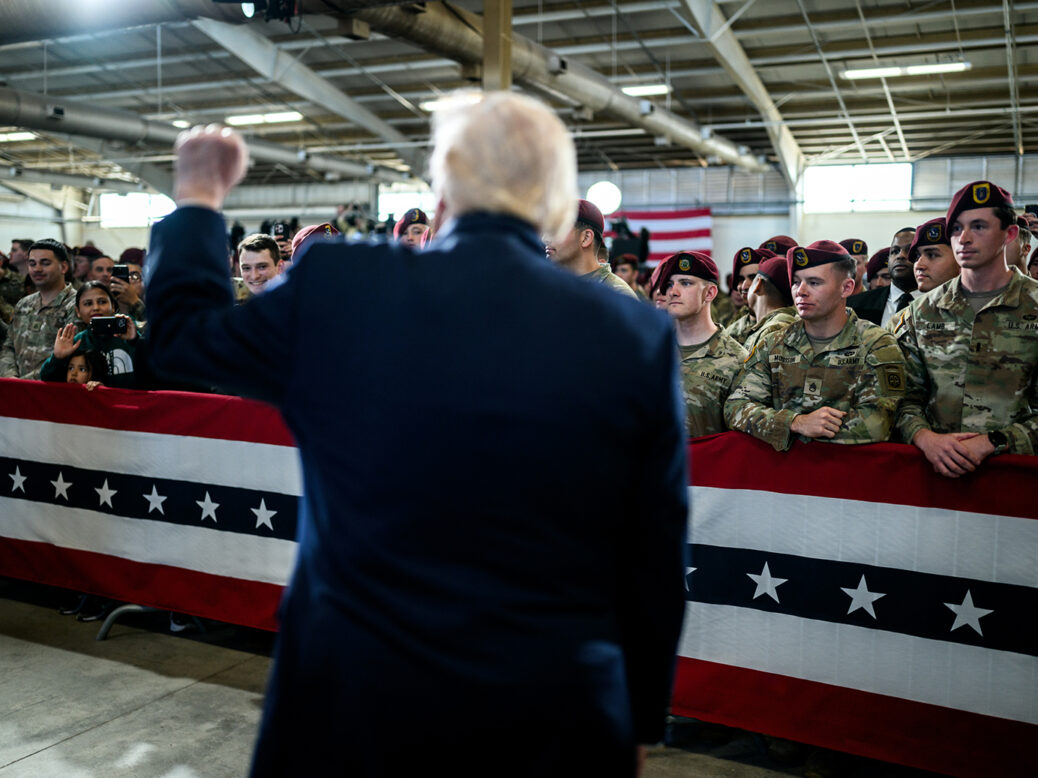
Donald Trump delivered a prime-time address from the White House on 1 April promising that the war with Iran would be over “very shortly” while also appearing to signal that he planned to escalate the conflict, vowing to hit the country “extremely hard” in the coming weeks. Meanwhile, thousands more American troops have arrived in the region in recent days, including the 31st Marine Expeditionary Unit and paratroopers from the 82nd Airborne Division, as the US president is reportedly weighing options for a possible ground assault. Potential targets could include the key Iranian oil export hub on Kharg Island – which Trump has previously said the US could take “very easily” – or an attempt to seize small islands in the Strait of Hormuz.
Ruben Stewart, Senior Fellow for Land Warfare at the IISS thinktank, and a former infantry officer in the New Zealand Defence Force and former United Nations peacekeeper, spoke to the New Statesman about Trump’s options for a ground assault in Iran, and what would be involved in an attempt to forcibly reopen the Strait of Hormuz or seize control of Kharg Island.
(This conversation has been lightly edited.)
Katie Stallard: What do you take away from President Trump’s address to the nation last night, and his various messages in recent days, about where we are in this war and whether it is nearing an end, or we should expect some sort of escalation in the coming days?

Ruben Stewart: It’s difficult to gauge from one speech where the outlines or contours of this conflict might head. It was clear from the outset that there were varying objectives that have been given differing weight at different times in the campaign, and that shape particular options that are being undertaken at an operational level.
I think in terms of the longevity, it might be more important to look at President Trump’s conduct of operations in the past. For example, if we look at Operation Rough Rider against the Houthis at the start of last year, or Operation Midnight Hammer [against Iran last June], there certainly seems to be an instinct that the duration of any of these operations should be kept as short as possible. This premise seems to be borne out by the demands of the American public, and the global public as well, which wish to see an end to this conflict as quickly as possible.
Is it clear to you what those objectives are?
No, there is a wide range of objectives that have been articulated by the president and his cabinet. One must keep in mind, of course, that there are also objectives that have been articulated by the Israeli prime minister that sometimes align with, but are not always in total agreement with, those stated by President Trump and his cabinet. Given the variety
of objectives that have been stated, that makes it difficult for military commanders, both at the strategic and operational level, to design operations to achieve those particular objectives. That lack of clarity is probably having an impact on how the operations are being undertaken.
That sounds like a very diplomatic way of saying that this is potentially making life very difficult for US commanders, and those serving under them. As someone who has served in the infantry and as a UN peacekeeper, what does that look like on the ground when it is not clear what the objectives are from those at the top?
What that means is that if you are trying to align your activities towards specific strategic objectives, and those objectives change, then what you’re currently doing may actually undermine some of the new strategic objectives that have been outlined to you.
So, if one of the objectives is to constrain the export of Iranian oil by attacking infrastructure on Kharg Island, for example, militarily, that might have utility at that point in time, but that is then undermined when those assets and resources are directed to another objective. [For instance], it is being undermined in an economic sense by sanctions being lifted on those same oil exports in line with an effort that is being undertaken by another part of the administration.
If we look at what the United States is doing as much as what President Trump is saying, what does the posture of American forces that we’re seeing in the region indicate about what sort of options might now be on the table? Particularly given the units that we’ve seen arrive in recent days, such as the Marine Expeditionary Unit that has deployed from Japan, with another underway from California, and elements of the 82nd Airborne. What does that say to you about the kind of operations the US could be preparing for?
If we start with the operation more broadly, it appears that the primary goal is to degrade Iranian military capabilities. That is a relatively straightforward process in terms of bombing targets, although it appears that Iranian attacks continue. So, while some degradation has occurred, it hasn’t necessarily had a complete effect.
The deployment of the two Marine Expeditionary Units, of which one is there, and one is still on the way, along with two battalions of the 82nd Airborne, and the additional troops and aviation assets that have reportedly been moved to the region, point to the potential for a limited incursion if it is required.
When you look at the total number of combat troops that have been deployed, we’re only talking about a few thousand, which is probably enough to achieve a limited geographic and temporal objective such as seizing an island, be that Kharg Island or one of the islands in the Strait of Hormuz, or perhaps a small part of Iranian territory itself. But that would be very limited in terms of the geographic area that they could occupy, and the moment that they landed, they would come under sustained attack. This would mean both direct attack by the IRGC [Islamic Revolutionary Guard Corps], but also standoff attacks using rockets, artillery, missiles, and drones, which would mean that they then need to be protected and sustained.
So, limited forces are there, but that means they only have a limited capability that they can deliver for a limited time.
There has been a lot of focus on Kharg Island, which President Trump has invoked several times now. How would you expect a potential US assault on the island to unfold?
The initial stages of an airborne or an amphibious operation are designed to be extremely rapid, but that has follow-on consequences for that force. Using the element of surprise, they could rapidly deploy to an area using amphibious vehicles, helicopters, or parachutes to seize a small piece of territory. However, the moment they land, they require extensive support, given the nature of the opponent, to protect their presence there.
That support would predominantly come from close air support, so those troops would have to be lodged in an area that allows aircraft to be within range 24-7 to protect them. That also means that they need to have supporting forces, which could be amphibious vessels, or it could involve utilizing the air bases of some of their allies in the Gulf, to provide support in terms of logistics, but also casualty and medical evacuation. So that shapes the type of locations that could be considered for such an operation, which in turn obviously shapes the objectives that they might be able to achieve.
Does that rule in or rule out for you some of the targets that have been discussed? One element of an operation targeting Kharg Island, for example, would presumably be how to get American forces there, and provide amphibious support, if they would still have to transit the Strait of Hormuz?
In the aftermath of the fall of the Taliban and the fall of Saddam Hussein’s regime, the Iranian Revolutionary Guard Corps [IRGC] and their Basij militia developed a doctrine of mosaic defence. This meant that if the leadership or the command and control was decapitated, regional and local commanders would have the authority to undertake defensive operations without referral to a higher command.
It appears that during this operation so far, that authority has also been granted to rocket and drone forces who have been able to operate independently of that higher authority. So, if US troops, be they airborne or amphibious, were to land on Kharg Island, they would be faced with a defensive force that is well-prepared and well-trained.
This is not the first time that Kharg Island has been threatened or attacked, so one should assume that it is very well prepared in terms of sea mines, but also land mines, be they anti-personnel or anti-tank, but also probably surface-to-air systems to prevent aircraft operating in that area. The Iranian ground troops themselves, whether IRGC or Basij, will be highly motivated, therefore it would take a substantial effort to secure the island. Even if secured, there is still a civilian population on the island [primarily comprising oil workers] that would need to be controlled. One could easily envisage an insurgency operation being undertaken on the island, in addition to the direct military attacks that the IRGC and the Basij would launch against those forces as well.
That would mean they need to be supported, and if we’re talking about amphibious troops by vessels who are in close proximity to the island, as we’ve seen in the Strait of Hormuz,
the use of sea mines, or indeed even the threat of sea mines, combined with fast attack vessels, again using rockets and drones as well, could make the presence of those vessels extremely vulnerable in such close proximity to the Iranian coast.
There has been some discussion of the potential for American forces to “hug” the island’s oil infrastructure, on the basis that Kharg is so important to the Iranian economy as an oil exporting hub that the regime would not be prepared to risk destroying it. Could the US potentially land a force close to that infrastructure and use that as cover to defend their positions on the island?
It is an approach that could be taken. But one should keep in mind that there are always other ways of redirecting the oil flow to areas that might allow it to avoid Kharg Island, if the US troops were to “hug”, as it were, that oil infrastructure.
The Iranian objective is the survival of their regime, so if they were forced to make a decision about the survival of that regime, even if that meant the destruction of some of their oil infrastructure, it would be a relatively easy decision in their mind about sacrificing their oil infrastructure in order to secure their own survival.
What about the smaller islands in the Strait of Hormuz itself – what would be involved in an American operation to seize those islands?
Those islands differ in size, so different force elements of different sizes could be used to secure some of those islands. But those islands are adjacent to other territory that is occupied by the IRGC, primarily for the purposes of interdicting maritime traffic in the Strait of Hormuz and that could also be used to launch attacks on the islands where US forces are lodged. So, every time the US forces were to secure an island, they would be effectively putting themselves within range of Iranian rocket and missile forces who could rain that down upon them.
It’s a different situation from Kharg Island. Even if one were to secure some of those islands, Iran still maintains maritime capabilities, such as sea mines, fast attack vehicles or rockets. These are stand-off methods of attack that mean that even if land and proximity to those transit routes is secured, Iran still maintains the ability to interdict the traffic through those maritime channels. So, they might secure land but not actually achieve the effect they’re hoping to achieve.
What does this mean for countries beyond the US, such as the UK, which President Trump is now effectively telling to “just take” the Strait of Hormuz by themselves, and “get your own oil”?
There are multiple options available to those that rely on Strait of Hormuz, but none of them are particularly attractive for a variety of reasons. Technically, securing the strait to allow tanker traffic to move through would be extremely difficult, even if one were to provide escort vessels or minesweepers. There are still multiple methods that the Iranians can use to threaten the movement of those vessels, so even if they were to attempt to secure the transit routes by escort, or going so far as to secure territory along the Strait of Hormuz, it would not necessarily address the problem. So technically that makes it unfeasible.
There is, of course, one state that does utilize the Strait of Hormuz for the transit of energy, and that’s China, which seems to have negotiated a way for that to occur. We’re unsure of the details, but it appears to include a route around some of the islands closer to the Iranian shore, where a fee or toll is then being charged for those vessels to pass through. So that might be an option for some states who are in dire need of receiving some of those energy transfers.
More fundamentally, though, I think the objections of many states, especially European states, about the legality of the war will still shape their thinking before they were to commit any forces. That has been laid bare, most clearly, by the Spanish authorities. But that will be in the mind of other European countries as well. Beyond the technical obstacles, there are significant legal and strategic reasons as to why they would find it difficult, or why they would wish to refrain from engaging.
Does that mean that as long as this war goes on, we should consider that the Strait of Hormuz will remain effectively closed, or at least selectively closed, subject to individual negotiations with Tehran? Is this a problem that has a military solution?
Like most conflicts, I think this will end through some kind of agreement, whether that is negotiated formally through a ceasefire or whether some sort of mutual understanding that is reached by the belligerents to back down and allow traffic to resume. Any military activity that continues just exacerbates the problem in terms of the flow of energy, but also accumulates into a sunk cost fallacy, where both sides need to be able to show some benefit to their populations for continuing to fight. So, the longer it goes on militarily, the harder it will be [for both sides] to extract [themselves] and revert to a more peaceful period.
President Trump asked Americans last night to keep this conflict in perspective and he outlined the length of previous wars, such as World War I, World War II, the Korean War, the Vietnam War. Do you think we are heading towards a longer war here?
It’s difficult to tell, given the varying strategic objectives and how those have taken on a different priority at different times to assess how long this might continue for. I think that what is more important than the duration is the impact that this has on the population, and although President Trump mentioned a number of conflicts that have lasted a long period of time, this conflict has borne a weight on the American population far quicker than some of those conflicts. The effects of this conflict have been evident within weeks, whereas in some of the instances that he cited, for example, it might have taken months or years for that effect to be felt. So, it’s more about the effect rather than the duration, and that effect is already being felt by a majority of Americans.
There has also been some talk in recent days about the potential for a special forces raid to try to recover the highly enriched uranium that is still unaccounted for after last year’s strikes and widely believed, at least in large part, to be deeply buried under the Iranian nuclear complex at Isfahan. What would be involved in that sort of an operation?
Iranian nuclear facilities have been deliberately sited well into the interior of Iran exactly for the purpose of avoiding that kind of attention from military forces, initially to avoid Iraqi aircraft. In many cases they are buried deep within the sides of mountains and hills. This makes it an extremely challenging proposition – even for highly capable US special forces and the assets that they can bring to bear – to penetrate into Iranian airspace, secure the area around that particular nuclear site, undertake an excavation of that damaged site to extract that material, and then successfully withdraw.
We’re talking about a long approach, in terms of hundreds of kilometres into Iranian territory, a large area, tens of square kilometres, that they would need to protect from various threats, be they ground forces, but also aerial attack as well. Then the physical task of actually extracting the material, which given its radioactive nature, would require special precautions during its evacuation as well. Then, the extraction of that entire force back to a safe area.
Technically, it’s feasible, but much like the amphibious and airborne operations along the coast that we have talked about, would expose that force to significant attack. So they would need a number of enabling capabilities, primarily aircraft, if it was inland, to protect them and sustain them while they were there to undertake that task.
On the broader question of what this means for European security and the security of longstanding American allies, we’ve seen President Trump threatened to pull out of Nato unless other countries join him in the Middle East. When the US president is openly threatening to do this, not for the first time, do we have to reckon with the reality of that alliance looking very different now?
This is just the most recent step in that direction. There have been multiple events in the last 15 months since Trump returned to power, starting with Vice President Vance’s statements at Munich [in 2025], for example, but more recently, the threats towards Greenland. This has awakened in many European leaders, I think, the urgency for some of those steps that they need to take at the political level. It has also had an impact militarily because we’re seeing the expenditure of critical munitions that are expected to be available, for example, in a Nato Article 5-type of operation, or indeed may actually be intended for delivery to Ukraine.
If these munitions are not available, purely as a matter of logistics and the ability of the defence industry to continue delivery at the rate that is required, then militarily, in addition to politically, Europe is going to have to take steps to make sure that they have the independence and the autonomy to undertake some of the operations that traditionally have relied upon US enablers. This is especially the case at the strategic level when we’re talking about intelligence, surveillance, and integrated air defence.
[Further reading: In Iran, air power fails America once again]
Content from our partners



Related

Join the debate
Subscribe here to comment