
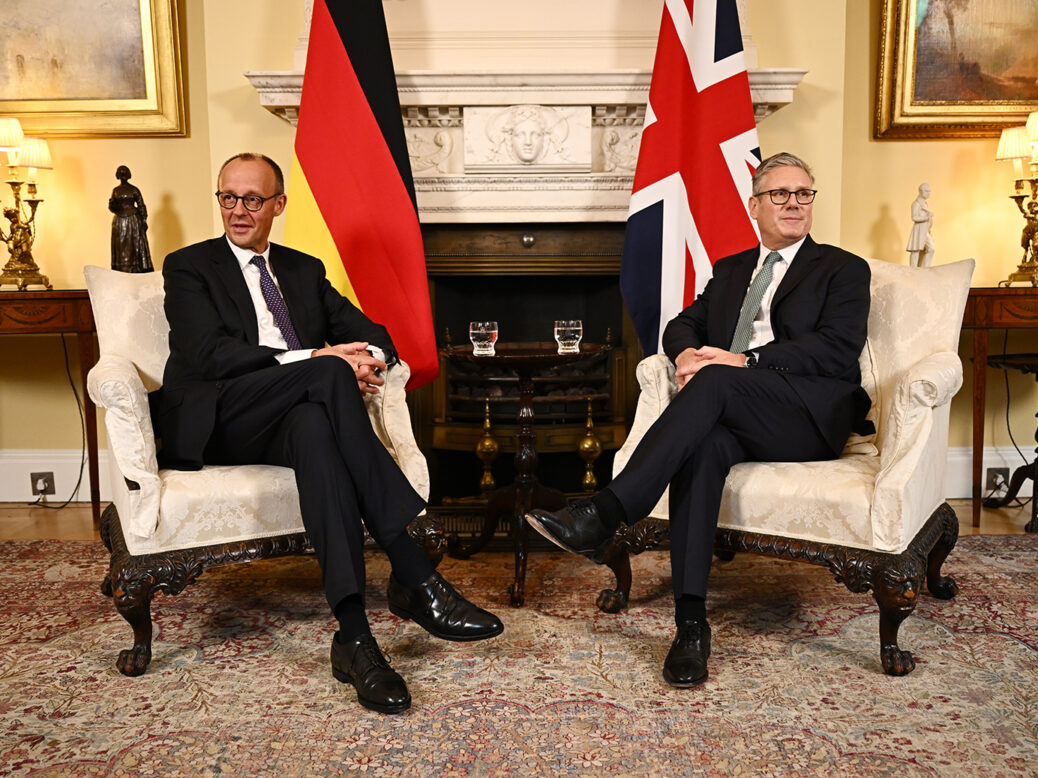
It is uncanny how similar the political drama currently playing out in Germany is to the one playing in the UK right now. Just as Keir Starmer is struggling to remain in power in London, so the German chancellor Friedrich Merz is struggling to hold on to power in Berlin. Like Starmer, Merz has not been in power for long. In fact, Merz has been in power for even less time than Starmer – he just completed a year in office a week ago. But he too suffers from historically low approval ratings for a recently elected head of government.
Merz leads a coalition of his own Christian Democrat party and the Social Democrats, who led the previous Ampelkoalition (“traffic light coalition”). Merz had slammed the Ampelkoalition for its incoherence and inertia and said that Olaf Scholz just didn’t have what it took to be chancellor. But after promising a fresh start when he took over in May 2025, Merz now finds himself in the same situation as his predecessor. His own attacks on the previous government are being used against him – just as Starmer’s criticisms of Conservative chaos are now coming back to bite him.
The criticism of the Merz government is the same as that of the Starmer government: it has no clear direction, let alone a vision, and it has achieved too little. Merz has also followed a similar strategy to Starmer: admit he needs to do more, but at the same time talk up his government’s somewhat-underwhelming achievements. Merz particularly emphasises that he has brought down the numbers of migrants arriving in Germany. Like Starmer, Merz faces a challenge from the right – the far-right Alternative für Deutschland (AfD) is now well ahead of the Christian Democrats in the polls.
Merz is also perceived as having done a little better in foreign policy – which has for the last year been dominated by questions of how to deal with Donald Trump. Even the joint leader of the AfD praised Merz for keeping Germany out of the war between Iran and the United States.

What makes the similarities between the dramas playing out in Germany and the UK even more remarkable is that the two countries have such different political systems. Whereas the UK is the paradigmatic majoritarian democracy, Germany is a much more consensual democracy, and has long had the kind of multi-party system that now appears emergent in the UK. Coalition governments are the norm in Germany – there has only been one single-party government in the history of the Federal Republic.
In the UK, the question is simply whether the Labour Party will elect a new leader. In Germany, on the other hand, the question is whether the coalition will collapse and fresh elections will be held – which is also how the Ampelkoalition ended in 2024. In both cases, however, it is the hard right that stands to gain most from the turmoil that such change would involve – or at least that is the argument of those who wish to keep going with the current, unpopular governments.
These parallel political dramas suggest that our problems cannot be solved simply through electoral reform – for example the introduction of proportional representation instead of first-past-the-post for elections to Westminster – as some are tempted to imagine. The challenges are much deeper and more structural, and not unique to the UK. In a podcast earlier this week, for example, New Statesman editor Tom McTague suggested that social media had made democratic governance harder – or perhaps even impossible. There is surely something to this, though there was also a widespread perception that Western democracies had become ungovernable in the 1970s.
At the same time, comparing the UK with Germany also illustrates what is so puzzling about the Starmer government. Merz was forced into forming a somewhat incoherent government by the German political system and the outcome of the election last February, which forced his centre-right party to form a coalition with the centre-left Social Democrats rather than govern from the right as he would have liked to. But the centrism of Starmer’s government was entirely voluntary. Having been elected with a huge majority, he could have sought to transform Britain. But instead he seems to have chosen to govern as if he were as constrained as a German chancellor.
[Further reading: How Labour can win again]
Content from our partners



Related

Join the debate
Subscribe here to comment