
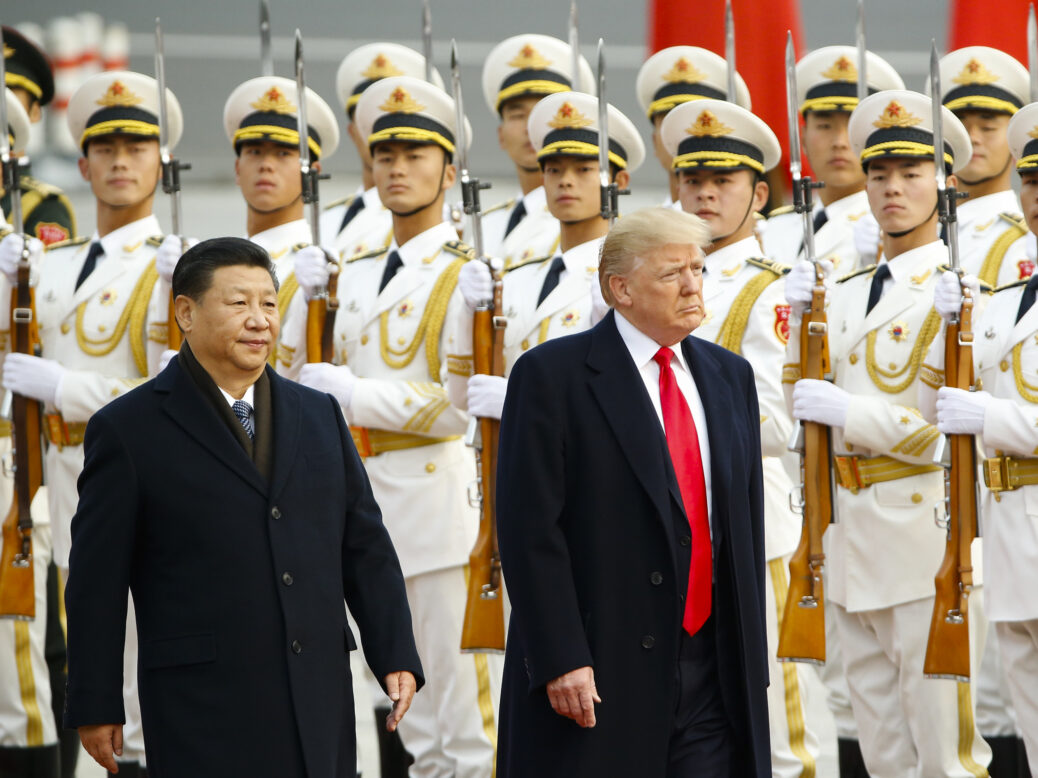
Nine years, two trade wars, and six weeks later than originally planned, Donald Trump has returned to Beijing. He is travelling with a bevy of high-profiles CEOs, including Elon Musk, Apple’s Tim Cook, and BlackRock’s Larry Fink. Brett Ratner, who directed Amazon’s Melania documentary and the first three Rush Hour movies is reportedly joining the trip to scout locations for a fourth instalment. The American delegation can surely expect a lavish welcome, a flurry of impressive-sounding deals, and many toasts to the future of Sino-US relations. In return, Xi Jinping can expect a torrent of effusive praise from Trump’s social media account as the US president frames the summit as a meeting of the two most powerful men in the world, or what he likes to call the “G2”.
In reality, the timing of this visit is itself an admission of defeat — or at least the US’s tacit acceptance that victory in the war with Iran is no longer within sight. Trump was originally due to travel to China at the start of April but delayed the trip because of the war. Presumably, Trump had imagined that the “little excursion” he launched with Israel on 28 February would be wrapped up well before the rescheduled meeting with Xi came around six weeks later. Instead, the US and Iran are, once again, exchanging fire – or what Trump has called “love taps” – while their mutual blockades are still in place, all but halting shipping through one of the world’s most important maritime trade routes, and the ceasefire is “on life support”. On Wall Street, the Taco (Trump Always Chickens Out) trade has been replaced by the Nacho (Not A Chance Hormuz Opens).
Prominent Chinese scholars have long been convinced that the US is in decline. Beginning around 2020, Xi popularised the slogan, “the East is rising, and the West is declining,” although he now appears to favour the less triumphalist formulation that the world is experiencing “great changes unseen in a century”. During a summit with Vladimir Putin in Moscow in 2023, Xi assured the Russian leader, “we are the ones driving these changes together”. This is not inconsistent with the current US president’s penchant for displays of formidable military might –– ordering the capture of Venezuela’s president, menacing Cuba, and now going to war with Iran. The Chinese narrative of American decline has long warned that this period would be dangerous as the ageing hegemon raged, refusing to go quietly into the dark night of multipolarity and faded dominance.
From Xi’s perspective, Trump is merely conforming to type, albeit the descent is more rapid, more volatile, and more self-defeating than predicted, and the consequences for the global economy more alarming than he might have hoped. Xi could surely never have imagined that Trump would attempt to tear down America’s long-standing network of alliances – long viewed by Beijing as one of Washington’s greatest strengths – all while burning through US munitions stockpiles and redirecting military assets from Asia to the Middle East. The prolonged closure of Hormuz is also likely to turbocharge the transition to renewable energy and electrical vehicles, industries that China dominates. So, we can expect Xi to lay on an extravagant summit for Trump, building on the “state visit plus” that so delighted the US president in 2017, and commit to buying more American soyabeans and airplanes, perhaps even announcing headline-grabbing plans for Chinese investment in the US. All of this will come without offering serious concessions, including on Iran. The Chinese leader is unlikely to commit to pushing Tehran to submit to Trump’s terms, or help to extricate him from his strategic morass, or even to agree to stop Chinese companies transferring more technology that could be used to make weapons systems to Iran.

Yet Xi is not as invulnerable as his posturing suggests. For at least as long as Chinese scholars have been predicting the decline of the US, there has been a parallel debate among American scholars about the inherent structural weaknesses in China’s economy and the coming collapse of the Chinese Communist Party’s (CCP) rule. Even among those who do not foresee the impending demise of the CCP, discussions about when China would overtake the US as the world’s largest economy – once seen as inevitable – have been replaced by debate as to whether its power has already peaked.
China’s famed economic miracle has given way to gloomy depictions of a worsening demographic crisis and slowing economy, with youth employment rising to record heights, the continued unravelling of a housing market as well as mounting local government debt. Xi is also in the midst of the most extraordinary purge of the People’s Liberation Army since the days of Mao Zedong, which does not signal a leader with complete confidence in the system he has built.
Xi has reason to believe China is better prepared than many American allies to withstand the continued blockade of Hormuz, with a substantial reserve of oil and gas that has not yet been tapped. But the last thing the faltering Chinese economy needs is another global financial crisis that will tank demand for the surging exports still propping up growth. So, Trump, too, might assess that he is meeting Xi from a position of strength, making him similarly disinclined to consider making serious concessions, such as adjusting the US’s official language on Taiwan, which Beijing wants, or lifting restrictions on advanced semiconductor exports. (Although, of course, there is always the risk that Trump goes off script if he perceives an enticing deal to be within reach.)
This means the most likely outcome from this summit is a mutual agreement to extend their current truce, which is otherwise set to expire in November. Surveying their respective domestic and foreign policy challenges, neither Trump nor Xi will be keen to reignite last year’s trade war. Returning to hostilities now would risk a form of mutually assured economic destruction that neither can afford.
There has been plenty of speculation that Trump’s chaotic return to power and his decision to plunge the US, once again, into another unwinnable war in the Middle East, will embolden Xi to attack Taiwan. In fact, the opposite is likely to be true. Russia’s four year-struggle to subjugate Ukraine, and now the US’s failure to dislodge the Iranian regime, has only illustrated the difficulties, and the political dangers, of launching a war of choice, even if Xi did have more confidence in his generals. If he believes the diagnosis of American decline, why would he risk his leadership and his legacy just as the US is liable to cede global leadership and undermine its alliances of its own accord? Far preferable to “win without fighting” as the classical Chinese military aphorism has it, by pressuring Taiwan and impressing on its citizens that the US is unreliable and unlikely to come to the self-ruling democracy’s defence.
From Trump’s perspective, having abandoned any prospect of ending his war with Iran before he travelled to China, he can expect to be flattered and feted as an honoured guest, and a few days’ reprieve from his plummeting approval ratings at home. But that is about it. There are no magical solutions on offer in Beijing. Trump is likely to return home to the same predicament: no obvious path out of this conflict that does not leave the Iranian regime in a stronger position than it was before the war – in control of the strait and, likely, its nuclear stockpile – and little prospect of victory.
[Further reading: What Xi Jinping wants from the UK]
Content from our partners



Related


Join the debate
Subscribe here to commentXi as always is playing the US, and the West keeps shooting itself in the foot. And, not just the thump. Good thing the West thinks solar and wind will drive their economies, but comparison is the thief of joy (Stoic)
International news sources over the last two weeks report a signed pipeline deal between Russia and China that would more than double the world’s largest, the Power of Siberia1 that started full delivery in 2020. Earlier, Zelensky had given notice that their contract of a billion dollars per year in gas transit fees from Russia would be terminated And, a couple years later US and/ or Ukraine blew up the Nordstream pipelines, ending essentially all Russia natural gas to Europe. The West has kept rationalizing Russia’s loss of export volumes while Russia goes to the bank with higher prices per barrel. And the US oligarchs grow rich exporting LPG, LNG, CNG and oil to Europe at world record prices.
Also, give even more credit to Biden for cementing China and Russia at the hip when the US for generations played them off against one and other. Now, they apparently include Iran.
“If he believes the diagnosis of American decline, why would he risk his leadership and his legacy just as the US is liable to cede global leadership and undermine its alliances of its own accord? ” I hadn’t even considered this very likely possibility!?