
I first met Richard Harries at the BBC as we both waited to be called into the Today programme’s studio. Richard, the former bishop of Oxford and occasional New Statesman contributor, was there to deliver a “Thought for the Day”. He preferred to deliver these live, which struck me as terrifying. I was there to debate with Michael Gove, though, which would no doubt fill many of you with horror of another kind. As Richard and I chatted, he asked what I did. “I work for the New Statesman,” I replied. “Tell me,” he said, now interested, “what do you think of the new editor?”
Richard was kind enough to avoid showing too much disappointment in me that morning, and so began a conversation that carried off and on until I discovered earlier this week, with great sadness, that he recently passed away, aged 89. I am now even happier that in the short time I knew him, I took him up on his invitation to lunch in the House of Lords. There, he hosted Pippa Bailey and me, regaling us with stories from his life in the Church and brimming with thoughts about the great moral questions he had dealt with in his life, from the “cruel homophobia within the Church of England” he had opposed to the treatment of the “untouchable” caste in India. I am sad I will not get the chance to carry on our conversation.
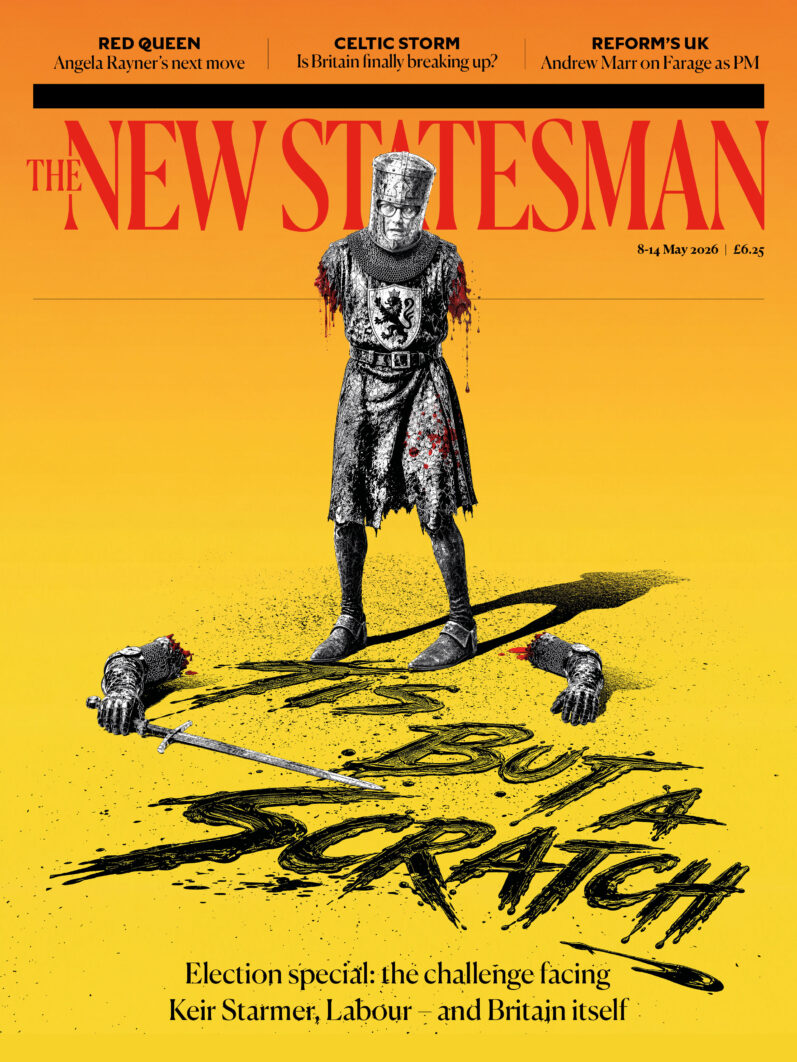
This week’s magazine, though, certainly carries on a conversation that has become impossible to ignore recently – the one about the future of this government and this country’s Prime Minister. In many ways, it is a conversation I wish we could ignore. And yet, given the frenzy in Westminster at the moment, we simply cannot. With our political editor, Ailbhe Rea, away this week, I have taken on the politics column to report on the latest thinking in parliament. As ever, please do get in touch with your thoughts about the options now before the Labour Party.
Whatever happens over the next few weeks, the stakes are higher – and not only for those whose lives and careers will be defined by the choices they make, but also for the rest of us who must live with their decisions. Alex Niven sets out the scale of the danger posed to the nation by the collapsing popularity of Britain’s traditional unionist parties. Meanwhile, Andrew Marr reviews a book that asks the question we might be forced to confront: what happens if Reform wins?

Elsewhere in the magazine, we try to bring a little light relief by dealing with another of the New Statesman’s traditional obsessions: cricket. The journalist Mihir Bose reviews Peter Oborne and Richard Heller’s history of the sport. Delightfully, Mihir got in touch to express his joy at making it into the magazine, having first started reading the NS as a schoolboy in Mumbai more than 60 years ago, when, as he put it, “Kingsley Martin was editor and the offices were in Great Turnstile”. As a boy, Mihir had looked at that faraway address and imagined a turnstile at the entrance to the newsroom. “I realised many years later that the turnstile stood for persuading the editor to commission you to write a piece for the magazine.”
After learning of Mihir’s long love affair with the NS, I dug out his memoir, Thank You Mr Crombie: Lessons in Guilt and Gratitude to the British, in which he talks about his “voracious and undiscriminating” reading, of which his weekly favourites were the political commentaries of the late Anthony Howard. “I had read that Nehru had the New Statesman air mailed to him every week and of the enormous influence its then editor, Kingsley Martin, had on him.” In India, Mihir imagined Howard as “a ray of sunshine cutting through a dense fog”, a journalistic David Niven, “our idea of the typical Englishman”.
I cannot let this reference to Niven pass without telling my favourite story about this early Hollywood star, who was also a decorated army officer in the Second World War. He worked for a little-known but romantically unorthodox army unit called Phantom. Posted in London in the early stages of the war, Niven was tasked with training pigeons to carry messages back to army command in the event of an invasion. To do this, an elaborate loft was built in the St James’s Park headquarters of the commander-in-chief of Britain’s Home Forces, who asked for a demonstration of the birds’ effectiveness. When the first bird arrived, the message that had been wrapped around its leg from Niven was read aloud to the general. “That beast Major Niven sent me away because he said I had farted in the nest,” read the note. If British politics is going to sink, stinking into the sea, let’s have a giggle before it does.
[Further reading: Angela vs Andy vs Wes vs Keir]
Content from our partners



Related

Join the debate
Subscribe here to comment