
Television has become strangely anxious about its own behaviour. Contemporary drama increasingly appears to be designed by wellness consultants and data analysts. Characters explain their trauma in perfectly articulated therapy-speak. Sex scenes are cautious and worthy. Even the messiest antiheroes tend to possess a lingering self-awareness, as though permanently conscious that social media may eventually judge them.
Rivals, thankfully, has no interest in any of this. Beneath all the silk shirts, infidelities and competitive horsemanship lies the suspicion that Britain’s ruling class behaves rather like Labradors who’ve somehow been introduced to the pleasures of cocaine and fast money. Nobody is learning. Nobody is growing. People are simply pursuing one another through the Cotswolds at tremendous velocity.
Judging by the first episode of season two, Rivals remains reassuringly committed to the world Jilly Cooper created. Modern television increasingly rewards self-awareness and emotional caution. Rivals continues to prefer vanity, desire and spectacularly poor judgement.
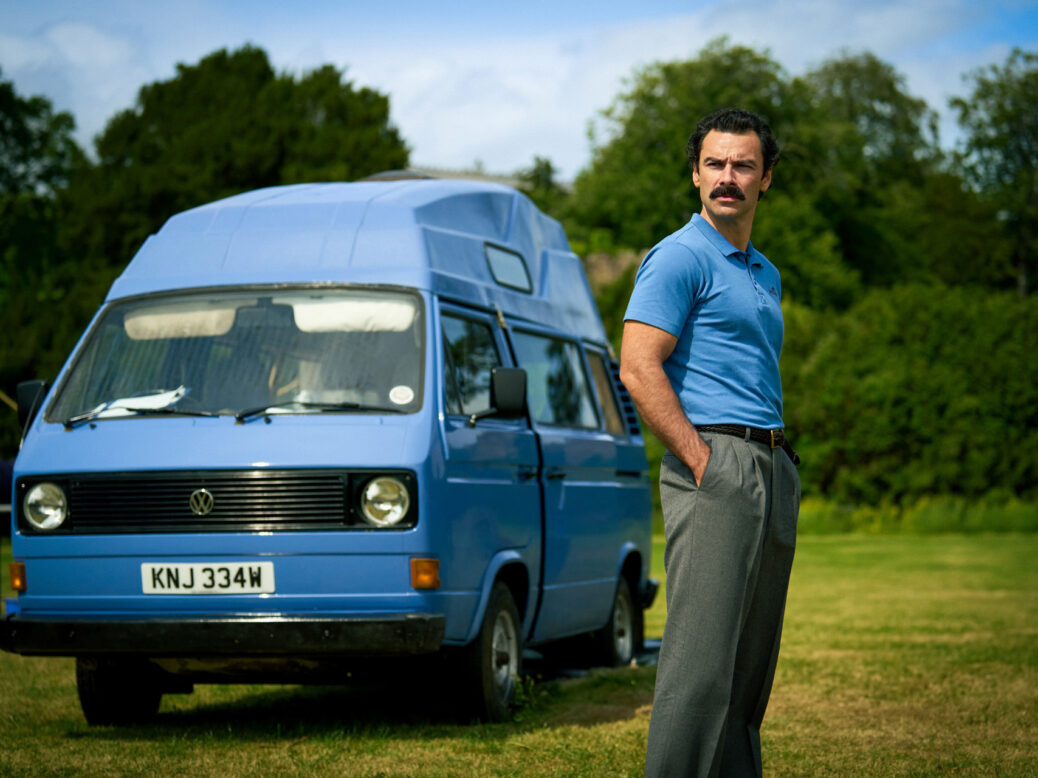
The series recreates the era with loving precision: the nicotine haze, the aggressively upholstered interiors, the alarming quantities of hair mousse. Even the cars appear dipped in muted matte shades of Union Jack red and blue, gliding through Rutshire like moving paint charts from 1986. Bryan Ferry on the soundtrack immediately places you back in that lost world of shoulder pads and low-level sexual chaos.

Before long, we are at an indoor pool party at Bella Vista, the Cotswold mansion of Freddie Jones, played by the completely fabulous Danny Dyer. Sexy polo-playing twins drift through the steam, men emerge from the water in tiny Speedos and gold chains, and an alarming proportion of the male cast ends up skinny dipping in front of the local vicar while conversations turn, quite naturally, to comparative willy size. Meanwhile Rupert Campbell-Black moves through Rutshire like an aristocratic sex emergency service. Rivals treats all this not as scandal but as perfectly ordinary upper-class recreation.
What saves Rivals from becoming merely nostalgic parody is that the cast commits to the melodrama with extraordinary seriousness. Nobody appears embarrassed by the material. Affairs, betrayals and attempted murders are delivered with the same emotional intensity as a Shakespearean succession crisis. In lesser hands, all this could feel camp in the pejorative sense, arch and self-satisfied. Instead the actors lean into the emotional absurdity with such conviction that the series becomes oddly transporting.
Part of the strange pleasure of Rivals is that it arrives during an era of managed behaviour, when public life feels over-sanitised. Rivals belongs to an older Britain, in which people flirt outrageously, drink too much and behave terribly at dinner parties. Perhaps that is why it feels so liberating now. Everybody in Rutshire is overreacting all the time, and the series treats this not as pathology but entertainment.
Of course, the world of Rivals was never real in the first place. Britain in the 1980s was not entirely populated by priapic aristocrats charging around Gloucestershire in open-top cars. But Cooper understood something true about fantasy: people long not simply for wealth or beauty, but for permission to be excessive.
Rivals succeeds not because anyone mistakes Rutshire for reality, but because it offers temporary escape from a culture increasingly terrified of embarrassment, vulgarity and desire. For an hour, at least, Britain can stop optimising itself and simply leap naked into the swimming pool.
[Further reading: How WWE replaced reality]
Content from our partners


Related

Join the debate
Subscribe here to comment