
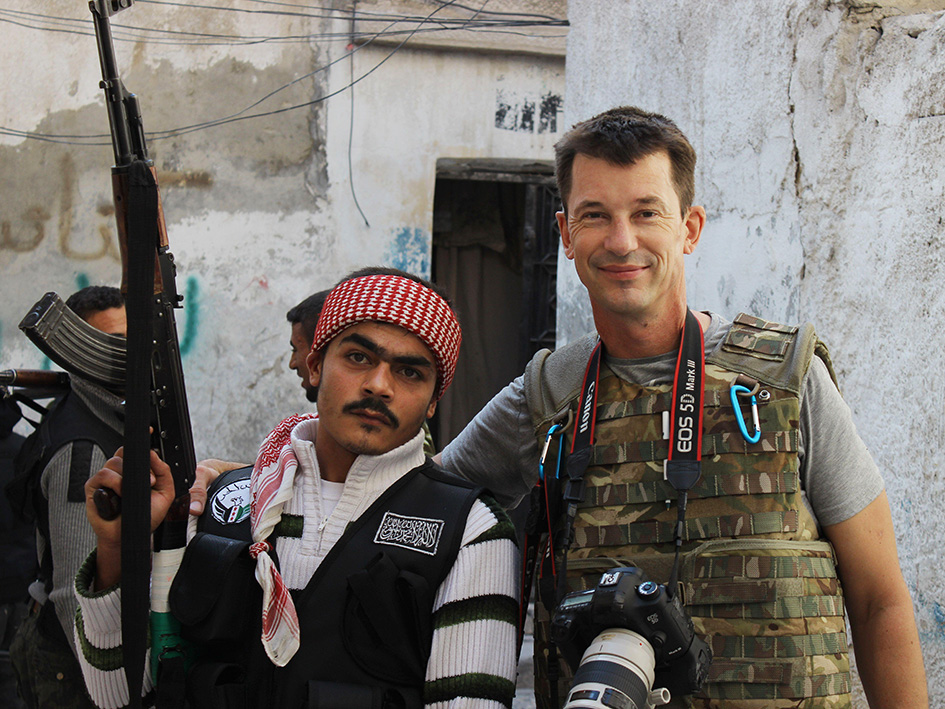
For several years the British photojournalist John Cantlie appeared in a series of deeply unsettling propaganda videos released by Islamic State. Thin and eerily composed, he addressed the camera in recordings filmed during the Syrian war, delivering the scripted messages of his captors. While other western hostages were murdered, Cantlie was kept alive and used.
The BBC’s three-part documentary Hostage attempts to reconstruct the path that led him there.
I do not usually write television reviews. But watching the series brought back an encounter I had with Cantlie in early 2012, when he came to see me at the Independent.
We sat in the bright, almost clinical canteen in the building where I worked. Cantlie showed me some of his photographs and talked about the work he hoped to do in Syria. The details of that conversation have faded. What remains clear is the feeling he left behind. There was a swagger about him, an excitement at the prospect of danger that I found disturbing.

In the end we did not commission him. It was decided that we could not insure him for the kind of work he was proposing, and there were also doubts about whether his photography, or perhaps the judgement behind it, justified taking that risk.
At the same time, the atmosphere around war reporting was shifting in ways many experienced journalists were already beginning to recognise. Around the picture desk were photographers who had spent decades working in conflict zones across the world, covering wars and uprisings in many different countries. Yet by the early years of the Syrian conflict some of them were beginning to draw a line. It was not just Syria that felt different. Across parts of the Middle East, from Libya onwards, the old assumption that journalists might enjoy even the thinnest protection as members of the press was starting to erode. Increasingly, journalists themselves were becoming targets.
Hostage places Cantlie at precisely that moment. His own footage from Libya and Syria is striking. He films constantly, often turning the camera on himself as he moves close to the fighting. In one sequence he jokes about standing beside a tank that is clearly an obvious target. Everything is delivered with laughter and bravado, his eyes bright with something close to excitement. Those moments are telling now. Cantlie appears to be doing more than documenting the war. He is also stepping into a familiar archetype of the conflict photographer, the figure who moves towards danger with visible confidence.
Watching those sequences, I found myself thinking again about that meeting in the canteen in 2012. The confidence I had noticed then is unmistakable in the footage. What I had taken for bravado in conversation now appears as something closer to a driving instinct.
War reporting has never belonged only to men. Some of the most perceptive and courageous journalists in modern conflicts have been women. Yet the culture surrounding the profession has often carried a certain masculine theatre, a language of bravado and nerve that Cantlie sometimes seemed eager to inhabit. Colleagues remember him as loud, confident, sometimes difficult. Others recall flashes of generosity. The portrait that emerges is complicated.
What followed is well known. Cantlie returned to Syria and was kidnapped alongside the American journalist James Foley. Foley was later murdered by Islamic State. Cantlie was kept alive. His ultimate fate remains uncertain. Cantlie appeared in a series of propaganda videos released by the group over the following years, the last of them filmed in Mosul in 2016. Since then there have been reports that he may have been killed during the fighting there, but no definitive confirmation of his death has ever emerged.
The documentary does not attempt to resolve the most troubling question that followed: the propaganda videos themselves. At the time some observers wondered whether he had willingly become part of the group’s media machinery. Hostage approaches this more cautiously. Faced with captivity and the threat of execution, Cantlie found a way to survive. As one interviewee asks, what would any of us do in that position?
Some of the most affecting moments come from those who shared captivity with him. The Danish photographer Daniel Rye recalls how Cantlie tried to keep other prisoners from sinking into despair, urging them to hold on. In those accounts the swaggering freelancer glimpsed earlier in the film gives way to someone defined by endurance.
The series is gripping, at times almost unbearably tense, yet its emotional centre lies elsewhere. The moment when the Danish hostage negotiator Jens Serup finally meets Daniel Rye as he walks into freedom is profoundly moving. Serup had spent 13 months searching for Rye while also trying to trace the whereabouts of James Foley and John Cantlie. When he hands the young photographer a new pair of glasses and embraces him with relief, the scene carries the weight of that long and uncertain search. By that point the story has become larger than Cantlie himself. It is about the fragile web of people who tried to find those taken by Islamic State, and about the endurance of those who survived.
Watching Hostage, I kept returning to a question that may be unfair but difficult to avoid. How good a photographer was John Cantlie? Having spent much of my career looking at the work of conflict photographers, I found myself studying the images shown in the film closely. They did not move me in the way the work of the finest photographers does. They felt competent rather than revelatory.
Yet perhaps that question misses the point.
What remains most vivid from the film is not Cantlie’s photography but the force of his personality: the appetite for danger, the confidence that he could master it, and later the resilience that helped sustain others in captivity.
Looking back to that brief meeting in the bright canteen in early 2012, I realise that what unsettled me was not Cantlie himself but the intensity of his confidence about what lay ahead in Syria. Hostage does not resolve that unease. Instead it leaves us with a portrait of a man drawn towards war with unusual intensity, and of the moment when that attraction collided with a conflict whose rules had already begun to change.
[Further reading: What the war in Iran means for China and Russia]
Content from our partners

Related
Join the debate
Subscribe here to comment