
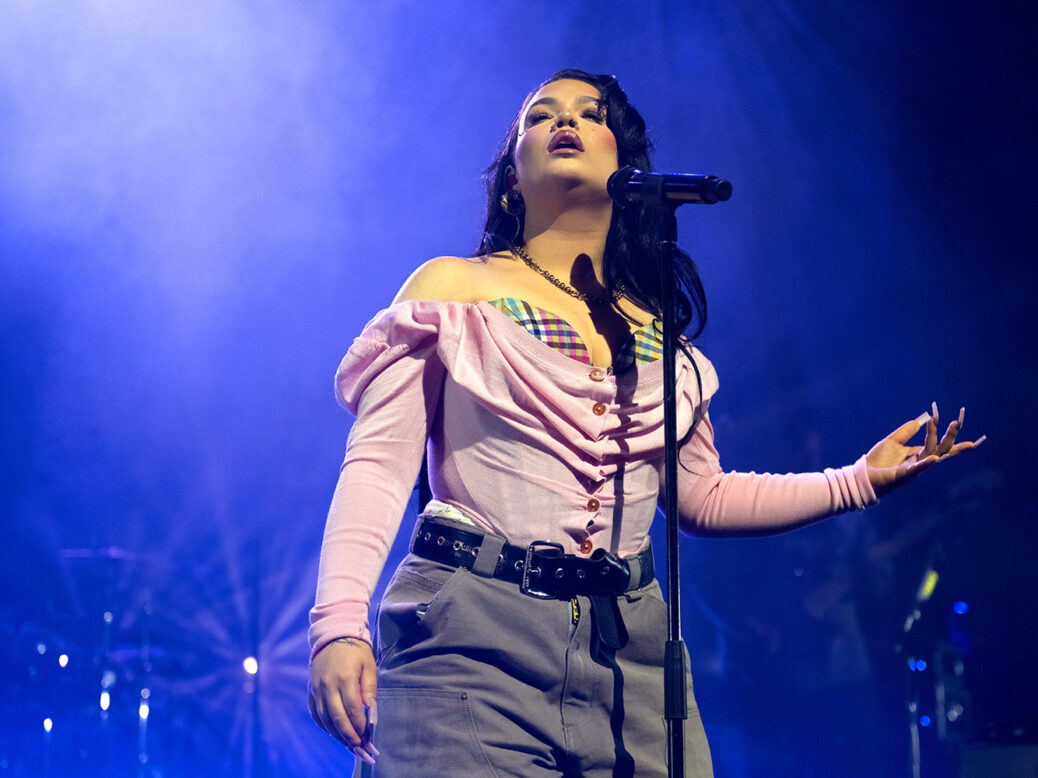
In the last two years, at gigs by Chappell Roan, Lily Allen, Olivia Dean and Lola Young, I’ve seen a level of audience engagement fiercer than anything I’ve seen in all my years as a music journalist, and very different, at this indie level, from the wall of sound you’d get at a screaming stadium. The conventions around gig-going have changed. Shows are entirely interactive – the performance itself is often super straight (costume changes are passé) and the crowd sings an entire album, every turn of phrase, back at the artist in an evening of mass karaoke.
The sense of the modern gig as an act of communion, a semi-religious experience, has often been linked to the internet – it’s a reaction against living online. What I saw at Young’s show at the O2 Academy in Brixton might also be a feature of the tech-frazzled attention span: the crowd veered between hyper-engagement and moments of withdrawal as they paused to make content on their phones. One reason we know the lyrics to every song these days is they roll out on your screen when you’re listening to music. But the main explanation for feverish levels of intensity at live shows is that we know far more about our artists than we ever did in the past, and that gives us a greater sense of claim over them. If their music sells their personal pain with no filter, it’s the least we can do to shout that pain back. When the opening notes to “Messy” – her viral ADHD anthem, a hymn to an overactive mind – ring out at the very end of her gig, the crowd barely reacts, as if to say, “Don’t worry Lola, we aren’t just here for your big hit!”
Young is part of the new Brit School power generation, alongside Olivia Dean and Raye, who studied in the years above her. Twenty years ago, Amy Winehouse, Kate Nash and Adele were making the place famous; the first generation was rather more downbeat, with Dane Bowers, The Feeling and Shingai Shoniwa from the Noisettes. Around the time of “Messy” in 2024, Young spent five weeks in rehab for cocaine addiction: last year, she relapsed and checked herself into a holistic facility. She cancelled her tour dates, and said on stage in Brixton, “I thought, ‘there is no way people will buy tickets again’” – which you can believe. (Then she said, “I love every single one of you,” which I believed a bit less.)
Young is a loveable figure, self-deprecating without being apologetic. Some of her tumbling songlines recall the vocal patterns of her hero, Joni Mitchell, while also feeling like an authentic expression of her neurological life. You wish she’d be a bit more observational of the world around her in her songs, but maybe that’s just me wanting to take the Joni Mitchell thing further – at least the evening was light on oversharing patter. The stage set is monochrome, unfussy – there is very little to look at, no back projections or the kind of themed sections popular a few years ago with artists who played around with alter egos. Young has none of those. But beyond the chaotic and human exterior, there is the same classic, Seventies edge to the songwriting that you get with Olivia Dean – it’s just delivered from a different vessel, in khaki capri pants. “Why Do I Feel Better When I Hurt You” could, melodically, be a Carole King song; “Walk On By” is an obvious callback to Burt Bacharach.

The biggest indicator that Young is highly trained, despite the vibe, is the vocal performance, which is anything but messy: she is more together on stage than she is on record, and barely moves about. When she belts out a line in the studio, it can occasionally sound over-reaching, but in live performance it is effortless, her voice fluttering down like a call to prayer. You get the feeling she has emotionally moved on from a lot of her early material, but of course she must still perform it. “I don’t let anybody call me a bitch these days,” she says after “Big Brown Eyes”, her upbeat blend of post-punk revival and indie rock.
I was impressed by Young, and her flawless yet lived-in voice – but I felt like I never really got near her at Brixton Academy. This, ironically, was a feature of the crowd interaction. Not for the first time, I found the intensity of the audience alienating; I wanted to absorb her performance, but it was partially masked by 5,000 other people performing the same thing at the same time. I suppose it all comes down to what you want from a gig experience, and what “connection” means in the musical context. I think it’s changed over time. And everyone loved it. So maybe it’s just me.
Lola Young is performing at the O2 Academy Brixton, London, SW9 on 18 and 19 June
[Further reading: Olivia Rodrigo is sick of love]
Content from our partners


Related
Join the debate
Subscribe here to comment