
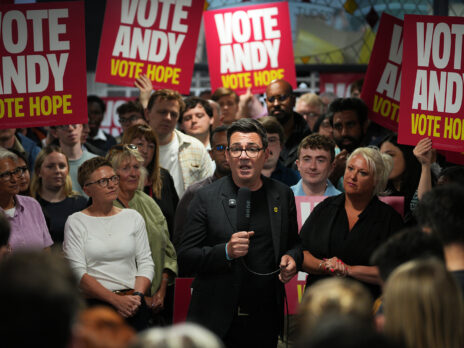
In the summer of 1976, as the postwar consensus began to crack in the heat, ITV gave its viewers the balm of a primetime drama about the structure of the labour movement and the prospects for socialism within the parliamentary system. As everyone said at the time, Bill Brand uncannily paralleled or anticipated the real events of 1976, in which a Labour prime minister had been replaced in the midst of a debt crisis. No-one could have imagined that the series would resonate just as much on its golden jubilee this year. Written by Trevor Griffiths, Bill Brand begins with a by-election in a fictional Greater Manchester constituency, “Leighley”, that might as well be Makerfield, and culminates in a Labour leadership contest in which Britain’s creditors take all too close an interest. Across 11 episodes, the issues of 2026 – nationalisation, government borrowing, the party system itself, raised recently by Andy Burnham – gripped a claimed audience of ten million.
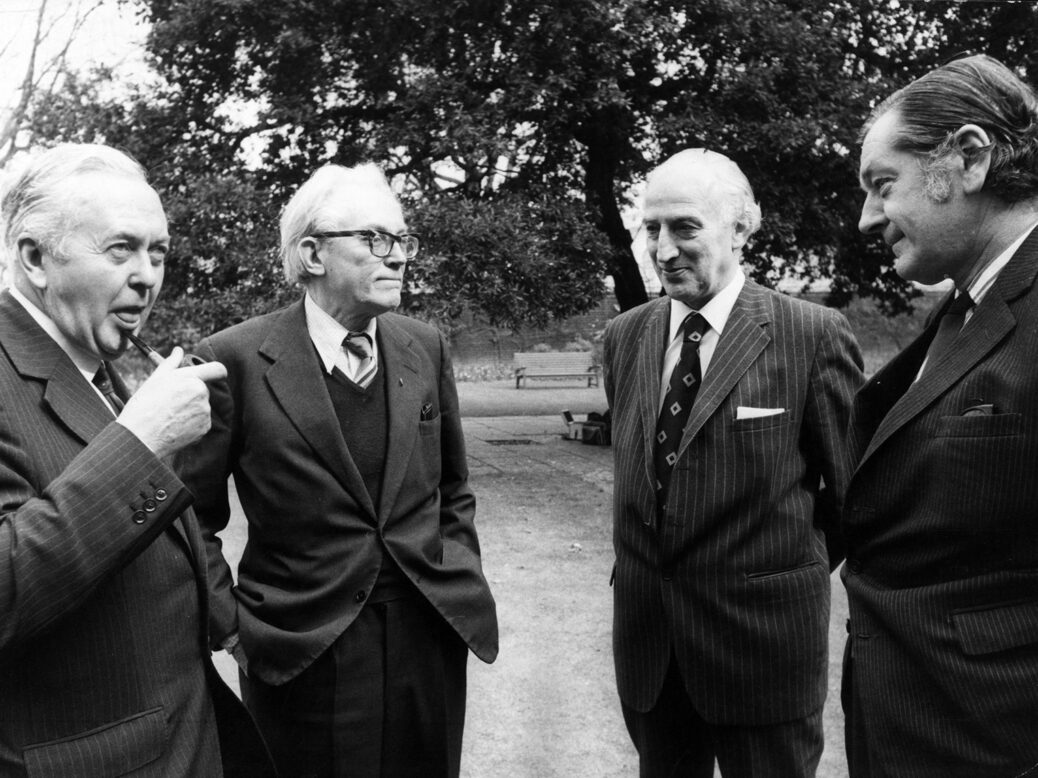
Played by Jack Shepherd, Bill is a former polytechnic lecturer whose victory in Leighley translates him to the capital and life as a backbencher in the struggling Labour government for which he has something approaching contempt. To the left of the official Labour left, modelled on the Tribune group, Bill eventually reconciles himself to supporting their candidate for the leadership when the ailing prime minister steps down. The ailing prime minster, played by Arthur Lowe, is a schemer called “Arthur Watson” – Harold Wilson had stepped down in March 1976 – and the fictional left’s challenger is equally identifiable as Michael Foot. But the most compelling of the candidates, the one Brand most respects, representing the party’s future, comes from the centre.
The series was conceived on the night of the February 1974 general election that returned Wilson to office, when Griffiths met Stella Richman, a former London Weekend Television executive. She had seen his play The Party, then running at the Old Vic, in which representatives of the extra-parliamentary left gather at the home of a television producer during the events of May 1968 and set out their ideological stalls – it was Laurence Olivier’s last stage performance. Richman had the ear of Verity Lambert, head of drama at Thames Television, who had recently called for a freeze on costume dramas. While this worked in Richman and Griffiths’s favour, once production began, recalled the series’ producer Stuart Burge, “it was a nightmare getting it through”.
Griffiths’s unforgiving perspective on Labour history was evidently inspired by a leading figure in the extra-parliamentary left, Ralph Miliband, author of Parliamentary Socialism, first published in 1961. In the book’s second edition, reflecting on the Wilson governments of 1964–70, Miliband wrote that “Left parliamentarians operate within the rules of a game designed to limit their capacity” and could not be expected to achieve socialism through parliamentary means. Bill Brand is Griffiths’s dramatisation of this thought, in a form inspired by the Hungarian Marxist critic Georg Lukács’s idea of “critical realism”.

What Griffiths understood this to mean was “the whole idea of a character working as a confluence of important social and political and moral forces within society, in real historical time”. Lukács’s The Historical Novel, in which Thackeray is described as “an outstanding critical realist”, appeared as a Penguin paperback while Bill Brand was on the air. Bill Brand uses characters to tell a story, but its chief aim is to reveal the rules of the game: to illuminate the complex totality that conditions their political behaviour, namely the labour movement and its integration within a political system not of its own design.
Bill’s progress brings him into contact with each element of the party, movement and fringe: the CLP and local party agents who reluctantly run his by-election campaign; the whips who discipline him when he votes against the government; the trade union leadership who tell him the facts of life, and the radical rank and file, with whom Bill claims an affinity. The series depicts the conference backrooms where “composites” are drafted; the Clapham houseshares where MPs dwell; the Ruskin College summer school in (not at) Oxford; and all the nooks and crannies of the Palace of Westminster – though not the House of Commons – well before parliament was televised.
In each of these encounters, at each of these sites, Bill’s interlocutors, clearly demarcated, as in The Party, by class background and intellectual tradition, state their case, sometimes at length. Griffith later said there was a danger of “schematism, that a character becomes a device, a vehicle for showing social forces”, but that is essentially what he was doing, and the question is one of execution, of the quality of writing and acting, which are high. Bill Brand continues to resonate not only for the obvious reasons, at the level of events, but because it comprehends such a broad panorama of the political scene, and its interrelationships, without recourse to melodrama, conspiracy or satire. The debates are real, the competing interests clear, and most are recognisable today – or revealing by their absence. And there is at least one character drawn from life. Born into a working-class family in Manchester, a scholarship boy, university graduate, New Left journalist and polytechnic lecturer, Bill is blatantly a stand-in for Griffith himself.
A month in, Clive James could be found referring to his Observer colleagues’ disapproval of the show, which he continued watching “with undiminished loyalty, tempered by impatience”. As he noted, in the fifth episode Bill calls his estranged wife Miriam (Lynn Farleigh) “a little bag of pus. There’s no joy left in you,” and we are meant to feel his pain, or so it seems. The worst thing anyone says to self-righteous Bill is “sententious bastard”, quite accurately. “I have to find ways both of allowing identifications and establishing critical distances”, Griffiths reflected, and while he struggled with the latter when it came to Bill, the passage of time has made it easier to see him as a “confluence” like everybody else, especially in the realm of sexual politics, where he is outflanked on the left by his feminist girlfriend Alex (Cherie Lunghi) – to whom he has transferred cooking and cleaning duties.
Having begun on 7 June, Bill Brand ended in mid-August, two weeks before the heatwave broke, and six before the Labour Party conference that marked, to use the title of Robert Skidelsky’s book, the end of the Keynesian era. The phrase “cap in hand visit to the IMF”, now associated with that oft-narrated moment, is actually heard on the radio in the eighth episode. In the world of Bill Brand, the loan and the attendant cuts all come to pass, but the leadership is won not by a Callaghan-type figure, as in reality, but by John Venables (Peter Howell), a proxy for Roy Jenkins or Anthony Crosland, whose ambition is to detach the Labour Party from the unions and appeal to the imagined centre. Here Griffiths was looking beyond the immediate crisis to the party’s split in the early 1980s, or indeed to New Labour a decade later.
There are evasions amid the foresight, and these include Europe. Jenkins withdrew from the real leadership contest after the first round because, wrote Christopher Hitchens and Peter Kellner, “he was the most fervently pro-Market”, ie EEC, ie Europe, of the candidates, while the party was largely unenthusiastic about the market, and the left fervently againts. Bill’s great cause is to save the dying textile industry by nationalising it – “the money we borrow will go into investing in factories, not cars, services, houses” – in ways that are unlikely to have won approval in Strasbourg or Brussels. These notes are played softly, and the same speech reveals another lacuna: the voters, or audience, some of whom presumably toiled in “services”, drove cars, owned houses or wanted to. This is what Bill would be up against in 1979. Each episode as it appeared on DVD in 2011, and on YouTube now, runs about 52 minutes, but the original length was one hour. To get the full picture, see the total structure, we would need to have the ads put back in.
[Further reading: Andy Burnham wins big in Makerfield]
Content from our partners


Related
Join the debate
Subscribe here to comment