
Paolo Sorrentino’s previous film, Parthenope, abjectly worshipping a stunning female personification of Naples, was ludicrously bad. It marked such a falling off from his earlier work, notably The Great Beauty of 2013, that there seemed to be little more to expect from him.
Nor did the premise of La Grazia look promising. An elderly, Catholic and conservative president of Italy, coming to the end of his term, must decide whether to pass a bill permitting euthanasia, against all his principles, while also meditating whether to pardon a man and a woman convicted of killing their respective partners: he, a wife lost to late-stage Alzheimer’s; she, an abusive husband. Too programmatic by half, surely?
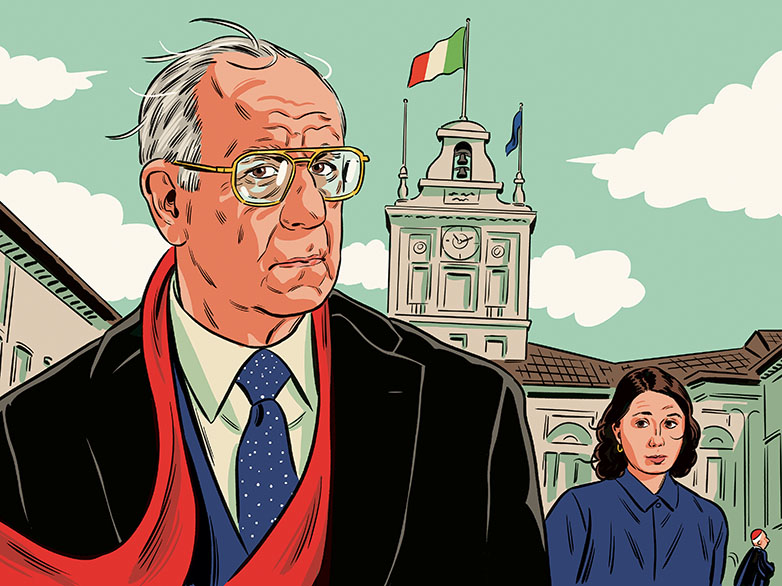
But La Grazia (which means grace, but is also the legal term for a pardon) is a marvel. Slow, grave and perfectly realised, it’s by far Sorrentino’s best film for years. He is working here again, for the seventh time, with Toni Servillo, the fantastically good actor he persuaded into film from the stage in 2001. Servillo makes the movie to the point that it’s inconceivable without him.
The actor (who dodged Parthenope, by the way) is now 67 but he looks a good decade older than that, and all the better for it. His face is extraordinary here, involving us in every inflection, not just full of years but by its very impassivity compelling us to read the depth of thought and feeling behind the facade he presents. It’s masterful work on both sides of the camera.

He plays Mariano De Santis, who had a long career as a jurist before becoming president and, we’re told, restoring order to politics by the judicious immovability that earned him the upsetting nickname “Reinforced Concrete”. His beloved wife, Aurora, died eight years ago, but he remains tormented by the knowledge that she had an affair decades before with someone he still can’t identify. Their son, a musician, has fled to Canada. Their daughter Dorotea (Anna Ferzetti), another lawyer, dutifully manages every detail of her father’s life at the expense of her own: reading his papers, monitoring his diet (joyless quinoa), trying to stop him smoking now that he only has one lung (La Grazia is a great smoking film), urging him finally to take decisions.
Both of them are lost in the vast grandeurs of Rome’s Palazzo del Quirinale, spaces that both dominate and dignify them. Every framing, every movement both of the people and of the camera, is deliberate, stately and eloquent in this sumptuous film. De Santis remains alone, despite the company of his resourceful cuirassier and his old friends, including the justice minister, Ugo (Massimo Venturiello), who wants to succeed him, and a raucous diva of an art critic, Coco Valori (Milvia Marigliano) whom he has known from his school days.
“I don’t know either of you,” De Santis says sadly to his daughter. “We don’t know you either,” she replies, speaking for her brother too. Time and responsibilities weigh him down. “Can you still remember what it feels like to be light?” his friend the Pope (Rufin Doh Zeyenouin – quite a turn in dreads) asks. His quandary about the euthanasia bill stalls him. “If I don’t sign, I’m a torturer; if I do sign, I’m a murderer.”
Gradually, though, De Santis moves towards grace, privately as well as politically. After Sorrentino and Servillo’s scathing portrayals of the politicians Giulio Andreotti in Il Divo and Silvio Berlusconi in Loro, it’s startling to realise that this is intended as quite the opposite. “I wanted to depict what a politician should be like,” said Sorrentino simply. La Grazia makes no direct reference to current events, but it’s peculiarly moving to see ethical seriousness honoured like this, at the time of Trump’s irresponsibility on the one hand and Starmer’s paralytic legalism on the other.
There are plenty of Sorrentino’s usual fantasias along the way. Bippy electronic music interferes and De Santis has a surprising passion for the Italian rapper Guè. A robot sniffer dog leads his final procession to retirement through the streets of Rome. In a great sequence, De Santis reaches out to a weightless tear dropping on-screen from an Italian on the International Space Station. In another, the even older president of Portugal is floored by wind and rain on the red carpet at the Quirinale, De Santis observing impartially.
But La Grazia is a film that irresistibly establishes its own gravity. A bit slow, a bit long? Not for me (my natural pace being more suited to parietal art than motion pictures, granted). In the season of Hollywood’s harvest festival, let’s say it: such independent films from elsewhere as Sentimental Value, The Secret Agent, Sound of Falling, It Was Just an Accident and La Grazia offer more.
“La Grazia” is in cinemas on 20 March
[Further reading: Who is Frankenstein’s Bride?]
Content from our partners

Related

This article appears in the 18 Mar 2026 issue of the New Statesman, The new world war
Join the debate
Subscribe here to comment