
The Kuleshov effect has been known for more than 100 years. In the 1920s, the director Lev Kuleshov demonstrated that the same shot of a neutral face would be interpreted differently, according to what the shots preceding or following it suggested this man was looking at. A girl in a coffin made it seem he was grieving, a woman on a sofa made him look lustful. The observation helped create the enthusiasm for montage in early Soviet cinema.
Some of the most compelling actors on screen have had faces that look intent without revealing thoughts or feelings, thus inciting the viewer to project and identify. And then there’s Indy the dog.
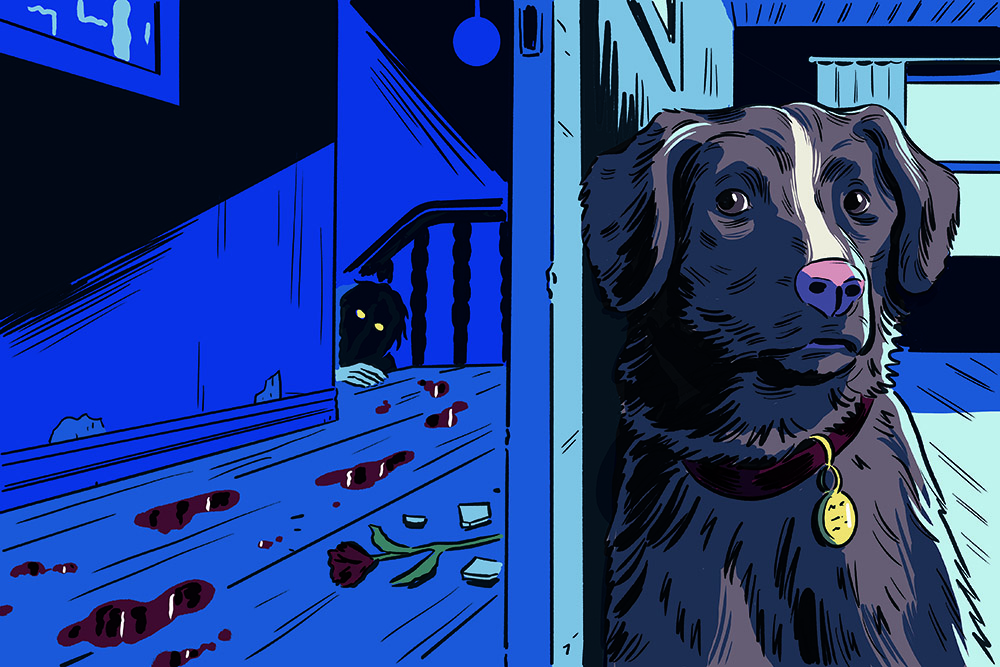
Indy is the star of Good Boy, its complete focus. For nearly all of the film, we either see him or we see what he is looking at – and it’s a horror story.
Indy’s owner, Todd, is seriously ill, coughing up blood. He retreats to the house in the woods that belonged to his grandfather, despite it being the place where his grandfather died and his dog disappeared. Indy is immediately spooked by the house, hearing strange noises and sensing weird presences. But he is unconditionally loyal to Todd and stays with him, always on the alert, trying to watch over him, however dark events become. What Indy, being a dog, cannot fully understand is that, as well as facing this supernatural menace, his owner is dying.

We see all of this through Indy’s eyes, literally at his eye level, so that human faces scarcely appear, intercut with seeing Indy himself, often in close-up. He proves a perfect subject for the Kuleshov effect. He always has a concentrated, attentive look to him and, being startled ourselves by whatever is going on, we can’t but project on to him our own anxieties. It’s a remarkably effective trick, offering both a novel take on the loyal dog yarn and new angle on a familiar horror movie scenario. Most dogs in horror films are demonic – only the bouncy retriever who detects that there’s something funny going on in the family home in Poltergeist stands as precursor to Indy.
Good Boy is the directorial debut of Ben Leonberg, produced by his wife, Kari Fischer. They also play Todd and his concerned sister physically in the film – rarely more than partially glimpsed. The roles are voiced by the actors Shane Jensen and Arielle Friedman, with horror veteran Larry Fessenden appearing in various guises as the grandfather.
Indy is the couple’s real-life dog, and that matters. This dog is not a marvel of training and manipulation like most dogs in film – Cujo, the rabid St Bernard in the Stephen King adaptation was played by four St Bernards, several mechanical dogs and a Black Labrador-Great Dane cross in a St Bernard costume. You can tell. Robert Bresson, the great enemy of theatrical acting in films, insisted that the donkey in Au hasard Balthazar could not be played by one already trained – “I did not want him to be professional” – and he was right.
Good Boy was made with Leonberg and Fischer living with Indy in the house that’s in the film for four years, shooting throughout that time. It’s a bit beyond method acting. Indy is himself – and he’s a beauty. He is in fact a Nova Scotia Duck Tolling Retriever, the smallest of the retrievers, known as the Toller for short. It’s not a breed that’s well known in the UK, but it’s ideal for this film. “Often mistaken for small Golden Retrievers, the Toller is more active, both physically and mentally,” as the Wikipedia entry, clearly written by an unrepentant Toller supremacist, tells us. So there. Over to you, Monty Don.
Good Boy is by no means a great film. Even at just 73 minutes, it loses its way, clumsily bundling together the real and the supernatural, relying on familiar horror tropes, the modest budget making the special effects, such as they are, a little too amateurish. The sniffing and whimpering are mixed a bit too high on the audio track. None of this is Indy’s fault, though; none of it lessens the appeal of this dog’s lovely face and expressive eyes (dogs, with such sleek and definite looks as Indy, are much better in close-up than squidgy, porous people).
I had always been determined that if I were ever to have a dog again, it would be a Golden Retriever, just like the dog that saw me through childhood and into adolescence. For the first time, I am not so sure. Perhaps Tollers really are best? There aren’t many films as life-changing as that.
“Good Boy” is in cinemas from 10 October
[Further reading: A House of Dynamite implodes in its third act]
Content from our partners


Related


This article appears in the 08 Oct 2025 issue of the New Statesman, The truth about small boats
Join the debate
Subscribe here to comment